- A 29-year-old woman comes to your office. As you take the history, you notice that she is speaking very quickly, and jumping from topic to topic so rapidly that you have trouble following her. You are able to find some connections between ideas, but it is difficult. Which word describes this thought process?
A) Derailment
B) Flight of ideas
C) Circumstantiality
D) Incoherence
Ans: B
Chapter: 05
Page and Header: 145, Techniques of Examination
Feedback: This represents flight of ideas because the ideas are connected in some logical way. Derailment, or loosening of associations, has more disconnection within clauses. Circumstantiality is characterized by the patient speaking “around” the subject and using excessive detail, though thoughts are meaningfully connected. Incoherence lacks meaningful connection and often has odd grammar or word use. Although severe flight of ideas can produce this condition, evidence is not present in this vignette.
- A young woman comes to you with a cut on her finger caused by the lid of a can she was opening. She is pacing about the room, crying loudly, and through her sobs she says, “My career as a pianist is finished!” Which personality type exhibits these features?
A) Narcissistic
B) Paranoid
C) Histrionic
D) Avoidant
Ans: C
Chapter: 05
Page and Header: 136, Symptoms and Behavior
Feedback: The theatrical nature of her behavior as well as her overreaction lead to a diagnosis of histrionic character disorder.
- A 24-year-old secretary comes to your clinic, complaining of difficulty sleeping, severe nightmares, and irritability. She states it all began 6 months ago when she went to a fast food restaurant at midnight. While she was waiting in her car a man entered through the passenger door and put a gun to her head. He had her drive to a remote area, where he took her money and threatened to kill her. When the gun jammed he panicked and ran off. Ever since this occurred the patient has been having these symptoms. She states she jumps at every noise and refuses to drive at night. She states her anxiety has had such a marked influence on her job performance she is afraid she will be fired. She denies any recent illnesses or injuries. Her past medical history is unremarkable. On examination you find a nervous woman appearing her stated age. Her physical examination is unremarkable. You recommend medication and counseling.
What anxiety disorder to you think this young woman has?
A) Specific phobia
B) Acute stress disorder
C) Post-traumatic stress disorder
D) Generalized anxiety disorder
Ans: C
Chapter: 05
Page and Header: 161, Table 5–3
Feedback: Post-traumatic stress disorder is the fearful response (nightmares, avoidance of areas, irritability) to an event that occurred at least 1 month prior to presentation. The patient’s fears and reactions cause marked distress and impair social and occupational functions.
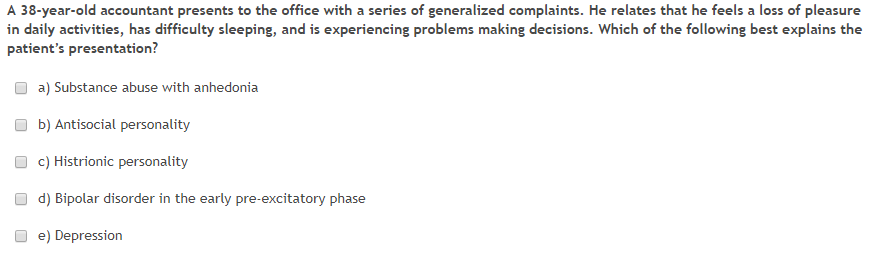
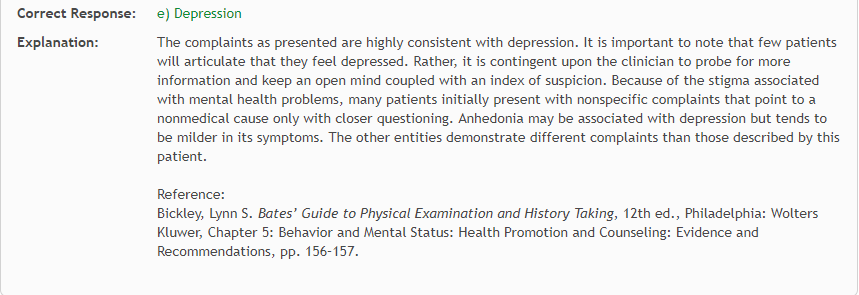
- A 32-year-old white female comes to your clinic, complaining of overwhelming sadness. She says for the past 2 months she has had crying episodes, difficulty sleeping, and problems with overeating. She says she used to go out with her friends from work but now she just wants to go home and be by herself. She also thinks that her work productivity has been dropping because she just is too tired to care or concentrate. She denies any feelings of guilt or any suicidal ideation. She states that she has never felt this way in the past. She denies any recent illness or injuries. Her past medical history consists of an appendectomy when she was a teenager; otherwise, she has been healthy. She is single and works as a clerk in a medical office. She denies tobacco, alcohol, or illegal drug use. Her mother has high blood pressure and her father has had a history of mental illness. On examination you see a woman appearing her stated age who seems quite sad. Her facial expression does not change while you talk to her and she makes little eye contact. She speaks so softly you cannot always understand her. Her thought processes and content seem unremarkable.
What type of mood disorder do you think she has?
A) Dysthymic disorder
B) Manic (bipolar) disorder
C) Major depressive episode
Ans: C
Chapter: 05
Page and Header: 160, Table 5–2
Feedback: Major depression occurs in a person with a previously normal state of mood. The symptoms often consist of a combination of sadness, decreased interest, sleeping problems (insomnia or hypersomnia), eating problems (decreased or increased appetite), feelings of guilt, decreased energy, decreased concentration, psychomotor changes (retardation or agitation), and a preoccupation with thoughts of death or suicide. There must be at least five symptoms for a diagnosis of major depression. This patient has six: (1) sadness, (2) trouble sleeping, (3) overeating, (4) fatigue, (5) difficulty with concentration, and (6) no interest in doing things.
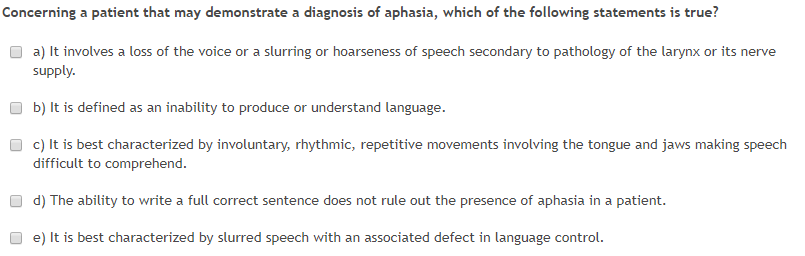
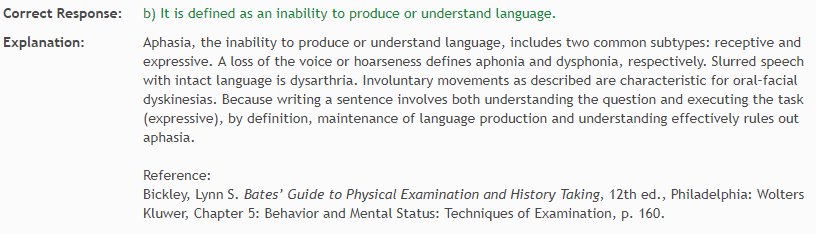
- A 72-year-old African-American male is brought to your clinic by his daughter for a follow-up visit after his recent hospitalization. He had been admitted to the local hospital for speech problems and weakness in his right arm and leg. On admission his MRI showed a small stroke. The patient was in rehab for 1 month following his initial presentation. He is now walking with a walker and has good use of his arm. His daughter complains, however, that everyone is still having trouble communicating with the patient. You ask the patient how he thinks he is doing. Although it is hard for you to make out his words you believe his answer is “well . . . fine . . . doing . . . okay.” His prior medical history involved high blood pressure and coronary artery disease. He is a widower and retired handyman. He has three children who are healthy. He denies tobacco, alcohol, or drug use. He has no other current symptoms. On examination he is in no acute distress but does seem embarrassed when it takes him so long to answer. His blood pressure is 150/90 and his other vital signs are normal. Other than his weak right arm and leg his physical examination is unremarkable.
What disorder of speech does he have?
A) Wernicke’s aphasia
B) Broca’s aphasia
C) Dysarthria
Ans: B
Chapter: 05
Page and Header: 145, Techniques of Examination
Feedback: In Broca’s aphasia patients articulate very slowly and with a great deal of effort. Nouns, verbs, and important adjectives are usually present and only small grammatical words are dropped from speech. Broca’s area is on the lateral portion of the frontal lobes.
- A 27-year-old woman is brought to your office by her mother. The mother tells you that her daughter has been schizophrenic for the last 8 years and is starting to decompensate despite medication. The patient states that she has been taking her antipsychotic and she is doing just fine. Her mother retorts that her daughter has become quite paranoid. When asked why, the mother gives an example about the mailman. She says that her daughter goes and gets the mail every day and then microwaves the letters. The patient agrees that she does this but only because she sees the mailman flipping through the envelopes and she knows he’s putting anthrax on the letters. Her mother turns to her and says, “He’s only sorting the mail!”
Which best describes the patient’s abnormality of perception?
A) Illusion
B) Hallucination
C) Fugue state
Ans: A
Chapter: 05
Page and Header: 145, Techniques of Examination
Feedback: An illusion is merely a misinterpretation of real external stimuli. In this case, the mailman is looking through the letters before he puts them in the box. The mother correctly assumes he is sorting the mail but her schizophrenic daughter attributes his actions to being part of a nefarious bioterrorism plot.
- A 35-year-old stockbroker comes to your office, complaining of feeling tired and irritable. She also says she feels like nothing ever goes her way and that nothing good ever happens. When you ask her how long she has felt this way she laughs and says, “Since when have I not?” She relates that she has felt pessimistic about life in general since she was in high school. She denies any problems with sleep, appetite, or concentration, and states she hasn’t thought about killing herself. She reports no recent illnesses or injuries. She is single. She smokes one pack of cigarettes a day, drinks occasionally, and hasn’t taken any illegal drugs since college. Her mother suffers from depression and her father has high blood pressure. On examination her vital signs and physical examination are unremarkable.
What mental health disorder best describes her symptoms?
A) Major depressive episode
B) Dysthymic disorder
C) Cyclothymic disorder
Ans: B
Chapter: 05
Page and Header: 160, Table 5–2
Feedback: Someone with dysthymia has a depressed mood and symptoms for most of the day, more days than not, for at least 2 years. The disorder generally begins in adolescence and is fairly stable throughout life. Although the symptoms are similar to those of major depression (in this case, fatigue and irritability), they are milder and fewer.
- In obtaining a history, you note that a patient uses the word “largely” repeatedly, to the point of being a distraction to your task. Which word best describes this speech pattern?
A) Clanging
B) Echolalia
C) Confabulation
D) Perseveration
Ans: D
Chapter: 05
Page and Header: 145, Techniques of Examination
Feedback: Perseveration is the repetition of words or ideas. Echolalia differs in that the patient repeats what is said to him. Clanging is the repetition of the same sounds in different words. Confabulation is making up a story in response to a question. This is sometimes seen in chronic alcohol use with Korsakoff’s syndrome.
- A 26-year-old violinist comes to your clinic, complaining of anxiety. He is a first chair violinist in the local symphony orchestra and has started having symptoms during performances, such as sweating, shaking, and hyperventilating. It has gotten so bad that he has thought about giving up his first chair status so he does not have to play the solo during one of the movements. He says that he never has these symptoms during rehearsals or when he is practicing. He denies having any of these symptoms at any other time. His past medical history is unremarkable. He denies any tobacco use, drug use, or alcohol abuse. His parents are both healthy. On examination you see a young man who appears worried. His vital signs and physical examination are unremarkable.
What type of anxiety disorder best describes his situation?
A) Panic disorder
B) Specific phobia
C) Social phobia
D) Generalized anxiety disorder
Ans: C
Chapter: 05
Page and Header: 161, Table 5–3
Feedback: Social phobia is a marked, persistent fear of social or performance situations.
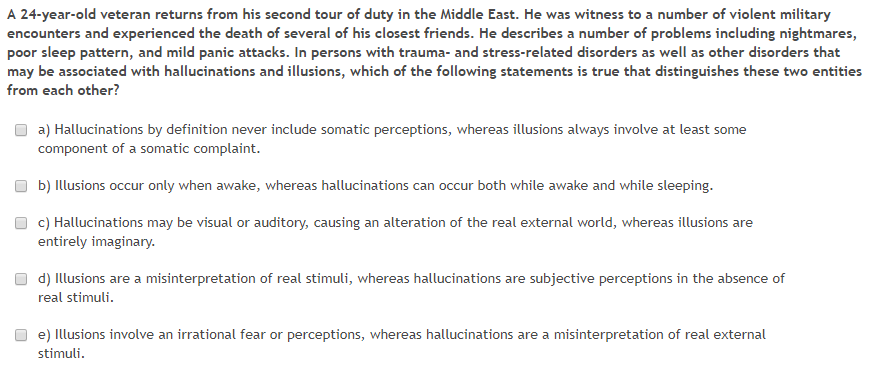
- A 22-year-old man is brought to your office by his father to discuss his son’s mental health disorder. The patient was diagnosed with schizophrenia 6 months ago and has been taking medication since. The father states that his son’s dose isn’t high enough and you need to raise it. He states that his son has been hearing things that don’t exist. You ask the young man what is going on and he tells you that his father is just jealous because his sister talks only to him. His father turns to him and says, “Son, you know your sister died 2 years ago!” His son replies “Well, she still talks to me in my head all the time!”
Which best describes this patient’s abnormality of perception?
A) Illusion
B) Hallucination
C) Fugue state
Ans: B
Chapter: 05
Page and Header: 145, Techniques of Examination
Feedback: A hallucination is a subjective sensory perception in the absence of real external stimuli. The patient can hear, see, smell, taste, or feel something that does not exist in reality. In this case, his sister has passed away and cannot be speaking to him, although in his mind he can hear her. This is an example of an auditory hallucination, but hallucinations can occur with any of the five senses.
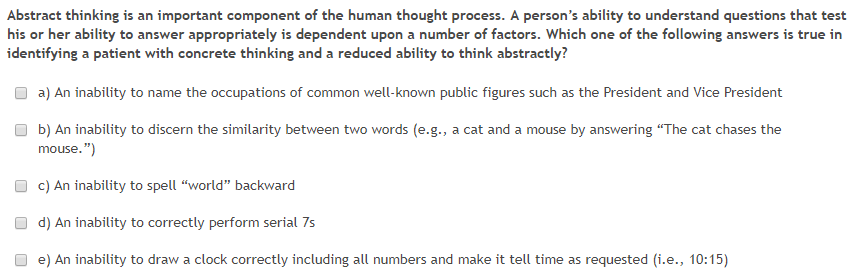
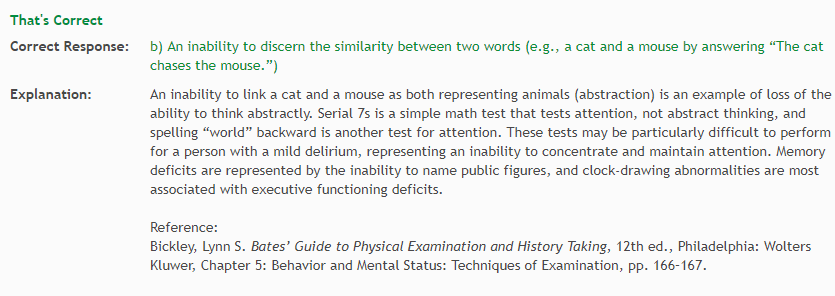
- You ask a patient to draw a clock. He fills in all the numbers on the right half of the circle. What do you suspect?
A) Hemianopsia
B) Fatigue
C) Oppositional defiant disorder
D) Depression
Ans: A
Chapter: 05
Page and Header: 145, Techniques of Examination
Feedback: You should suspect a visual problem because there is no writing on one half of the circle. This is consistent with a hemianopsia, sometimes seen in stroke. These patients may also eat food on only one half of their plate. The other conditions would not account for this pattern.
- Susanne is a 27 year old who has had headaches, muscle aches, and fatigue for the last 2 months. You have completed a thorough history, examination, and laboratory workup but have not found a cause. What would your next action be?
A) A referral to a neurologist
B) A referral to a rheumatologist
C) To tell the patient you can’t find anything
D) To screen for depression
Ans: D
Chapter: 05
Page and Header: 136, Symptoms and Behavior
Feedback: Although you may consider referrals to help with the diagnosis and treatment for this patient, screening is a time-efficient way to recognize depression. This will allow her to be treated more expediently. You may tell the patient you have not found an answer yet, but you must also tell her that you will not stop looking until you have helped her.
- A 75-year-old homemaker brings her 76-year-old husband to your clinic. She states that 4 months ago he had a stroke and ever since she has been frustrated with his problems with communication. They were at a restaurant after church one Sunday when he suddenly became quiet. When she realized something was wrong he was taken to the hospital by EMS. He spent 2 weeks in the hospital with right-sided weakness and difficulty speaking. After hospitalization he was in a rehab center, where he regained the ability to walk and most of the use of his right hand. He also began to speak more, but she says that much of the time “he doesn’t make any sense.” She gives an example that when she reminded him the car needed to be serviced he told her “I will change the Kool-Aid out of the sink myself with the ludrip.” She says that these sayings are becoming frustrating. She wants you to tell her what is wrong and what you can do about it. While you write up a consult to neurology, you describe the syndrome to her.
What type of aphasia does he have?
A) Wernicke’s aphasia
B) Broca’s aphasia
C) Dysarthria
Ans: A
Chapter: 05
Page and Header: 145, Techniques of Examination
Feedback: With Wernicke’s aphasia the patient can speak effortlessly and fluently, but his words often make no sense. Words can be malformed or completely invented. Wernicke’s area is found on the temporal lobes.
- A 19-year-old college student, Todd, is brought to your clinic by his mother. She is concerned that there is something seriously wrong with him. She states for the past 6 months his behavior has become peculiar and he has flunked out of college. Todd denies any recent illness or injuries. His past medical history is remarkable only for a broken foot. His parents are both healthy. He has a paternal uncle who had similar symptoms in college. The patient admits to smoking cigarettes and drinking alcohol. He also admits to marijuana use but none in the last week. He denies using any other substances. He denies any feelings of depression or anxiety. While speaking with Todd and his mother you do a complete physical examination, which is essentially normal. When you question him on how he is feeling, he says that he is very worried that Microsoft has stolen his software for creating a better browser. He tells you he has seen a black van in his neighborhood at night and he is sure that it is full of computer tech workers stealing his work through special gamma waves. You ask him why he believes they are trying to steal his programs. He replies that the technicians have been telepathing their intents directly into his head. He says he hears these conversations at night so he knows this is happening. Todd’s mother then tells you, “See, I told you . . . he’s crazy. What do I do about it?”
While arranging for a psychiatry consult, what psychotic disorder do you think Todd has?
A) Schizoaffective disorder
B) Psychotic disorder due to a medical illness
C) Substance-induced psychotic disorder
D) Schizophrenia
Ans: D
Chapter: 05
Page and Header: 162, Table 5–4
Feedback: Schizophrenia generally occurs in the late teens to early 20s. It often is seen in other family members, as in this case. Symptoms must be present for at least 6 months and must have at least two features of (1) delusions (e.g., Microsoft is after his programs), (2) hallucinations (e.g., technicians sending telepathic signals), (3) disorganized speech, (4) disorganized behavior, and (5) negative symptoms such as a flat affect.
- A 23-year-old ticket agent is brought in by her husband because he is concerned about her recent behavior. He states that for the last 2 weeks she has been completely out of control. He says that she hasn’t showered in days, stays awake most of the night cleaning their apartment, and has run up over $1,000 on their credit cards. While he is talking, the patient interrupts him frequently and declares this is all untrue and she has never been so happy and fulfilled in her whole life. She speaks very quickly, changing the subject often. After a longer than normal interview you find out she has had no recent illnesses or injuries. Her past medical history is unremarkable. Both her parents are healthy but the husband has heard rumors about an aunt with similar symptoms. She and her husband have no children. She smokes one pack of cigarettes a day (although she has been chain-smoking in the last 2 weeks), drinks four to six drinks a week, and smokes marijuana occasionally. On examination she is very loud and outspoken. Her physical examination is unremarkable.
Which mood disorder does she most likely have?
A) Major depressive episode
B) Manic episode
C) Dysthymic disorder
Ans: B
Chapter: 05
Page and Header: 160, Table 5–2
Feedback: Mania consists of a persistently elevated mood for at least 1 week with symptoms such as inflated self-esteem, decreased need for sleep, pressured speech, racing thoughts, and involvement in high-risk activities (such as drug use, spending sprees, and indiscriminate sexual activity). In this case, the patient has racing thoughts and pressured speech, has a decreased need for sleep, and is engaging in high-risk activities (spending sprees).



