•Behaviour Finance•
Cognitive - Hindsight bias
Hindsight bias - see past events as having been predictable, resulting in regret or forgetting errors
- taking too much risk or clients who unfairly blame their manager
- keep and review records to determine successes and failures
•Behaviour Finance•
Cognitive - Illusion of control bias
Illusion of control bias - assuming they can influence the outcome
- trade too quickly
- under-diversify
•Behaviour Finance•
Cognitive - Representativeness bias
Representativeness bias – classify new information based on past experiences/stereotype heuristics.
- overemphasizing data covering short time periods
- reacting too quickly to new information
•Behaviour Finance•
Cognitive - Confirmation bias
Confirmation bias – Look for / notice what confirms beliefs (ignore contrary data)
- under-diversification (e.g. over concentration in employer stock)
•Behaviour Finance•
Cognitive - Conservatism bias
Conservatism bias
- emphasizing initial information (maintain prior forecast)
- slow to update views (hold securities too long)
- overweight past info
•Behaviour Finance•
4 axioms of Utility Theory
If all holds, individual is rational
1. Completeness: defined preference and decides b/w 2 choices (A > B)
2. Transitivity: rankings are applied (if A > B and B > C, then A > C)
3. Independence: new item does not change independent utility (if A > B then [A + C] > [B + C]) – utilities are additive and divisible
4. Continuity: smooth and continuous (unbroken) indifference curve
•Behaviour Finance•
Bayes’ Formula
Bayes Formula – how probabilities should change given new information (i.e. conditional probability)
P (A | B) = [P (B | A) * P (A)] / P (B) = probability of A given B (eg. A urns, B red ball.)
•Behaviour Finance•
Decision tree under Traditional Finance
- 4 axioms of the utility function
- Use Bayes’ Formula (conditional probability)
- Max. exp. utility subject to budget constraints
Rational Economic Man (REM)
- Perfectly rational
- Perfectly informational
- Perfectly selfish
•Behaviour Finance•
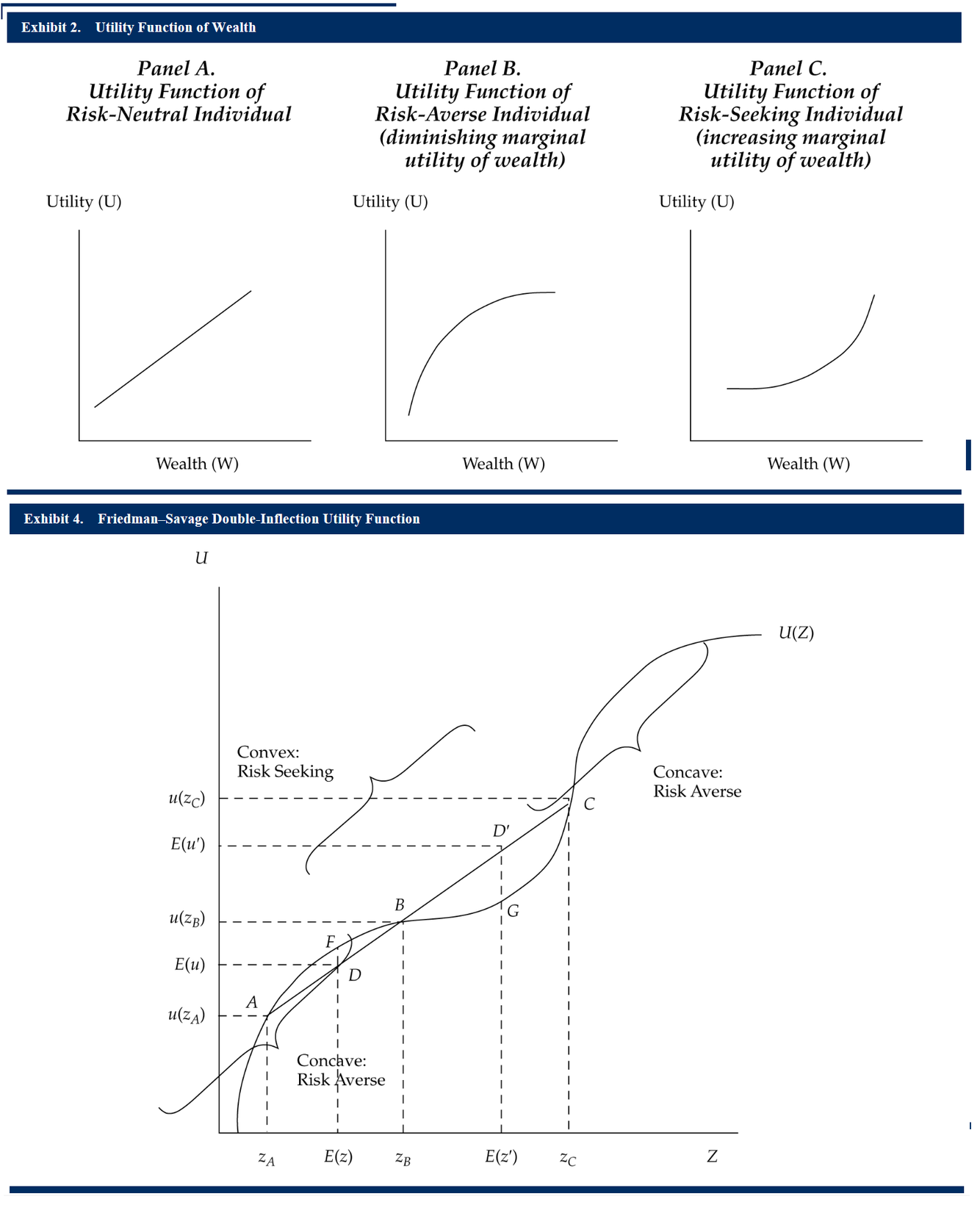
Utility Function - Traditional Finance vs. Behaviour Finance
Traditional finance - risk averse (concave, eg. insurance), risk-loving (convex, eg. lottery ticket) or risk neutral
Behaviour Finance - Double inflection utility function (utility change based on the level of wealth) + Prospect Theory
•Behaviour Finance•
Prospect Theory
Prospect Theory - Alternative to utility theory, dependent on framing effects
- Focus on perceived gains/losses (Δ wealth) based on a reference point
- Subjective decision weights replace objective probability
- Risk-averse for gains
- Risk-seeking for losses
•Behaviour Finance•
Behavior Finance Decision Tree
(i) Editing phase - Organize and reformulate simplify option
- Isolation Effect - Focus on one while ignoring other factors
(ii)Evaluation phase - people are loss-averse and reference dependent – decisions are made based on wpv (weight * probability * value)
•Behaviour Finance•
Bounded Rationality
Bounded Rationality - Relaxes perfect information and process according to expected utility theory.
Satisfice (satisfy + suffice) when bounded by constraints (e.g. time and money). It may not be optimal, but it is acceptable / adequate
When some (but not all) information is available, use heuristics (rule of thumb).
•Behaviour Finance•
Forms of Efficient Market Hypothesis
(and market anomalies)
(i) Weak form: price and volume (i.e. technical analysis do not work)
(ii) Semi-strong form: public information, prices, volume (i.e. technical and fundamental analysis do not work)
(iiI) Strong form: public and private information (i.e. technical, fundamental or insider information do not work)
Market anomalies: Fundamental (small vs large cap), Technical (moving avg) and Calendar (January effect)
•Behaviour Finance•
Traditional Finance Portfolio Construction
MVO subject to constraints and objectives
•Behaviour Finance•
Behavioral Finance Portfolio Construction
Asset Pricing (equity discount rate)
CAPM + SDF = rf + risk premium + sentiment premium (i.e. stochastic discount factor considering dispersion of analysts forecast)
•Behaviour Finance•
Behavioral Biases:
Cognitive errors vs Emotional biases
Cogntive errors: heuristics / memory errors, faulty reasoning
- Better info / education
Emotional biases: impulse or intuition, reasoning influenced by feelings.
- Recognize and adapt
•Behaviour Finance•
Cognitive Errors
Confirmation bias - Related bias
- Confirmation bias – Look for / notice what confirms beliefs
- Base-rate neglect (rely on stereotypes)
- Sample-size neglect (assume that small data size reflects the whole)
•Behaviour Finance•
Cognitive Errors
Believe Perseverance Biases
CC-RIH’der
- Conservatism bias – emphasizing initial information
- Confirmation bias – Look for / notice what confirms beliefs (“stock love bias”)
- Base-rate neglect (rely on stereotypes)
- Sample-size neglect (assume that small data size reflects the whole)
- Representativeness bias – once classification is made, do consider the accuracy of it
- Illusion of control bias
- Hindsight bias - see past events as having been predictable, resulting in regret or forgetting errors
•Behaviour Finance•
Cognitive Errors
Information-Processing Biases
FAMA
- Framing bias - how information is presented changes the decision made
- Anchoring & Adjustment
- Mental accounting bias
- Availability bias - likelihood based on how easily recall information
•Behaviour Finance•
Emotional Biases
Loss aversion bias - Related bias
- Loss aversion bias - strongly prefer avoiding losses than earning gains
(i) Myopic loss aversion - Avoiding equity to avoid short-run declines in value
Disposition Effect - Selling winners and holding on to losers
•Behaviour Finance•
Emotional Biases
Overconfidence bias - Related bias
- Overconfidence bias (illusion of knowledge)
(i) Prediction overconfidence - overestimate accuracy
(ii) Certainty overconfidence - confidence increasing faster than accuracy
(iii) Self-Attribution bias:
a. Self-Enhancing bias - Take all the credit
b. Self-Protecting bias - Place blame on others
•Behaviour Finance•
Emotional Biases
Self-control bias - Related bias
- Self-control bias - Lack of self-discipline
(i) Hyperbolic discounting - fail to balance short-term satisfaction with long-term goal
•Behaviour Finance•
Emotional Biases
Regret-aversion bias - Related bias
- Regret-aversion bias
(i) Error of commission - from action taken
(i) Error of omission - from action not taken


-
Ethical and Professional Standards22
-
Behaviour Finance33
-
Private Wealth Mgt (1)19
-
Private Wealth Mgt (2)12
-
Institutional Investor Portfolios21
-
Economic Analysis18
-
Asset Allocation22
-
Fixed Income18
-
Equity Portfolio Management12
-
Alternative Investment10
-
Risk Management17
-
Trading6
-
Performance Evaluation7
-
GIPS8



