Vertebral Body Osteoporosis
Common metabolic bone disease that is often detected during routine radiographic studies
- characterized by vertical striations in vertebral body
- can lead to continued loss of trabecular bone (bone becomes less white)
- If osteoporosis becomes se ver, can lead to excessive thoracic kyphosis
What is a laminectomy?
Surgical excision of one or more spinous processes and adjacent supporting vertebral laminae
Often performed to relieve pressure on the spinal cord or nerve roots caused by a tumor, herniated IV disc, or bony hypertrophy (excess growth)
Dislocation of Cervical Vertebrae
- Cervical vertebrae are more likely to be dislocated due to more horizontally oriented articular facets
- However, large vertebral canal means less chance of damaging spinal cord
Jefferson Fracture
Fracture of both arches of the atlas
- Usually from a diving accident or large object falling onto the head
- Does not typically injure spinal cord (Larger vertebral foramen)
Hangman’s Fracture
Fracture of the vertebral arch of the axis
- Results from hyperextension of the head on the neck (not whiplash)
- One of the most common cervical vertebrae injuries
Fracture of Odontoid Process
Due to horizontal blow to the head
- Transverse ligament is stronger than the odontoid process.
- These breaks are typically harder to heal b/because of the lack of blood supply to the odontoid process (transverse ligament limits its blood supply)
- Can also results as a complication of ostopenia
Lumbar Spinal Stenosis
Narrowing of the Lumbar Vertebral Foramen
- Lumbar spinal nerves increase in size as the vertebral column descends, but paradoxically, the IV foramina decrease in size
- Compression of one or more spinal nerve roots occupying the inferior vertebral canal
- Complication: If IV Disc protrusion occurs along with stenosis, further compromises vertebral canal
(along w/ Arthritic Proliferation and Ligamentous Degeneration)
Cervical Ribs
Developmental costal element of C7 becomes abnormally enlarged, which can become a supernumerary (extra) rib
-Can place pressure on structures that emerge from superior thoracic aperture (notablly brachial plexus and sublcavian artery), which can thoracic outlet syndrome
Caudal Epidural Anesthesia
Anesthetic agents are injected into the fat of the sacral canal that surrounds the proximal portions of the sacral nerves
-accomplished via sacral hiatus or posterior sacral foramina
Coccygodynia
Painful bruisng or fracture of the coccyx (tailbone)
- hard to treat and pain relief is difficult
- dislocation common
- can happen as a result of difficult childbirth
Hemisacralization
Partial or complete incorporation of L5 into sacrum
-can produce painful symptoms
Lumbarization
Separation of S1 from sacrum and fusion with L5 vertebra
Effect of Aging on Vertebrae
Birth to Age 5: lumbar vertebra grows 3x in height
Age 5-13: lumbar vertebra grows 50% in height
Ages 13-25: Minimual longitiduinal growth until completion
Older Age: Overall decrease in bone density, causing changes in the shape of vertebral bodies (why there is slight height loss in aging)
-can see production of osteophytes (bony spurs) and osteoarthritis
Spina Bifida Occulta
Vertebral lamina fail to fuse and close off the vertebral canal
- Most common in L5-S1
- Possible to have tuft of hair over this area as well
Spina Bifida Cystica
One or more vertebral arches may fail to develop completely
-Associated with herniation of meninges (meningocele) or spinal cord (meningomyelocele)
Aging of Intervertebral Discs
Nuclei pulposi dehydrate and lose elastin and proteoglycans while gaining collagen, leading to IV discs becoming stiffer and more resistant to deformation
-Can lead to degenerative disc disease
Back Pain
Second most common reason to visit doctor (after cold)
Sources of Pain:
- Fibroskeletal structures: periosteum, ligaments, and anuli fibrosi of IV discs.
- Meninges: coverings of the spinal cord.
- Synovial joints: capsules of the zygapophysial joints.
- Muscles: intrinsic muscles of the back.
- Nervous tissue: spinal nerves or nerve roots exiting the IV foramina.
Herniation of Nucleus Pulposus
Protrusion of nucleus pulposis through the annular fibrosis
- Most common in L4/L5 and L5/S1
- Typically occurs posterolaterally where anterior and posterior longitudinal ligaments do not support the annular fibrosis
Sciatica
Pain radiating from lower back into buttock down the posterior or lateral aspect of thigh into leg
-often caused by herniated lumbar IV disc that compresses L5 or S1 component of sciatic nerve
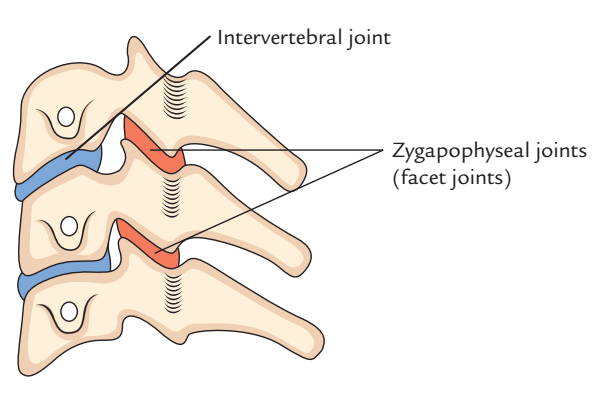
Zygapophysial Joints
If they are injured or develop osteophytes (osteoarthritis), the spinal nerves are often affected
- Pain along the distribution patterns of the dermatomes and spasm in the muscles derived from the associated myotomes
- Myotome: consists of all muscles or parts of muscles receiving innervation from one spinal nerve*
Hyperextension/Whiplash
Overstretching of anterior longitudinal ligament (at front of vertebral body)
-most often in rear-end motor vehicle collisions
What do you do for a patient who has had a fracture of the vertebral column?
Keep them in hyperextension. Pull of the anterior longitudinal ligament.
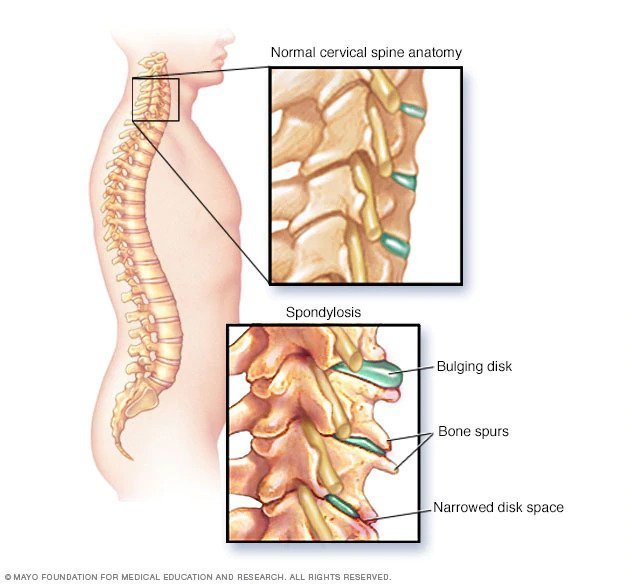
Spondylosis
Calcification of edges of the vertebral bodies
-Causes joint pain and stiffness
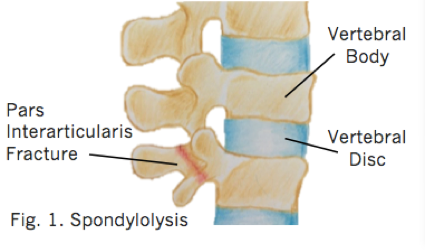
Spondylolysis
Separation of vertebral arch from vertebral body
-Fracture of the column of bones connecting the superior and inferior articular processes (pars interarticularis)


-
Blue Boxes: Back36
-
Blue Boxes: Lower Extremity15
-
Back Osteology30
-
Back Arthrology26
-
Back Myology37
-
Back Angiology and Neurology29
-
Autonomics18
-
Femoral Triangle29
-
Anterior Medial Thigh83
-
Gluteal Region Muscles40
-
Gluteal Region61
-
Tissue Architecture36
-
Epithelial Tissue29
-
Dermatomes, Myotomes, Plexuses18
-
Posterior Thigh and Popliteal Fossa40
-
Fertilization and Gastrulation68
-
Neurulation and Neural Crest24
-
Posterior Leg49
-
Foot and Ankle Joints16
-
Foot79
-
Lecture 12: Hip and Knee Joints32
-
Anterolateral Leg46
-
Fibrous Connective Tissue33
-
Development of the Musculoskeletal Systems29
-
Limb Development61
-
Lecture 4: Skeletal Muscle and Nerve Tissue53
-
Lecture 5: Membrane Potentials37
-
Lecture 7: Introduction to Anatomical Imaging23
-
Lecture 10: Cartilage Histology29
-
Lecture 10: Bone Histology45
-
Lecture 14: Imaging Extremities20
-
Lecture 15: Pharmacology of the Neuromuscular Junction (DSA+CIS)20
-
Lecture 16: Synaptic Transmission27
-
Lecture 17: Contractile Protiens37
-
Lecture 18: Bood Histology21
-
Lecture 19: Integument81
-
Nerve Roots to Memorize12
-
Joints of the Lower Extremity (Darren's)49
-
18. Excitation Contraction Coupling28
-
Blue Boxes: Upper Extremity62
-
Lecture 5: Membrane Potentials COPY37



