What does the EEG measure?
- EEG measures AP excitation @ cerebrum
- Small EF by pyramidal cells detected by EEG
- Synchrony of PC’s detected
- Pmaker/ Inhibit or excited neurons
Describe the International 10-20 system
- Standardised placement reproducible + symmetrical- electrode coverage over scalp
- Cap with electrodes embedded
- Frontal/Temporal/Parietal/ Occiptal/ Septal part
- Blink artifacts- frontal lobe area, ~ muscular activity interfering with EEG trace
- Need reference electrode in area with no AP, if you are going to use it partially. Normally @ earlobe where there is no muscular contraction. Active vs Reference electrode
- Electrode gel = no resistance and no air pockets
- AP is measured
- because has to pass skull so there is an amplifier to increase signal
Explain the primary frequency bands recorded by an EEG
- Delta <4= deep sleep, slowest thus less freq.
- Theta 4-8 Hz= fatigue, slow but increased freq.
- Alpha 8-13 Hz= awake
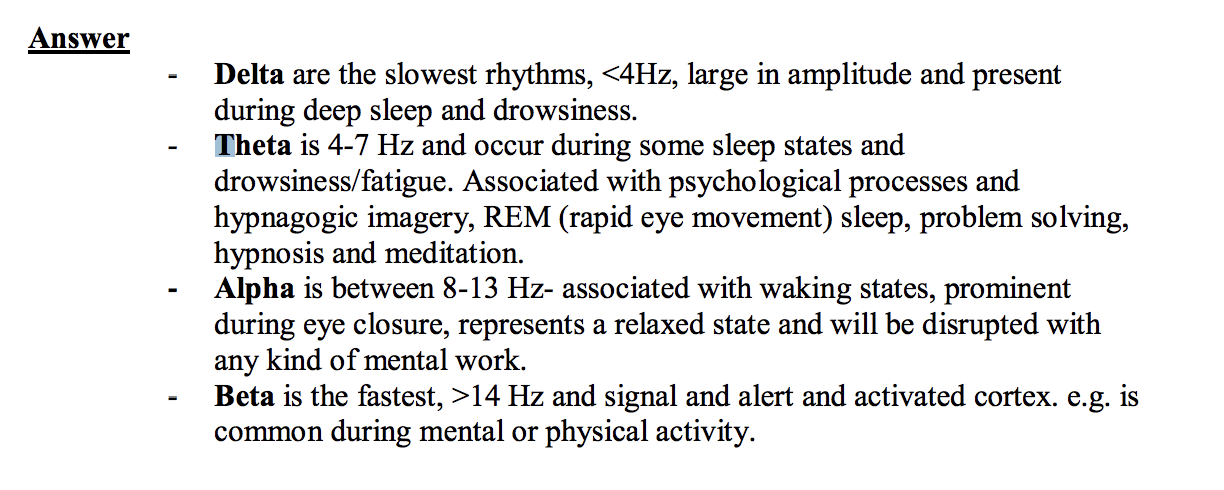
Beta >13= alert
What is consciousness?
What are the grades of consciousness?
What is consciousness?
- Consciousness= AP @ large cortical surface area/ motor control/ connecting thoughts (memory)
What are the grades of consciousness?
- Grade of consciousness= alert, drowsy, stupor (between awake and coma), coma
What is the difference between a seizure, convulsion and epilepsy?
- Seizure= abnormal AP @ cerebral cortex –> abnormal activity depending on where AP came from (sensory perception/ motor jerking/ autonomic changes or psychic phenomenon)
- Convulsion= motor seizure entire body
- Epilepsy= lots of seizures–> fit
What is the cause of seizures?
- Ions distribution unbalanced due to altered membrane permeability
- Thalamus is pacemaker that can inhibit AP that would otherwise be needed for homeostasis
- Nt imbalance: low GABA = inhibitory neurons not working
- AP too excited/ inhibited (not homeostatic) due to strong interconnection
What can be used to prevent seizures?
- Strong convulsants = meds that block inhibitory neurons (GABA neurons) making patient more prone in getting siezures
- Anticonvulsants do opposite, prolong inhibition of GABA
Discuss the correlates of seizures, epilepsy and EEG
- General- disturbed consciousness:
- Absence (AKA petitmal)/ Atonic (drop attack, poor muscle tone, droop),
- Myoclonic (tonic= ongoing violent contraction/ clonic= repeat contraction and relax),
- Tonic Clonic (grand mal- muscle contract and lose consciousness)
- Partial:
- Simple (1 hemisphere)/
- Complex (temporal -> 2 lobes)/ partial (2nd general seizure (one -> 2, involve thalamus or reticular formation)
- 2nd generalised
- convulsive STATUS EPILEPTICUS: 5/20min/ repeated seizure with no break (convulsive/non) -> death due to lung failure (1st Tx= BDZ increase inhibitory nt, 2nd Tx= anticonvulsants through IV, barbituate= coma inducing)
- Absence seizure- Large regular voltage, 3Hz rythm
The human cerebral cortex is very large and folded. What do these foldings of the cortical surface do to the brain signals that are recorded by an EEG electrode at the sca
For the most part, an EEG measures voltages generated by the currents that flow during synaptic excitation of the dendrites of many pyramidal neurons in the cerebral cortex. The signal must penetrate several layers of non-neural tissue, including the meninges, fluid, bones of the skull, and skin to reach the electrodes. The population of cells deep within the folds of the cortical surface contributes very little to the recorded EEG, which measures activity only in the superficial layers of cortex close to the skull.
The EEG rhythm that is associated with a quiet, waking state is the ________ rhythm.
a) alpha
b) beta
c) gamma
d) delta
a) alpha
Seizures are usually accompanied by very large EEG patterns. a) true b) false
t
In general, what part of the brain’s electrical activity is measured by an EEG?
a) brainstem
b) medulla
c) cerebellum
d) cerebral cortex
d) cerebral cortex
Generalized seizures + tx:
consist of a tonic (muscles become stiff)- clonic (jerking) phase followed by a period of unconsciousness.
Treatment is based on modifying the balance between the inhibitory gammaaminobutyric acid (GABA) and glutamatergic network within the rain or the repetitive firing potential of neurons.
The EEG recordings reveals what about epilepsy?
The EEG recordings reveals that epileptic fits (ictal events) are associated with either generalized synchronous or focal spike and wave discharges. These events can also be seen transiently at other times without a seizure (interictal activity)
Model for the generation of an epileptic discharge
Interictal activity corresponds to a depolarizing shift with superimposed action potentials from an assembly of neurons. Hyperpolarization follows as local inhibitory interneurones are activated. Repeated interictal spikes leads to the period of hyperolarization shortening and this activates ion channels in the neurons and increases extracellular K+ concentrations, which further depolarizes the neurons. If sufficient neurons are activated then synchronous discharges are produced in many neurons which can lead to a seizure. Seizure (synchronous discharge) is then terminated by ion channel inhibition within the neurone and within neuronal network by GABA related interneuronal activity.
1) Define epilepsy.
Epilepsy is a transitory disturbance of the functions of the brain and develops suddenly and can cease spontaneously. - Serious neurological condition prevalent mainly during early childhood and in the elderly
2) What is the common non-invasive way to monitor epileptic fits?
Recording of the EEG reveals that epileptic fits (ictal events) are associated with either generalized synchronous or focal spike and wave discharges. - This abnormality can also be transient: interictal activity.
3) Describe the cellular physiology model of epilepsy.
- Model for generation of epileptic discharge is that interictal activity corresponds to a depolarizing shift with superimposed action potentials from assembly of neurons -
- Followed by hyperpolarization as these neurons and activate local inhibitory interneurones - With repeated interictal spikes the period of hyperpolarization shortens and activates ion channels in the neurons and raises extracellular K+ concentration which further depolarize the neurons
- If sufficient neurons are activated then synchronous discharges are produced across populations of neurons which can lead to a seizure.
- Seizure or synchronous discharge is terminated by active processes of inhibition both within the neuron (via ion channels) and within the neuronal network by GABA associated interneuronal activity
Seizures are usually accompanied by:
a) fast, small amplitude EEG patterns
b) very large amplitude EEG patterns of about 3 Hz
c) extensive beta activity
d) EEG activity >35 Hz
e) both a) and c) are correct
b) very large amplitude EEG patterns of about 3 Hz
A generalized seizure involves the entire _______.
a) cerebellum
b) cerebral cortex
c) medulla
d) thalamus
b) cerebral cortex
) Why do EEGs with relatively fast frequencies tend to have smaller amplitudes than EEGs with slower frequencies?
EEG signal amplitude depends on the synchronized activity of the underlying neurons. If a group of cells are excited simultaneously, the tiny signals sum to generate one large surface signal. However, when each cell receives the same amount of excitation, but spread out in time, the summed signals are small and irregular. That is, the number of activated cells and the total amount of excitation has not changed; however, the timing of the activity changes. Therefore, EEGs with relatively fast frequencies tend to have smaller amplitudes than EEGs with slower frequencies.
2) List some common causes of seizures by age.
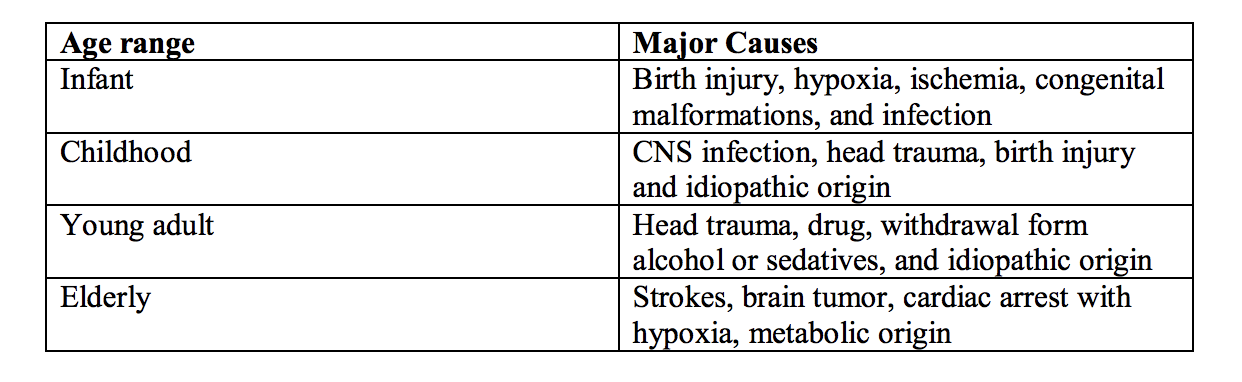
3) Define simple partial seizures (focal).
- Simple partial seizures involve a limited region of the cortex. - The manifestation can be motor impairment (i.e., jacksonian seizure) or sensory impairment. - The seizures may be emotional or hallucinatory (visual, auditory, olfactory) phenomenon, epigastric rising or déjà vu. - Consciousness is maintained during a simple partial seizure as opposed to impairment consciousness during complex partial seizures. - May last seconds to many hours.
Define complex partial seizures.
- Seizure may begin with or without warning or aura, or with stereotyped motor, sensory, autonomic, or psychic symptoms.
- Complex partial seizures alter consciousness due to bilateral spread of the seizure discharge, no recollection.
- Patient may sit, walk, mumble and exhibit autonomic acts such as lip smacking or other movements - Lasts 1-3 minutes and can be followed by period of confusion 5-20 minutes.


-
Introduction to Neuroscience & Neuroanatomy7
-
Membrane Potential5
-
Synaptic Transmission16
-
Neurotransmitter35
-
Brain Rhythms27
-
Memory14
-
Sleep36
-
Chemical Control + Brain Behaviour38
-
Motivation & Emotion36
-
Mental Illness19
-
T8: Schizophrenia12
-
Chemical Senses22
-
Central Visual System26
-
Brain Control of Movement17
-
Spinal Control of Movement20
-
P5: Skull & Vertebral Column17
-
P8: Motor Centres & Pathways2
-
Auditory and Vestibular Systems38



