what are objectives?
what the business is ultimately seeking to achieve
what is a long-term plan?
defines the general direction of the business over
next five or so years
provide examples of long-term plan
Market(s) the business aims to serve
• Production / service methods
• Levels of profit sought
• Financial / financing requirements and methods
• Personnel and other requirements
what is a budget?
financial plan for a future time period. Short-term business plan for the following 12 months
- Expressed mainly in financial terms
- Converts the long-term plan into an actionable blueprint for the future
distinguish budget and forecast
A budget is a plan for a future time
• Sales revenues and expenses
• Cash flows
• Short-term credit to be given or taken
• Inventory requirements
• Personnel requirements
Forecasts tend to be predictions of the future state of the environment. They are useful to the planner / budget setter.
are budgets always produced for the following two months?
not necessarily
the manager has discretion.
May also depend on the industry
how may limiting factors influence the budget?
Limiting factors are aspects of a business that thwarts it from achieving objectives.
• Managers need to take account of these factors when preparing their budget.
what are examples of limiting factors?
• Examples: limited ability to sell products, a shortage of funds, labour, materials or plant.
what is a period budget?
periodic budget:
is prepared for a particular period (usually
one year). The budget is prepared just once during each financial year.
what is a rolling budget?
A rolling budget (also called continual budget) changes the start date of the budget once a period being budgeted has passed.
• It ensures that all times there will be a budget for a full planning period
limitation of rolling budget
time consuming. It may be unreasonable to expect
managers to take this future-oriented approach continually
what does interrelationship of budgets refer to?
In a business, there is not one budget, but several -
each relating to a specific aspect of the business
Ideally, there should be a separate budget for each
person in a managerial position
eg. finished inventories budget, production budget, cash budget, raw inventories budget etc. interact
Describe the first 3 steps of the budget setting process
- Establish who will take
responsibility for the
budget-setting
process - Communicate budget
guidelines to relevant
managers - Identify the key or
limiting factor
describe steps 4-6 of budget setting process
4.Prepare the budget for
the area of the
limiting factor
5.Prepare draft budgets
for all other areas
6.Review and co-ordinate
the budgets
describe steps 7-9 of budget setting process
7.Prepare the
master budgets
8.Communicate the budgets
to interested groups
9.Monitor performance
relative to the
budgets
what are the five main uses of the budget?
- Allows business to be prudent and **foresee **short-term problems, take early course of action
- Help co-ordinate various sections of the business;
- Motivate managers to achieve better performance;
- Provide a basis for a system of control;
- Provide a system of authorisation for managers to
* *spend up to a limit**
what is the key budget and why?
The cash budget is a key budget
- all aspects of a business are eventually reflected in cash
- The cash budget reflects the whole business more than any other single budget
- Particularly important for small businesses
what does a budgeted income statement look like?
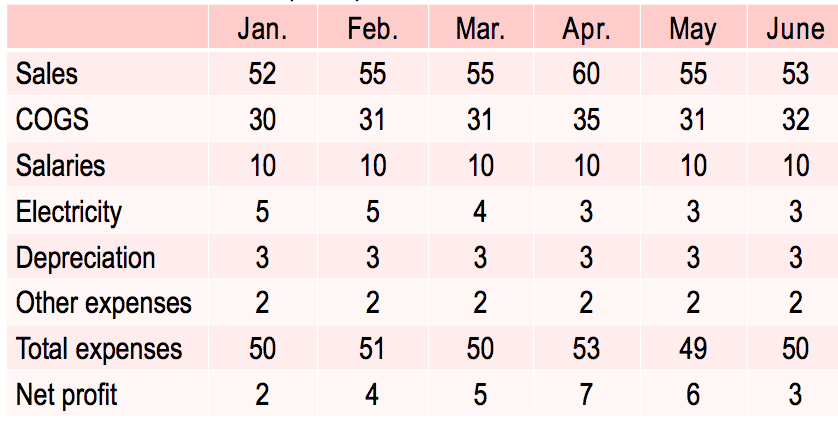
how may you use budgets as control?
what is control?
Budgets represent the plan and therefore provide
the basis for exercising control over the business
making events conform
to a plan by taking corrective action when needed
planning and controlling process steps 1-3
- Identify objectives
- consider options
- evaluate options and make a selection
planning and controlling process
steps 4-6
- Prepare long-term plans (long-term budgets)
- Prepare budgets (short term)
- Perform and collect information on actual performance
planning and controlling process 7-9
- Identify and analyse differences between** plans and actuals** (variations or variances)
- Respond to variances and exercise control
- Revise plans (and budgets)if necessary
how may you use budgets for control?
what is the most important budget target?
Comparing actual performance with the budget
The most important budget target to meet is the profit target
eg. Draw a comparison between actual costs incurred and the budgeted costs for the actual level (volume) of production achieved
using budgets for control
what is a flexed/flexible budget?
a budget revised to reflect costs that would have been expected for the actual activity (i.e. the volume of output which actually occurred).




