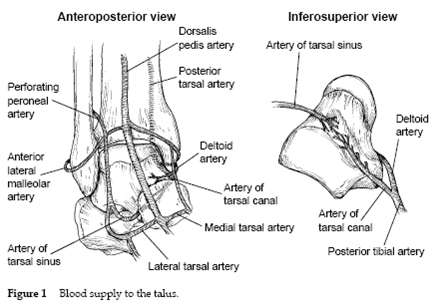
Blood supply to the talus
- Posterior Tibial Artery
- artery of tarsal canal
- deltoid branch
- Anterior tibial artery
- Artery of tarsal sinus
- *posterior tibial artery**
- via artery of tarsal canal (dominant supply) supplies majority of talar body
deltoid branch of PT supplies medial portion of talar body
may be only remaining blood supply with a displaced fracture
anterior tibial artery -suplies head and neck
perforating peroneal artery via artery of tarsal sinus suplies head and neck
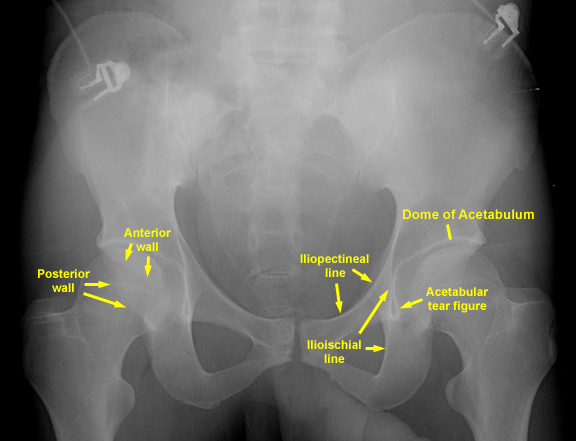
List specific things evaluated in an AP pelvis radiograph in the trauma setting.
Symphysis pubis <5 mm in width
Sacroiliac joint 2-4 mm in width
Pelvic ring should have no disruption
Obturator ring should have no disruption
Sacral foraminal arcs should be visible
Check TPs of lower lumbar vertebrae for fracture
Check the fat stripes: gluteal, iliopsoas, obturator
internus
Iliopectineal or arcuate line disruption # anterior column
Ilioischial line disruption # posterior column
Radiographic U or teardrop
Acetabular roof Sorcil
Anterior rim of the acetabulum
Posterior rim of the acetabulum
Line of Klein drawn along superior edge of femoral neck
should intersect epiphysis
Shenton line - smooth continuous arc
6 radiographic landmarks of the acetabulum:
- iliopectineal line (anterior column)
- ilioischial line (posterior column)
- anterior rim
- posterior rim
- teardrop
- weight bearing roof
List all potential sources of bleeding in pelvic fractures. And give a alogorythm to appoach hemorrahgic shock in pelvic fractures.
Basic algorithm
- Is there massive blood loss - >2L (0-5 minutes)
if yes the OR
- ATLS performed
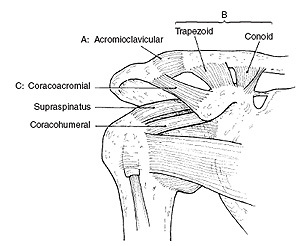
List the 4 SC joint ligaments (4)
- Posterior Capsule (most important)
- Anterior Capsule
- Interclavicular (attaches across notch to other SC)
- Costoclavicular (holds it to first rib)
Which AC joint ligaments provide horizontal stability (AP)? (2)
Which ones provide vertical stability ?
Superior & Posterior Ligaments- horizontal
Conoid & Trapazoid Ligaments - Vertical
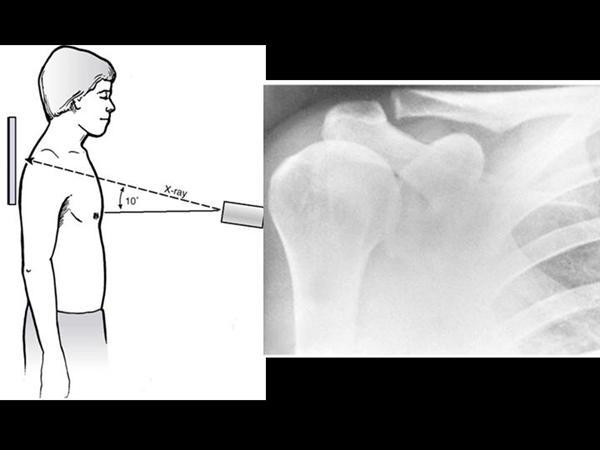
What x-ray is the money view for AC joints?
Zanca view
- performed by tilting the x-ray beam 10° to 15° shooting caudal to cephalic direction and using only 50% of the standard shoulder anteroposterior penetration strength.
How do you position hemi in type 4 proximal humerus fractures?
Height?
Version?
Preop
- Template unsing other arm
interop
- 5.6mm above superior border of pec major tendon
- Restore gothic arch (fluoro,xrays)
- GT 5-9 mm below superior aspect of head
Retroversion
- 20-40 degrees retroverted (30)
- bicipital groove is on average, angled approximately 30° more retroverted than the humeral head with respect to the epicondylar axis.
Describe deltopectoral approach.
What is the internervous plane?
Internervous plane
- axillary nerve - Laterally
- medial and lateral pectoral nerve - Medially
- Incision 8-10-cm extending inferiorly and laterally from the tip of the coracoid process toward the deltoid tuberosity
- deltopectoral fascia - cephalic vien(lateral w deltoid)
- substantial hematoma, which should be evacuated
- pectoralis major insertion is preserved
- conjoined tendon coracobrachialis & SHbiceps is identified
- clavipectoral fascia is incised just lateral to SH-biceps superiorly to the coracoacromial ligament
- finger swept medially, deep to CJ tendon, superiorly-inferiorly
- identify axillary nerve - passes superficial to the subscapularis muscle belly toward the quadrilateral space.
- musculocutaneous nerve passes thru CJ-tendon approx 5-6 cm distal -tip of the coracoid
- biceps sheath ident. inf. portion - superior to pectoralis major
- pec-major inserts on lateral lip - bicipital groove
- biceps traced superiorly to transverse humeral ligament, which is preserved
- soft-tissue split parallel-ant border of supraspinatus all the way to the glenoid
- biceps is then tenodesed-pec-major
- joint accessed - GT fracture line & split at anterior border SS
- heavy nonabsorbable suture- bone-tendon junction GT & LT most lateral extent on each
Indications for Prosthetic humeral head replacement in trauma (3)
- head-splitting fractures
- fracture-dislocations
- four-part fractures with significant initial varus displacement (>20°).
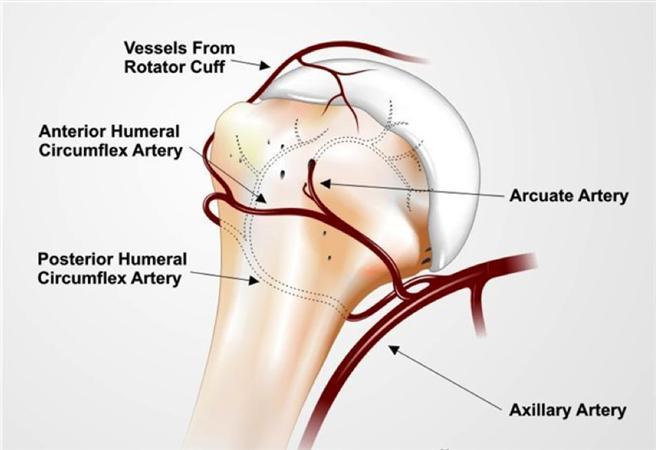
Vascularity to the Humeral Head
anterior humeral circumflex artery
- anterolateral ascending branch (of AHCA)
- arcuate artery - terminal branch
posterior humeral circumflex artery
- recent studies suggest it is the main blood supply to humeral head
Describe the Neer classification (4)
Based on anatomic relationship of 4 segments:
- greater tuberosity
- lesser tuberosity
- articular surface
- shaft
separate part - displaced > 1 cm 45° angulation
valgus impacted is not true 4 part.
Approach to radial nerve palsy in humerus fractues.
What Tendon transfers are typically preformed.
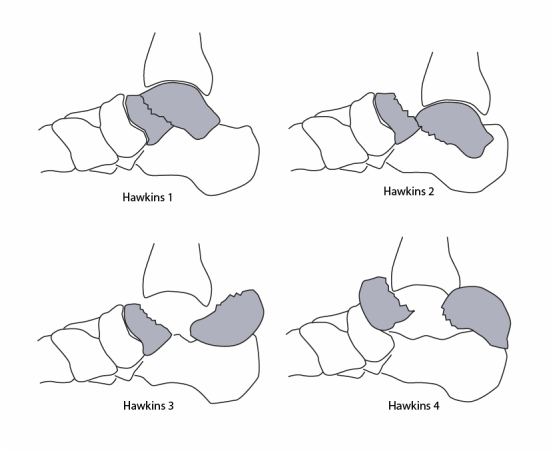
Describe Hawkins classification and Osteonecrosis rates (4)
Hawkins 1: Nondisplaced 0-13%
Hawkins 2: Subtalar dislocation 20-50%
Hawkins 3: Subtalar and tibiotalar dislocation 20-100%
Hawkins 4: Subtalar, tibiotalar, and talonavicular dislocation 70-100%
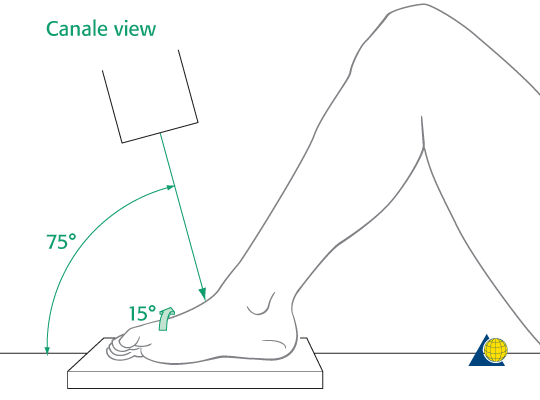
What x-ray provides optimal view of talar neck?
Canale View
technique:
- maximum equinus,
- 15 degrees pronated,
- Xray 75 degrees cephalad from horizontal
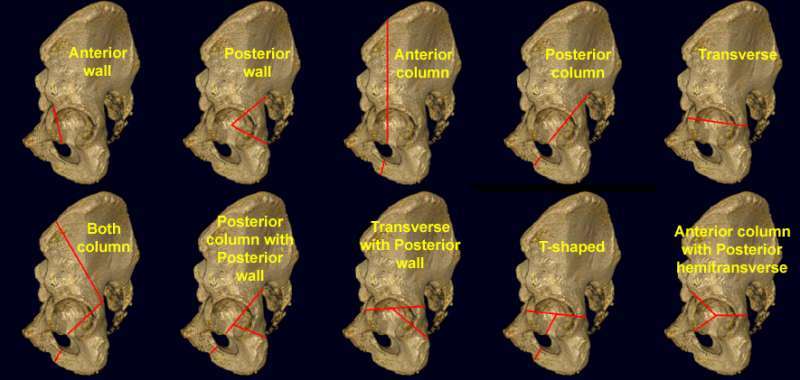
List all 10 types of Periacetabular fractures
Elementary
- Posterior wall
- Posterior column
- Anterior wall
- Anterior column
- Transverse
Associated
- Associated Both Column
- Transverse + Post. Wall
- T shaped
- Anterior column or wall + Post. hemitransverse
- Post. column + Post. wall
What is this?
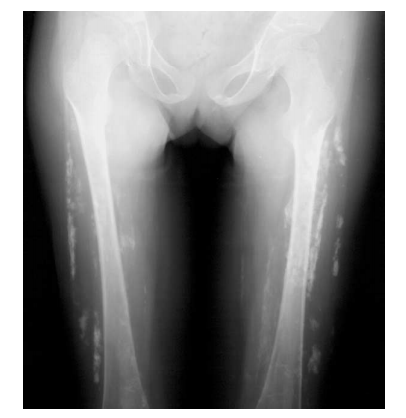
Extensive soft-tissue calcifications are noted bilaterally in
the lower extremities of this patient with dermatomyositis.
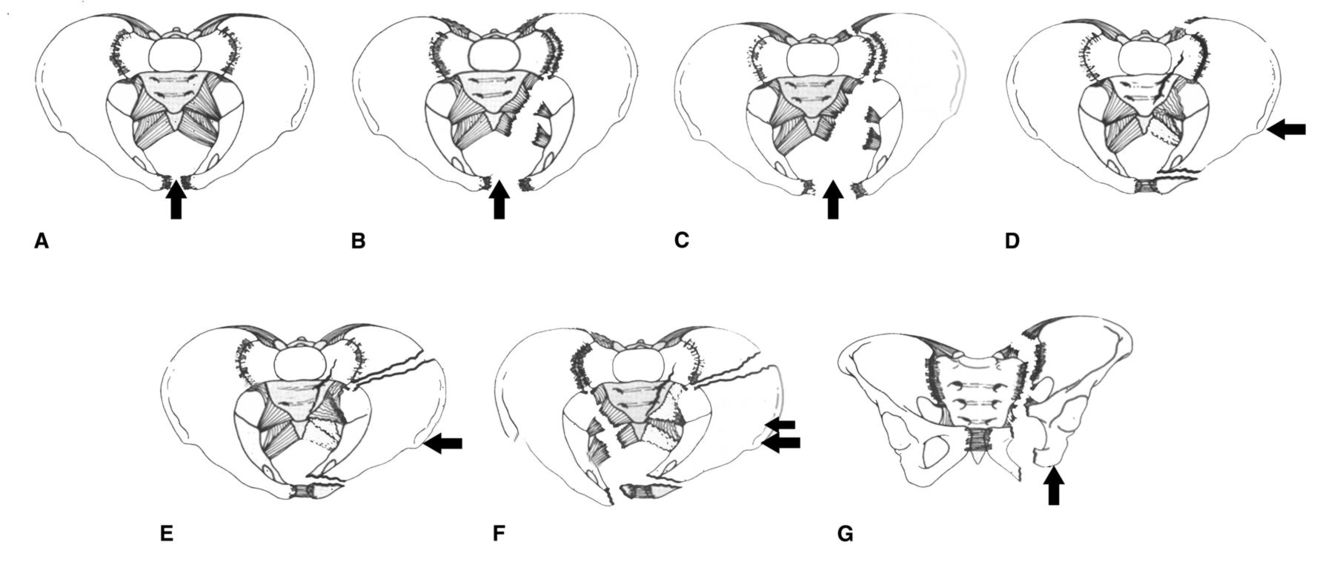
Describe the Young-Burgess classification.
Anteroposterior compression (APC)
- A) APC type I - wide pubic symphasis <2.5cm
- B) APC type II- no sacrotuberous, sacrospinous& ant.SI ligaments; post. SI ligaments remain intact >2.5cm
- C) APC type III -dissociated SI or displacedvnonimpacted posterior fracture
Lateral compression (LC)
- D) LC type I - buckle # sacral ala & Rami #
- E) LC type II - near comp post disruption crescent #
- F) LC type III - rollover or windswept pelvis
G)Vertical shear - Comple disruption of SI
arrows indicates direction of force
In open pelvis fracture management what are the important intitial steps.
- Hemodynamically unstable at presentation.
- Pack open wounds & apply pelbic binder
- Broad spectrum Abx & tetnus
- While continuing resescitation - assess other sorces of Bleeding
- Plan for OR control of other bleeds plus I&D of wound Ex fix and Fecal diversion - Colostomy
- ICU likely needed
Although not definitive what could one predict with blood transfusion requirements in trauma using Young-Burgess & Letounal classifications. (JOT2007)
Most blood required:
- APC III avg -12.6 units
- tansverse (13)
- both columns (8.8)
Most likely need transfusion
- all APCs
- LC III
- VS
- combined pelvis & acetabulum
- all acetabulum except ant wall may require blood
- Nearly 50% (10 of 25) of APC II, APC III, or LC III
- patients with acetabular fractures are just as likely to require transfusion
- High enegy patterns require more - transverse (13.0), both column (8.8 units) & AC post. hemi-T (6.4 units)
what is PUDA?
Proximal ulna dorsal angulation
exists in 96% of population
6 +/- 3 ° - 5 cm from tip of olecranon
5 degrees malreduction = radial head instability
varus angle proximal ulna (N) = 14 ° +/- 4°
Describe how to apply an External fixator to pelvis.
list the Principles of Tendon Transfer (8)
- Supple joint: joint must have max pROM otherwise transfer will fail. Need aggressive physio or even surgical releases PRIOR to tendon transfer procedure
- Soft tissue equilibrium: want healthy soft tissue bed free from edema, inflammation, scar so do not get adhesions which will result in poor outcome of tendon transfer. Either need to wait or excise scar or even consider flap coverage
- Expendable donor: do not want to regain one function at expense of losing another function
- Donor of adequate excursion (=max linear distance). Wrist flexors/extensors = 33mm, finger extensors = 50mm, finger flexors = 70mm
5.Donor of adequate strength: FCR/wrist extensors/pronator teres/finger flexors strength = 1; brachioradialis/FCU strength = 2; finger extensors strength = 0.5; APL/EPB/EPL/PL strength = 0.1
a. Lose one grade of strength with a transfer
6. Straight line of pull: direction changes weaken force of pull
7. Synergy: certain muscle groups work together ex. Wrist flexion & finger extension, wrist extension & finger flexion. Finger flexion & extension not synergistic, so try to avoid.
8. Single function: if try to restore multiple functions, compromise strength & movement
Whats the diffrence between High and Low radial nerve palsy clinically?
High radial nerve palsy = injury proximal to elbow = radial nerve proper
Lack wrist/finger/thumb extension
Lack sensation 1st webspace/dorsoradial hand (not critical to normal hand function)
Low radial nerve palsy (PIN) = injury distal to elbow = posterior interosseous nerve
Lack finger/thumb extension
Have sensation 1st webspace/dorsoradial hand
Wrist extension preserved (ECRL is radial nerve proper), although may have radial deviation in extension if proximal PIN injury and ECU affected




