What is a capacitor?
A device designed to store charge.
How does a capacitor charge?
- Two parallel metal plates placed near each other.
- When connected to a battery, electrons move through the battery and are forced onto one of the plates.
- This makes the first plate become negative.
- On the other plate, an equal number of electrons are repelled making that plate positive.
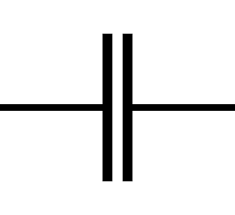
What is the symbol for a capacitor in a circuit?
Two equal length parallel lines.
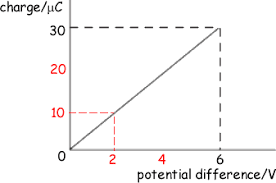
What would a charge against pd graph for a capacitor look like?
What can be found from this graph?
A straight proportional line passing through the origin.
Area = work done = energy stored
gradient = capacitance
Define capacitance
The charge stored per unit pd.
C = Q/V
Define a farad
One coulomb of charge stored per volt
C = Q/V
1 F = 1CV-1
What factors affect the capacitance of a capacitor?
- surface area of plates
- Separation of plates
- Dielectric
Define permittivity
Permittivity is a measure of how difficult it is to generate an electric field in that medium.
The higher the permittivity of the material the more charge needed to generate an electric field.
Define relative permittivity
Relative permittivity is the ratio of the permittivity of a material to the permittivity of free space, it is sometimes known as the dielectric constant.
Explain permittivity
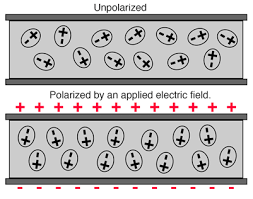
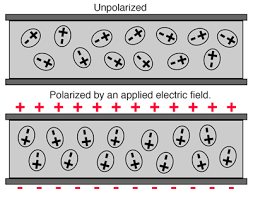
- When no charge is stored by a capacitor, no electric field is generated, the polar molecules are randomly aligned.
- When a charge is applied to the plates of a capacitor an electric field is generated between them.
- The negative ends of the molecule are attracted to the positive plate and vice versa.
- This causes the molecules to rotate and align them selves anti-parallel to the field.
- The molecules each have their own electric field, which now opposes the applied electric field of the capacitor.
- The larger the permittivity, the larger the opposing field.
- This reduces the overall electric field between the plates and therefore reduced the p.d. needed to transfer a given charge to the capacitor.
- This increases the capacitance (Q = CV).
When capacitors are placed in series how can the total capacitance be found?
1/CT = 1/C1 + 1/C2 + 1/C3 + ……
When capacitors are placed in parallel how can the total capacitance be found?
CT = C1 + C2 + …..
For a capacitor discharging sketch a graph of voltage against time.
Exponential decay - see diagram
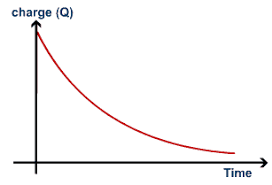
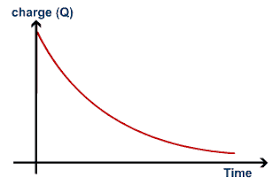
For a capacitor discharging sketch a graph of charge against time.
What can be found from this graph?
Exponential decay - see diagram
Gradient = current
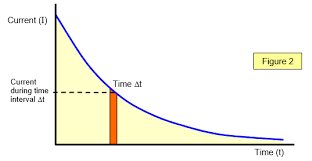
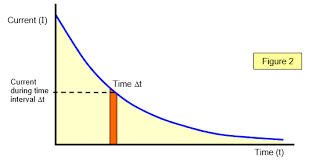
For a capacitor discharging sketch a graph of current against time.
What can be found from this graph?
Exponential decay - see diagram
Area = charge
Explain why the rate of change of p.d. between capacitor plates decreases as the capacitor discharges?
- When a capacitor is fully charged one plates is negatively charged due to the electrons it has gained.
- When is starts to discharge the negative electrons repel each other.
- Initally there are lots of electrons, lots of repulsion so electrons leave quickly
- As there are now less electrons on the plate, there is less repulsion and so electrons leave the plate at a slower rate.
- So charge is decreasing (as electrons are leaving the plate) but the charge leaves the plate at a slower rate as time increases.
- As voltage is proportional to charge it follows the same relationship.
If you measure voltage and time for a capacitor discharging, what graph would you plot to obtain a straight line? What could you find from this graph?
ln V against t
Gradient = - 1/RC
Intercept = ln Vo
For a capacitor charging sketch a graph of voltage against time.
Voltage increases but the rate of increase (gradient is decreasing)
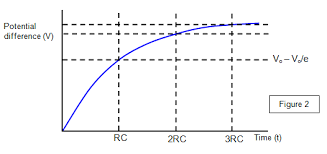
For a capacitor charging sketch a graph of charge against time.
What can be found from this graph?
Voltage increases but the rate of increase (gradient is decreasing)
Gradient = current
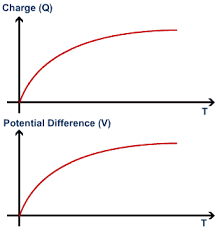
For a capacitor charging sketch a graph of current against time.
What can be found from this graph?
Exponential decay
Area = charge
Explain why the rate of change of p.d. between capacitor plates decreases as the capacitor charges?
When a capacitor is uncharged it is initially easy to add electrons onto the first plate. (so charge increases quickly)
As the first plate is now negative it is harder to add electrons due to the electrostatic repulsion.
Electrons are now added but at a slower rate. (charge increases but at a slower rate)
As voltage is proportional to charge it follows the same relationship.
What is the time constant of a circuit?
The rate of discharge of a capacitor.
The time take for the voltage/charge/current to fall to 1/e (37%) of its original value
Time constant = RC
What are the units of time constant
seconds
When t=RC in a capacitor’s discharge, what percentage charge remains?
37%


-
Mechanics 1100
-
Mechanics 292
-
Materials33
-
Electricity124
-
Prefixes11
-
Particle Physics110
-
Quantum Mechanics73
-
Practical skills27
-
Waves and Optics80
-
Thermal physics47
-
Gravitational fields44
-
Electric Fields37
-
Capacitors27
-
Magnetism40
-
Fields Exam Questions52
-
Nuclear Physics30
-
Circular Motion26
-
SHM revision40



