Metes and Bounds Survey System:
it is a method for describing a property in the form of a narrative. The property is described by beginning at a specific point on the property boundary and then describing the length and direction of the boundaries of the property, until the entire property is encompassed.
example:
“beginning with a corner at the intersection of two stone walls near an appletree on the north side of Muddy Creek road one mile above the junction of Muddy and Indian Creeks, north for 150 rods (rod is a unit of measurement) to the end of the stone wall bordering the road, then northwest along a line to a large standing rock on the corner of John Smith’s place, thence west 150 rods to the corner of a barn near a large oak tree, thence south to Muddy Creek road, thence down the side of the creek road to the starting point.”
Plat map:
a land plan. A component of a survey, typically furnished by a civil engineer,
and drawn to scale, it indicates the bearings and dimensions of property lines.
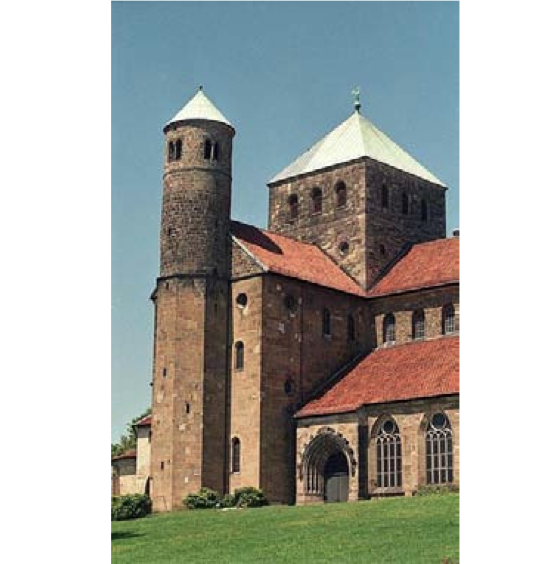
Romanesque
St Michaels Church (shown) /Trier Cathedral /Pisa Cathedral
- Walls of massive thickness with few and comparatively small openings
- Buttresses are not a highly significantfeature, as they are in Gothic architure
- The arches used in Romanesque architecture such as doors and windows, for vaults and for arcades.
- Arcades are also used: an arcade is a row of arches, supported on piers or columns.
- Piers were often employed to support arches
- Columns and vaults are an important structural feature of Romanesque
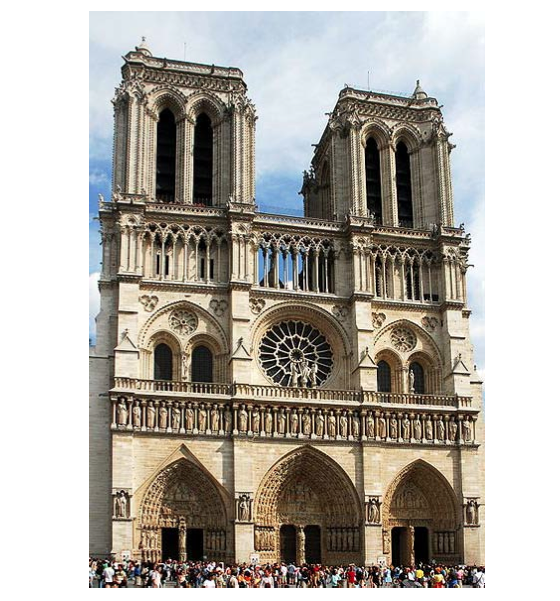
Gothic
Cathedral de Notre Dame de Paris (shown)/ Reims Cathedral/ Chartres Cathedral
Emphasizes verticality (height) and light (expansive area of windows) achieved by the development of certain architectural features: clustered columns, pointed ribbed vaults, and flying buttresses = thinner walls
- Religious structures were often surmounted by one or more towers and pinnacles and perhaps tall spires.
- Gothic cathedrals were intended to convey a theological message: the great glory of God.
- Symbolically and through ornamentation.
- Most Gothic churches, unless they are entitled chapels, are of the Latin cross (or “cruciform”) plan, with a long nave making the body of the church, a transverse arm called the transept and, beyond it, an extension which may be called the choir, chancel or presbytery.
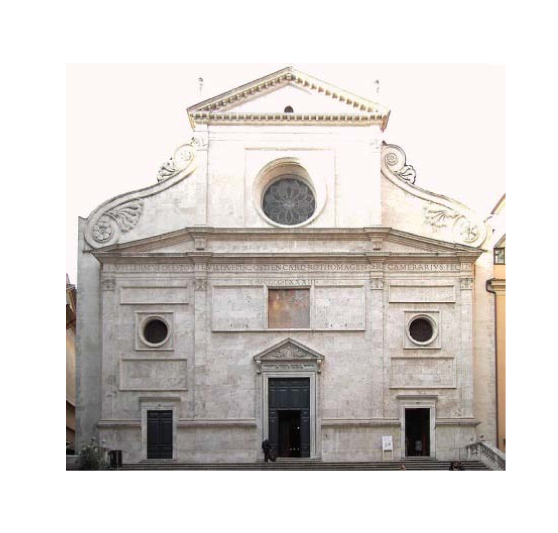
Renaissance
San Augustino (shown)/St Peters Basilica / Santa Maria Novella / Palazzo Medici / St Peters Piazza
- The plans of Renaissance buildings have asquare, symmetrical appearance in which proportions are usually based on a module
- Façades are symmetrical around their vertical axis
- Arches are semi-circular or (in the Mannerist style) segmental.
- Vaults do not have ribs. They are semi- circular or segmental and on a square plan, unlike the Gothic vault which is frequently rectangular.
- The dome is used frequently, both as a very large structural feature that is visible from the exterior, and also as a means of roofing smaller spaces where they are only visible internally
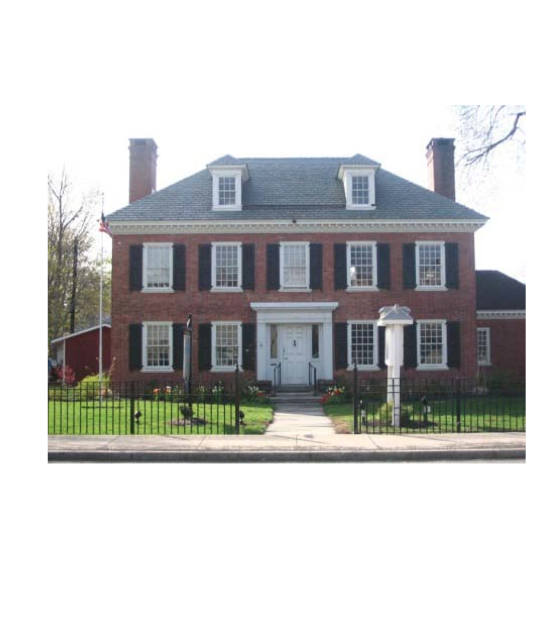
American Georgian
A 1–2 story box, 2 rooms deep, using strict symmetry arrangements
- Panel front door centered, toppedwith rectangular windows (in door or as a transom) and capped with an elaborate crown/entablature supported by decorative pilasters
- Cornice embellished with decorative moldings, usually dentil work
- Multi-panewindowsareneverpaired,and fenestrations are arranged symmetrically (whether vertical or horizontal), usually 5 across
- Roof: Side-gabled; Gambrel; Hipped
- Chimneysonbothsidesofthehome
- Aporticointhemiddleoftheroofwitha window in the middle is more common with post-Georgian styles
- Largerwindowswith9or12panesonthe
main floors
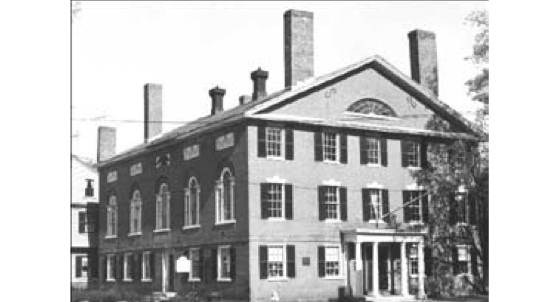
Federal/Adamesque
- Differs from preceding Georgian colonial interpretations in its use of plainer surfaces with attenuated detail, usually isolated in panels, tablets and friezes.
- Flatter smoother facade and rarely used pilasters.
- applied to the balanced and symmetrical version of Georgian architecture
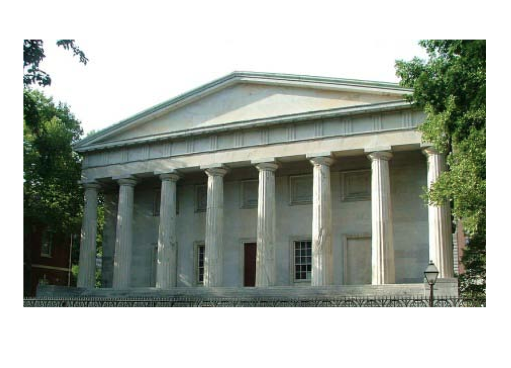
Greek Revival
- Thomas Jefferson was to prove instrumental in introducing Greek revival architecture to the United States.
- A rebirth of classical Greek architectural elements
- Some larger or commercial buildings in this style are loosely based on the Greek temple, with a low triangular roofline and a facade of columns. Usually includes rectangular balanced compositions with sash windows, elaborate entrances with transoms, projecting porticos, and large ornaments.
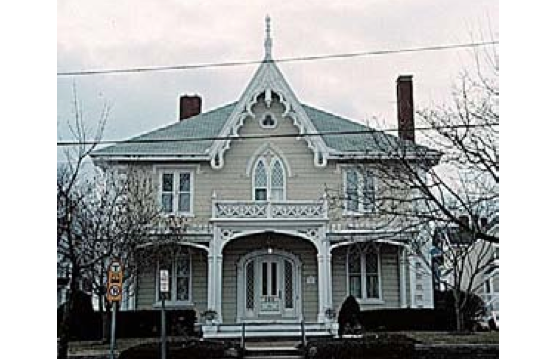
Gothic Revival
a.k.a Victorian Gothic
The Gothic Revival style was based on the churches and homes of Europe in the Middles Ages and is considered the firsttrue Victorian style. They have irregular pitched gable roofs, fanciful eave treatments, pointed arch windows, and sometimes elaborate Gothic ornamentation and details
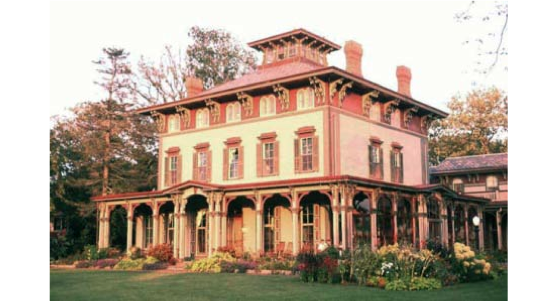
Italianate
- Borrowed Italian Renaissance motifs synthesized with picturesque aesthetics.
- They are rectangular in shape, with two to three stories, tall and narrow, a balanced composition with bracketed cornices, parapets and false fronts, elongated, arched, wooden sash windows, largepaneled doors, and facades decorated with molded panels, friezes, pilasters or quoins.
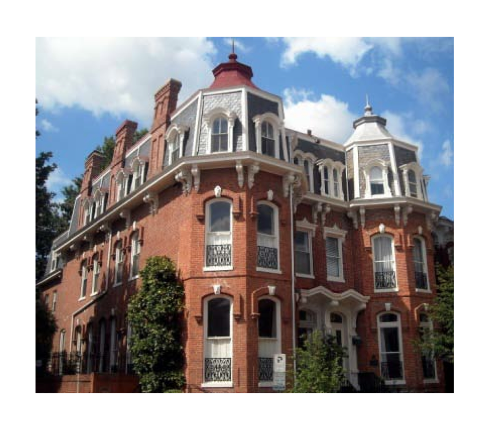
Second Empire
- In the United States, the Second Empire style usually combined a rectangular tower, or similar element, with a steep, but short, mansard roof; the roof being the most noteworthy link to the style’s French roots.
- This tower element could be of equal height as the highest floor, or could exceed the height of the rest of the structure by a story or two.
- The mansard roof crest was often topped with an iron trim, sometimes referred to as “cresting”.
- Floor plans for Second Empire residences could either be symmetrical, with the tower (or tower-like element) in the center, or asymmetrical, with the tower or tower-like element to one side.
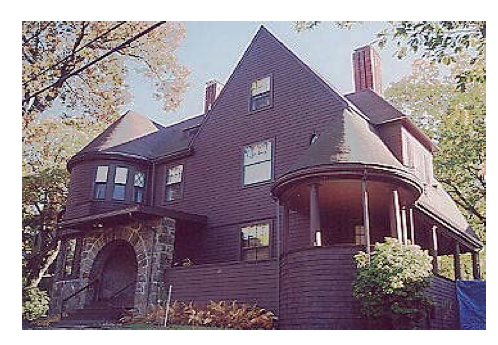
Shingle Style
McKim, Mead and White and Peabody and Stearns were two of the notable firms of the era that helped to popularize the Shingle style
- Aside from being a style of design, the style also conveyed a sense of the house as continuous volume. This effect—of the building as an envelope of space, rather than a great mass, was enhanced by the visual tautness of the flat shingled surfaces, the horizontal shape of many Shingle-style houses, and the emphasis on horizontal continuity, both in exterior details and in the flow of spaces within the houses
- This impression of the passage of time is enhanced by the use of shingles.
- Shingle-style houses often use a single, large roof, such as a gambrel or hip roof. The houses thus emanate a more pronounced mass and a greater emphasis on horizontality
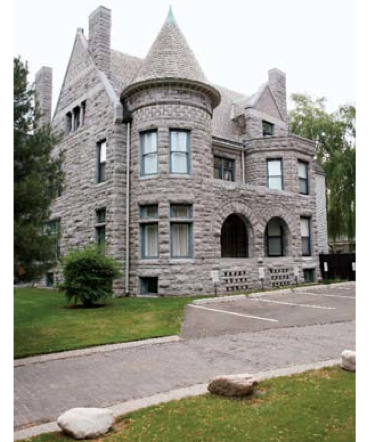
Richardsonian Romanesque
- It is a style of Romanesque Revival architecture named after architect Henry Hobson Richardson, whose masterpiece is Trinity Church, Boston (1872–77), designated a National Historic Landmark.
- It emphasizes clear, strong picturesque massing, round-headed “Romanesque” arches, often springing from clusters of short squat columns, recessed entrances, richly varied rustication, blank stretches of walling contrasting with bands of windows, and cylindrical towers with conical caps embedded in the walling.
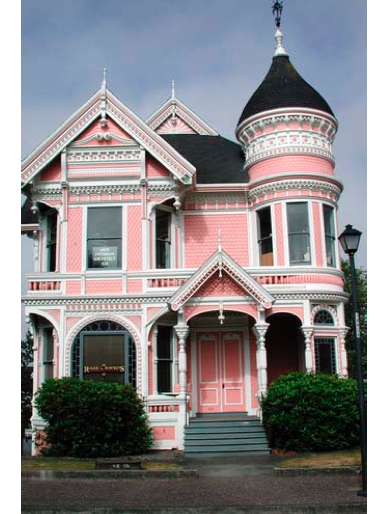
Queen Anne
Originating in England’s pre-Georgian period, the Queen Anne style usually includes Classical ornamentation added to a building with medieval forms. The American Queen Anne period began at the end of the 19th century, and is characterized by spool work, shaped shingles, foliated plasterwork, irregular, gabled, hipped and conical roofs, complex compositions emphasizing varied, surface textures, varied entrance designs frequently with porches, and a mixture of various ornamentation. They may include a turret or brick chimney, or fish scale shingles, combining various elements of earlier styles.
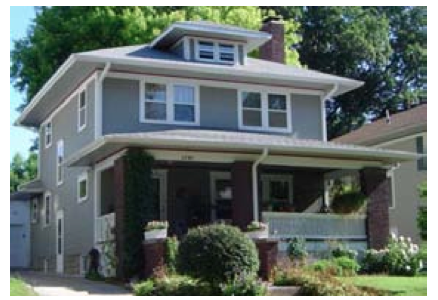
American Foursquare
-A reaction to the ornate and mass produced elements of the Victorian and other Revival styles popular throughout the last half of the 19th century, the American Foursquare was plain, often incorporating handcrafted “honest” woodwork (unless purchased from a mail-order catalogue). This style incorporates elements of the Prairie School and the Craftsman styles.
The hallmarks of the style include a basically square, boxy design, two-and-one-half stories high, usually with four large, boxy rooms to a floor, a center dormer, and a large front porch with wide stairs. The boxy shape provides a maximum amount of interior room space, to use a small city lot to best advantage. Other common features included a hipped roof, arched entries between common rooms, built-in cabinetry, and Craftsman-style woodwork
-
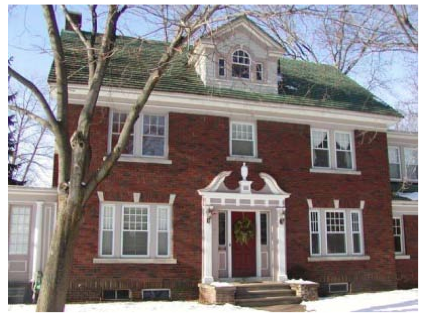
Colonial Revival
Sought to revive elements of Georgianarchitecture usually being two stories in height with the ridge pole running parallel to the street, a symmetrical front facade with an accented doorway and evenly spaced windows on either side of it
=Elaborate front doors, often with decorative crown pediments and overhead fanlights and sidelights, but with machine-made woodwork that had less depth and relief than earlier handmade versions. Window openings, while symmetrically located on either side of the front entrance, were usually hung in adjacent pairs or in triple combinations rather than as single windows. Side porches or sunrooms were common additions to these homes, introducing modern comforts.
-Also distinctive in this style are multiple columned porches and doors with fanlights and sidelights.
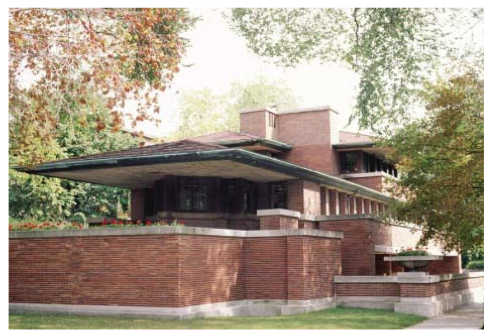
Praire School
The works of the Prairie School architects are usually marked by horizontal lines, flat or hipped roofs with broad overhanging eaves, windows grouped in horizontal bands, integration with the landscape, solid construction, craftsmanship, and discipline in the use of ornament. Horizontal lines were thought to evoke and relate to the native prairie landscape.
The Prairie School was also an attempt at developing an indigenous North American style of architecture that did not share design elements and aesthetic vocabularywith earlier styles of European classical architecture.
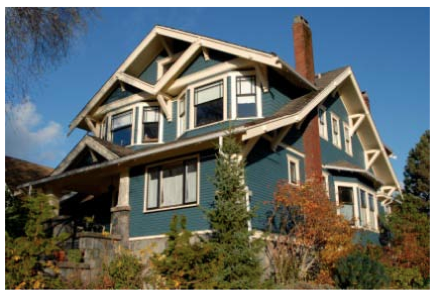
American Craftsman
- the movements emphasized the hand-made over the mass produced
- kitchen be integrated into the main house with easy sight lines to the common areas of the main floor as well as the backyard
- built in “breakfast nook”
- low pitched roof lines, gabled or hipped roof
- deeply overhaning eaces
- exposed rafters or decorative brackets under eaves
- front porch beneath extension of main roof
- tapered, square columns supporting roof
- 4-over-1 or 6-over 1 double hung windows
- FLW design motifs
- hand crafted stone wood work
- mixed material throughout structure
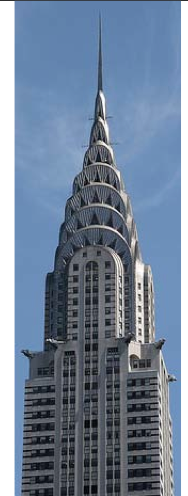
Art Deco
-art deco was purely decorative
Deco is distinctive in its use of geometric designs in low relief. It borrowed from other cultures, Egypt, Central America and Asia and even from the machine age, in its incarnation as Streamline Modern. This innovation softened the hard edges of 1920’s Deco with aerodynamic curves suggestive of airplanes and ocean liners in
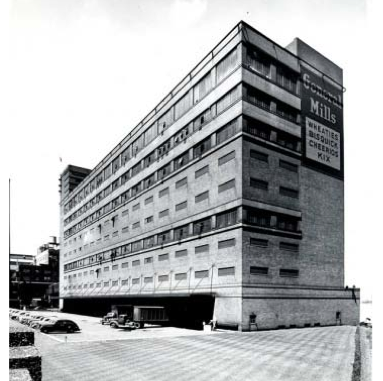
The term International Style came from the 1932 exhibition at the Museum of Modern Art, organized by Philip Johnson, and from the title of the exhibition catalog for that exhibit, written by Johnson and Henry Russell Hitchcock
-Three principles: the expression of volume rather than mass, the emphasis on balance rather than preconceived symmetry, and
the expulsion of applied ornament.
Indemnification clause:
attempts to hold harmless both the owner and architect for any damages, claims, or losses resulting from the performance of any work on the project whether by the contractor or others with whom the architect has no contractual relationship.
Warranty Deed:
a guarantee that the property title will be transferred to a buyer free of liens, claims, or other debt.
Deed:
it is a document signed by the seller (grantor) and delivered to the buyer (grantee), conveying the title of a property from one owner to another, when a property is sold. This document becomes legally recognized when it has been recorded in the office of the recorder in the city or county in which the property is located.
Functional Program:
it is information or data provided by the owner for the analysis and creation of a facilities program

-
Jenny's Notes67
-
Ballast - Environmental Analysis & Project Planning105
-
Vocabulary69
-
Things to Memorize14
-
Treatment of Historic Buildings4
-
Code86
-
Caronline's Notes70
-
Ballast - Building Programming51
-
AHPP - Chapter 9 - Design Project Delivery16
-
AHPP - Chapter 10 - Design Project Management14



