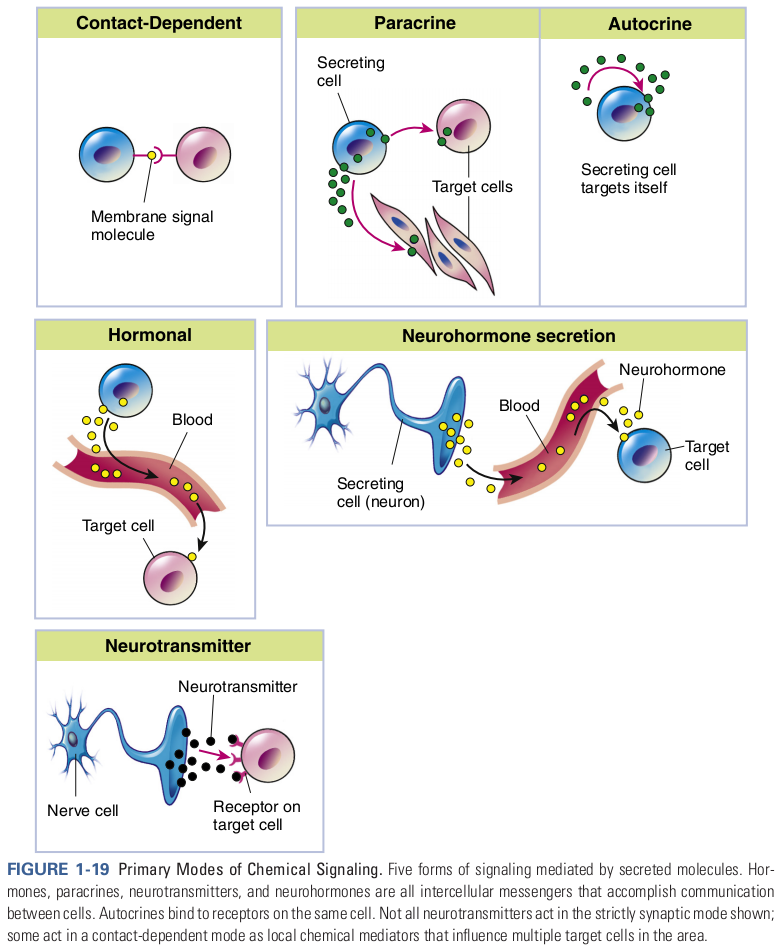
Mechanisms cells use to communicate:
Electrical and chemical signaling systems that control electrical potentials, the overall function of a cell, and gene activity needed for cell division and cell replication.
Cellular Function Communication
(from pp slide)
- Chemical messenger systems
- Move from cell to cell through channels
- Move into extracellular fluid
- Bind to receptors on or near cell surface (first messenger)
- External signals converted to internal signals carried by second messenger
- Second messenger triggers change
How does cell communication work?
Chemical messengers exert their effects by binding to cell membrane proteins or receptors → that convert the chemical signal → into signals within the cell, in a process called signal transduction.
How do cells regulate response to chemical messengers?
Cells can regulate their responses to chemical messengers by increasing or decreasing the number of active receptors on their surface.
Describe known cell surface receptor classes:
- Three classes of cell surface receptors known
- G-protein linked
- rely on G proteins
- function as on -off switch to convert external signals (first messengers) into internal messengers (second messengers)
- ion-channel liked
- mediated by neurotransmitters
- transiently open/close channels formed by integral proteins in cell membrane
- enzyme linked
- interact w/ certain peptides
Discuss G-protein linked signaling
- rely on G proteins - guanosine triphosphate (GTP)-binding regulatory protein
- Indirectly activate or inactivate plasma membrane enzyme or ion channel
- function as on -off switch to convert external signals (first messengers) into internal messengers (second messengers)
Discuss ion-channel linked messengers
- aka ligand-gated channels
- involve rapid synaptic signaling between electrically excitable cells.
- Channels open and close briefly in response to neurotransmitters, changing ion permeability of plasma membrane of postsynaptic cell
- mediated by neurotransmitters
Discuss catalytic (enzyme) linked messengers
- Interact w/ enzyme-linked peptides
- Once activated by ligands, function directly as enzymes.
- Composed of transmembrane proteins that function intracellularly as tyrosine-specific protein kinases.
Discuss what happens when G protein gets activated:
- When activated, a chain of reactions occurs that alters concentration of intracellular messengers, such as:
- cyclic adenosine monophosphate (cAMP) and calcium, or
- signaling molecules
- May also interact with inositol phospholipids, which are significant in cell signaling, and molecules involved in the inositol-phospholipid transduction pathway.
Discuss what happens with G-protein activation of the enzyme phosphoinositide-specific phospholipase
- G-protein linked receptor activates the enzyme phosphoinositide-specific phospholipase which generates 2 intracellular messengers:
- inositol triphophate (IP3) releases Ca++
- diacylglycerol remains in the plasma membrane and activates protein kinase C
- Protein kinase C further activates various cell proteins.
How do cells communicate?
- they display plasma membrane–bound signaling molecules (receptors) that affect the cell itself and other cells in direct physical contact.
- they affect receptor proteins inside the target cell and the signal molecule has to enter the cell to bind to them.
- they form protein channels (gap junctions) that directly coordinate the activities of adjacent cells
McCance, Kathryn L.; Huether, Sue E. (2015-06-08). Pathophysiology: The Biologic Basis for Disease in Adults and Children (Pathophysiology the Biologic Basis) (Page 20). Elsevier Health Sciences. Kindle Edition.
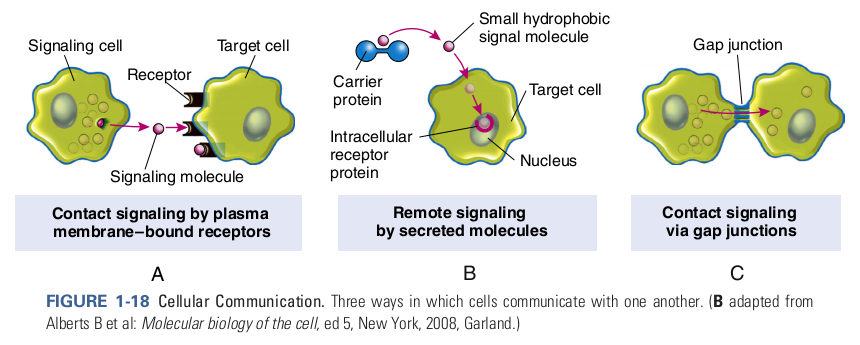
Contact-Dependent Signaling
Requires cells to be in close membrane-membrane contact.
Paracrine Signaling
- Cells secrete local chemical mediators that are quickly absorbed, destroyed, or immobilized. (Exerts more local action)
- Paracrine signaling usually involves different cell types;
What is autocrine signaling? When might we see it?
Cells also can produce signals that they, themselves, respond to called autocrine signaling (released inside own cell)
Example:
Cancer cells use this form of signaling to stimulate their survival and proliferation.
Autocrine circuits function as a component of normal growth-regulatory mechanisms in many adult tissue types.
What is hormonal signaling?
- Hormonal signaling involves specialized endocrine cells that secrete chemicals called hormones (e.g., thyroid-stimulating hormone);
- Hormones are released by one set of cells and travel through the tissue and through the bloodstream to produce a response in other sets of cells
What is neurohormonal signaling?
- In neurohormonal signaling, hormones (e.g., angiotensin II) are released into the blood by neurosecretory neurons.
- Like endocrine cells, neurosecretory neurons release blood-borne chemical messengers,
- Whereas ordinary neurons secrete short-range neurotransmitters into a small, discrete space (i.e., synapse).
What are neurotransmitters?
- Used for neurons to communicate directly with the cells they innervate.
- Neurons release chemicals or neurotransmitters at specialized junctions called chemical synapses;
- The neurotransmitter diffuses across the synaptic cleft and acts on the postsynaptic target cell
- Many of these same signaling molecules are receptors used in hormonal, neurohormonal, and paracrine signaling.
Chemical Signaling Pictograph
Chemical Signaling Pictograph