Why might some particles not diffuse across?
Describe the permeability of cell-surface membranes:
Partially permeable - some particles may not diffuse across because:
- they are not soluble in lipids and cannot pass through phospholipid layer.
- they are too large to pass through channels in membrane.
- they are of the same charge as charge on protein channels and so are repelled.
- electrically charged/polar and so find it difficult to pass through non-polar hydrophobic tails of bilayer.
How can substances move across the cell-surface membrane?
Diffusion, osmosis or active transport.
What model was proposed in 1972?
Why?
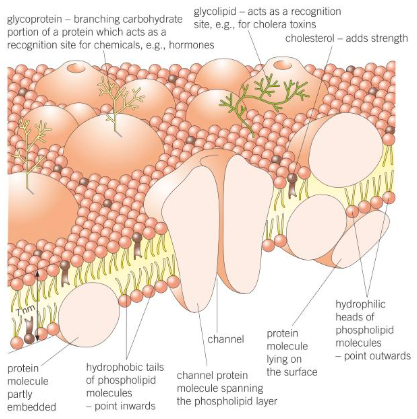
The fluid mosiac model was suggested to describe the arrangement of molecules in the membrane.
Why is the model for cell membranes known as the ‘fluid mosaic’ model?
Fluid - because individual phospholipid molecules can move relative to one another, giving the membrane a flexible structure that is constantly changing in shape.
Mosaic - because the proteins embedded in the phospholipid bilayer vary in shape, size and pattern in the same way as the tiles in mosiacs do.
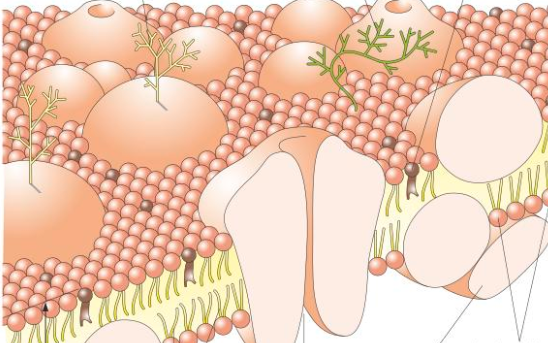
Label this diagram:
5 to list
Describe the function of membranes within a cell:
- Control exit and entry of materials in discrete organelles, like mitochondria and chloroplasts.
- Separate organelles from cytoplasm so that specific metabolic reactions can take place within them.
- Provide an internal transport system, like the ER.
- Isolate enzymes that might damage the cell, like lysosomes.
- Provide surfaces on which reactions can occur.
List the different components of cell membranes:
- Phospholipids
- Cholesterol
- Glycoproteins
- Glycolipids
- Channel protein (intrinsic proteins)
- Extrinsic proteins
What do phospholipids form?
A bilayer
Why are phospholipids important parts of the cell membrane?
- Hydrophilic heads of both phospholipid layers point to the outside of the cell surface membrane attacted by water on both sides.
- Hydrophobic tails of both phospholipid layers point into the centre of the cell membrane, repelled by the water on both sides.
What are the functions of phospholipids in the cell-surface membrane?
- Allow lipid soluble molecules to enter and leave the cell.
- Prevent water-soluble substances entering and leaving the cell.
- Make the membrane flexible and self-sealing
What is the role of extrinsic (surface) proteins in the phospholipid bilayer?
- Give mechanical support to the membrane
- In conjunction with glycolipids, act as cell receptors for molecules like hormones.
Channel proteins
Water-filled tubes to allow water-soluble ions to diffuse across the membrane.
Carrier proteins.
Proteins on the cell-surface membrane that bind to molecules or ions and change shape in order to move these molecules across the membrane.
Water-filled tubes to allow water-soluble ions to diffuse across the membrane.
Channel proteins
Proteins on the cell-surface membrane that bind to molecules or ions and change shape in order to move these molecules across the membrane.
Carrier proteins.
list 5
What are the functions of proteins in the cell membrane?
- Provide structural support
- Act as channels transporting water-soluble substances across the membrane.
- Allow active transport across the membrane through carrier-proteins.
- Form cell-surface receptors for identifying cells.
- Help cells adhere together.
What type of molecule is cholesterol?
It is a type of lipid.
It is present is all cell membranes (except bacterial cell membranes).
What do cholesterol molecules fit between?
Phospholipids.
Why do cholesterol molecules make the membrane less fluid and more rigid?
Molecules bind to the hydrophobic tails of the phospholipids, causing them to pack more closely togther.
It also resticts their movement.
What is the function of cholesterol?
- Reduce lateral movement of other molecules including phospholipids.
- Make the membrane less fluid at high temperatures.
- Prevent leakage of water and dissolved ions from the cell.
What are glycoproteins made of?
A carbohydrate covalently bonded with a protein.
Where does the carbohydrate portion of a glycolipid extend in to?
Extends from the phospholipid bilayer into the watery environment outside the cell where it acts as a cell-surface receptor for specific chemicals.
What are the functions of glyolipids in the membrane?
- Act as recognition sites
- Help maintain the stability of the membrane.
- Help cells to attach to one another and so form tissues.
Glycoproteins
Carbohydrate chains attached to proteins on the outer surface of the cell membrane, which act as cell-surface receptors.

-
BM: Carbohydrates67
-
BM: Lipids29
-
BM: Proteins37
-
BM: Enzyme Action25
-
BM: Factors Affecting Enzyme Action11
-
BM: Enzyme-Controlled Reactions1
-
BM: DNA & RNA32
-
BM: DNA Replication18
-
BM: Water17
-
BM: ATP10
-
BM: Inorganic Ions17
-
CELLS: Eukaryotic Cells95
-
CELLS: Diagrams to Label15
-
CELLS: Prokaryotic Cells18
-
CELLS: Viruses18
-
CELLS: Analysing Cell Components23
-
CELLS : Mitosis/Cancer33
-
CELLS: Investigating Mitosis3
-
CELLS: Cell Membrane Structure32
-
CELLS: Diffusion21
-
CELLS: Osmosis14
-
CELLS: Active Transport20
-
CELLS: The Immune System50
-
CELLS: Vaccines and Immunity33
-
CELLS: Antibodies in Medicine20
-
CELLS: Vaccine and Antibody Data2
-
CELLS: HIV and Viruses32
-
GI: DNA, Genes and Chromosomes30
-
GI: RNA and Protein Synthesis19
-
GI: Genetic Code and Nucleic Acids11
-
GI: Meiosis and Genetic Variation19
-
GI: Mutations4
-
GI: Genetic Diversity and Natural Selection14
-
GI: Investigating Selection2
-
GI: Classification of Organisms11
-
GI: DNA Technology, Classification and Diversity5
-
GI: Investigating Variation7
-
GI: Biodiversity10
-
E&T: Size and Surface Area7
-
E&T: Gas Exchange in Insects35
-
E&T: Gas Exchange in Humans12
-
E&T: Effects of Lung Disease22
-
E&T: Dissecting Gas Exchange Systems2
-
E&T: Digestion and Absorption29
-
E&T: Haemoglobin18
-
E&T: Circulatory System15
-
E&T: Heart39
-
E&T: Cardiovascular Disease19
-
E&T: Transport in Plants - Xylem and Phloem23
-
G&E: Chi-squared test6
-
Statistical tests4



