Palisade leaf cells are adapted for photosynthesis.
- They are packed with …. for photosynthesis, more crammed at the top so they’re nearer the light.
- They are …. which means they have a large surface area exposed down the side for absorbing CO2 from the air in the leaf.
- A … shape means that you can pack loads of them at the top of a leaf.
- They are packed with chloroplasts for photo photosynthesis.
- They are tall which means they have a large surface area exposed down the side for absorbing CO2 from the air in the leaf.
- A thin shape means that you can pack loads of them at the top of a leaf.
Where are palisade leaf cells found?
Grouped together at the top of the leaf where the most photosynthesis happens.
What are the 3 main functions of the egg cell?
To carry the female DNA.
To nourish the developing embryo in the early stages.
It also contains huge food reserves to feed the embryo.
Palisade leaf cells are adapted for…. .
Palisade leaf cells are adapted for photosynthesis.
Give an example of an organ system and describe it…
- The system and overall function
- Organs it’s made up of and functions (5)
How does this system interact with the envrinoment?
The digestive system for breaking down food to extract nutrients
- Glands (slaivary and the pancreas) produce digestive juices
- The stomach and small intestine digest food
- The liver which produces bile
- The small intestine absorbs soluble food molecules.
- The large intestine absorbs water from undigested food leaving faeces.
It exchanges materials by taking in nutrients and releasing substances such as bile.
1/5 in an animal cell - contains genetic material that controls the activities of the cell.
Nucleus
Name two single celled microorganisms.
Yeast and Bacterial Cells
What is a partially permeable membrane?
A membrane with small gaps in it, which holds its structure, but allows small molecules to diffuse through it.
How is the sperm cell adapted to make sure it gets its DNA to the female DNA?
(swimming, 2, energy, and fusion)
It has a long tail and a stream lined head, to help it swim to the egg.
There are a lot of mitochondria in the cell to make sure it gets the energy it needs.
They carry enzymes in their heads to digest through the cell membrane.
What is diffusion?
Diffusion is the spreading out of particles from an area of high concentration to an area of low concentration.
What is differentiation?
Differentiation is the process by which cells become specialised for a particular job.
What affects the rate of diffusion down the concentration gradient?
Temperature
Difference in concentrations
Surface area of the diffusion surface
Distance travelled
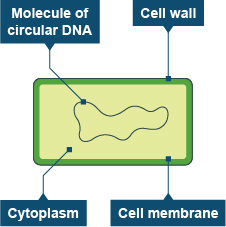
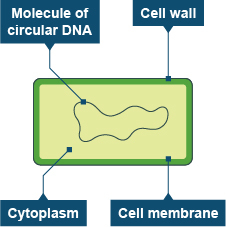
A bacterial cell has … and a cell … surrounded by a cell … . The genetic material floats in the … because bacterial cells don’t have a … . Draw the bacterial cell.
A bacterial cell has cytoplasm and a cell membrane surrounded by a cell wall. The genetic material floats in the cytoplasm because bacterial cells don’t have a nucleus.
How does the egg cell make sure the offspring get the right amount of DNA?
The membrane changes shape as soon as a sperm cell has fused with it. This stops any more sperm getting in.
2/3 in a plant cell - these are where photosynthesis occurs, which makes food for the plant. They contain a green substance called chlorophyll.
Chloroplasts
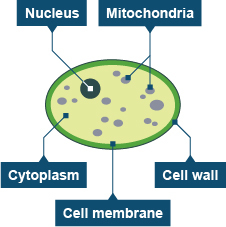
A yeast cell has a … (containing genetic material), …, and a cell …, surrounded by a cell … . Draw the yeast cell.
A yeast cell has a nucleus (containing genetic material), cytoplasm, and a cell membrane, surrounded by a cell wall.
What states does diffusion happen in?
Diffusion happens in both solutions and gases, because in these substances particles can move around more freely.
The bigger the difference in … the faster the diffusion rate. When different gases diffuse through eachother, like when perfume is sprayed in a room.
The bigger the difference in concentration, the faster the diffusion rate.
3/5 in an animal cell - holds the cell together and controls what goes in and out.
Cell membrane
What is haemoglobin?
What is missing in the cell to make room for more of this?
It is a pigment carried by red blood cells because it absorbs oxygen.
There is no nucleus to make more room for the haemoglobin.
So what are the guard cells adapted to do? (2 marks)
G
W
They are adapted to their function in…
- allowing gas exchange
and
- controlling water loss
within a leaf.
What are the advantages of the red blood cells’ concave shape? (2)
- Gives them a big surface area for absorbing oxygen
- Helps them pass smoothly through capilleries to reach body cells.
1/3 in a plant cell - made of cellulose, it supports the cell and strengthens it.
Rigid cell wall
What happens to the specialised cells in systems etc?
1.
2.
3.
What is 3 used for in large multicellular organisms?
The specialised cells form tissues.
A few of these form oragns.
A few of these form organ systems.
In large multicelluar organisms, there are different organ systems to exchange and transport materials.

-
Cells (specialisation and diffusion)43
-
Plants and photosynthesis25
-
Distribution of Organisms15
-
Enzymes , Enzymes and Digestion36
-
Enzymes in respiration, other uses32
-
DNA and DNA in cells29
-
Stem cells and X and Y chromosomes18
-
Genetic disorders and diagrams37
-
Fossils, speciation and extinction27



