why do we breakdown our food stepwise and not just combust it?
we’re interested in energy storage- when we break it down stepwise, we produce ATP, which we can use to store energy
what are the 2 ways to make ATP?
- 2 ways to make ATP:
- Chemiosmotic synthesis- happens more at end of process
- Substrate level phosphorylation- this is just the enzyme step that makes ATP
what is chemiosmotic synthesis?
an enzymatic reaction process to make ATP where the energy comes from a proton concentration gradient. this is the pumped hydro of energy production, utilizes a rotor to place p’s on ADP’s
how is ATP synthase related to chemiosmosis?
ATP synthase is the enzyme that makes ATP by chemiosmosis. It allows protons to pass through the membrane and uses the free energy difference to phosphorylate adenosine diphosphate (ADP), making ATP.
how do you get chemiosmotic synthesis going?
- in mitochondria, have a bunch of protons in intermembrane space. Low concentration gradient inside makes protons flow in.
substrate level phosphorylation
Enzyme destabilizes bond with inorganic phosphate and substrate to remove the substrate and add the extra phosphate to ADP to create ATP. the delta G of removing P from PEP is so negative, that it drives the positive delta G of adding P to ADP.
what is the big picture behind cellular respiration? why do we do it?
- Take sugars with O2 and oxidize it in a bunch of small steps to get carbon dioxide and water
- Do it in small steps to harvest the energy and use it for other purposes
- GOAL: convert all the energy from small steps into creating ATP which can be used everywhere in the body
high level- what is glycolysis, why is it crucial to evolution? where in cell does it occur?
A series of steps to break down the large macromolecules into their subunits. Present in all living things (evidence of one common ancestor.) Can occur without oxygen so we think it evolved before our atmosphere had free oxygen.
- Happens in the cytoplasm of cells
in glycolsis, what do you start with and what do you end with?
INS: Glucose, NAD+, 2 ADP
OUTS: 2 Pyruvate, 2 Net ATP, 2 NADH
draw out glycolysis process starting from glucose and including correct end processes
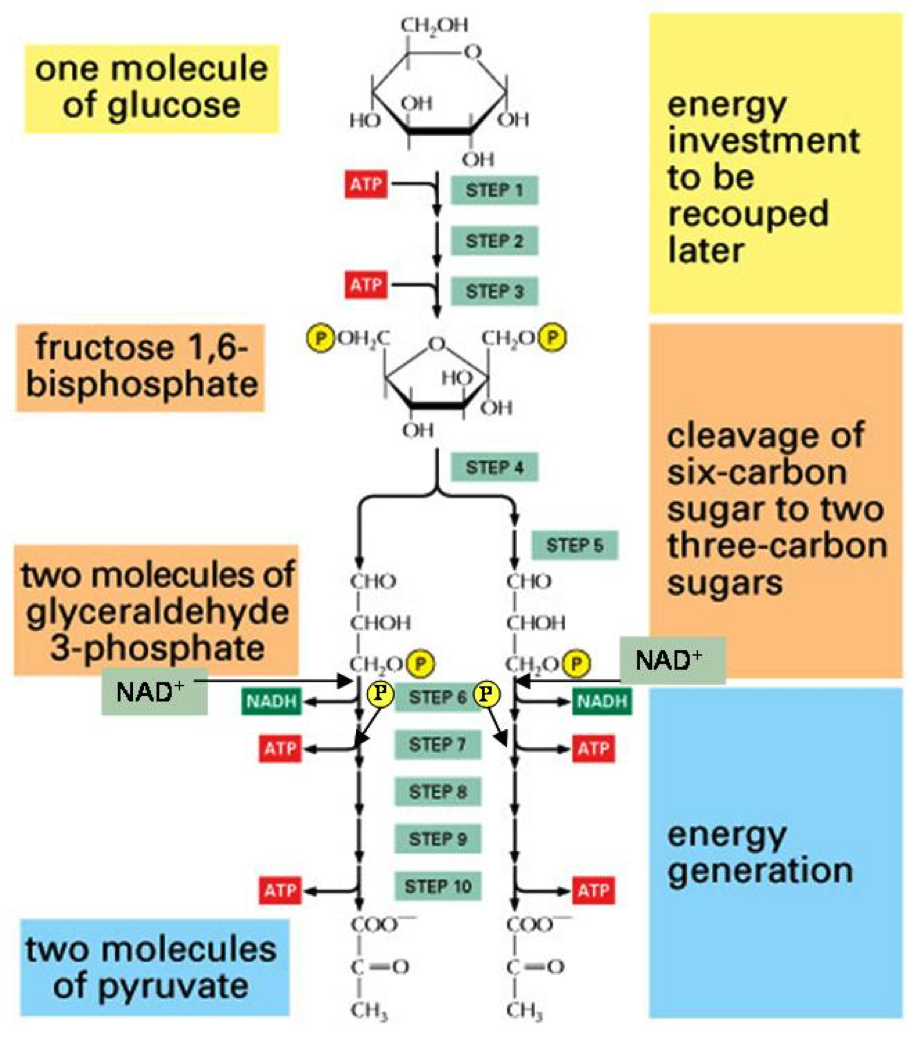
describe how the cell can regulate cell resp? and is this competitive or non competitive?
- If there is a lot of ATP around, it can inhibit (turn down) the phosphofructokinase enzyme
- If there is a lot of ADP and Citrate, it can turn up the phosphorfructokinase enzyme
- This is non-competitive inhibition (allosteric)—the inhibitor changes the form of the enzyme
where does chemiosmotic synthesis occur?
in the mitochondria
why would humans use a process of fermentation?
When you exert yourself you do not supply oxygen fast enough to break down pyruvate : begin to pile them all up . You also use up all the NAD+ you make too
what does fermentation allow us to do?
Fermentation allows us to use organic molecule to accept electrons from NADH so we can regenerate NAD+ so glycolysis can continue to run
what are the phases of cellular respiration and the options?
- glycolysis (doesn’t require O2).
- with O2: pyruvate oxidation , krebs cycle, ETC, chemiosmosis
- without O2: fermentation, -> glycolysis
theoretical total and % yield of ATP for all of cellular respiration?
36 ATP
- 38% efficiency in converting heat to energy
what is our energy % yield through glycolysis
2%
Q: If after glycolysis, oxygen is present, additional breakdown continues in the ____
mitochondrion
The entire goal for a yeast cell is to recycle ___ into ____to continue glycolysis
NADH into NAD+
inputs and outputs pyruvate oxidation
ins: 2 pyruvate, 2 NAD+
outs: 2 acetyl coA, 2 CO2, 2 NADH
describe pyruvate oxidation and where it occurs
- Once it enters mitochondrial matrix, Oxidation of pyruvate by pyruvate dehydrogenase (removes electrons which is an oxidation step)
- Pyruvate dehydrogenase is a multi-subunit enzyme complex
in the presence of oxygen, pyruvate is converted to:
acetyl CoA
a large, multi-subunit enzyme complex that links glycolysis and the citric acid cycle under aerobic conditions:
pyruvate dehydrogenase
acetyl CoA is:
- the fuel for the citric acid cycle



-
Ch 3- carbs + lipids, DNA60
-
Nucleic Acids / DNA ch 314
-
Proteins, structure and function48
-
cell structure20
-
cytoskeleton40
-
cell membrane65
-
cell junctions17
-
energy and enzymes26
-
cellular respiration51
-
photosynthesis49
-
mitosis/meiosis68
-
genetics + mendel53
-
chromosomal aberrations22
-
Genetics95
-
human genetic traits22
-
transcription43
-
gene regulation21
-
Mutations and recombinant DNA57
-
kingdoms, viruses, pathogens29
-
bacteria kingdom17
-
Fungi & Protists kingdom29
-
cancer36
-
evolution19
-
origins of life17
-
epigenetics9
-
test 3 prep56
-
plants12



