Define senescence.
The process of cellular ageing, a senescent cell being one that undergoes irreversible growth arrest.
Senescence is a stable form of cell cycle arrest that limits the proliferative potential of cells
What is the importance of senescence?
Cellular senescence is an important process which is thought to stop the division of damaged cells that could progress into the development of tumours. In addition to suppressing tumorigenesis, cellular senescence is thought to promote tissue repair, and fuel inflammation associated with ageing and cancer. Therefore senescence may play a part in four major processes:
- Tumour suppression
- Tumour promotion
- Ageing
- Tissue repair
What is the theory of antagonistic pleiotropy?
The evolutionary theory of antagonistic pleiotropy stipulates that a biological process can be both beneficial and deleterious, depending on the age of the organism. The rationale for this rests on the fact that most organisms evolve in environments that are rich with fatal extrinsic hazards (predation, infection, starvation, etc.). Under these conditions, aged individuals are rare, and so selection against processes that promote late-life disability or disease is weak. That is, age-associated phenotypes, including age-related diseases, have escaped the force of natural selection. Thus, a biological process that was selected to promote fitness in young organisms (e.g., suppressing cancer) can be detrimental in aged organisms (promoting late-life disease, including cancer).
What are features of the senescence phenotype?
The senescent phenotype is extremely stable and resistant to apoptosis:
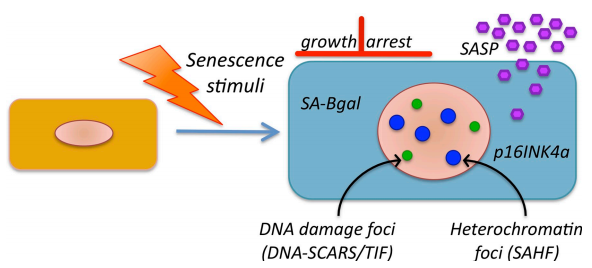
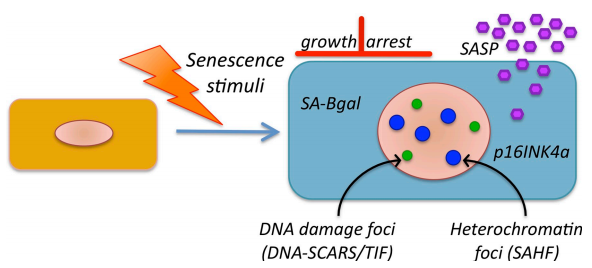
- Most senescent cells express p16INK4a , which is not present in quiescent or terminally differentiated cells. In some cells, p16INK4a activates pRb which causes senescence-associated heterochromatin foci (SAHF) formation, which silences pro-proliferative genes. Senescence is permanent, and cannot be reversed by any known stimuli. However, some senescent cells that do not express p16INK4a after inactivation of p53 can resume growth.
- Senescent cells increase in size, sometimes more than doubling in size.
- Senescent cells express senescence-associated β-galactosidase (SA-Bgal).
- Senescent cells that have retained damage contain DNA foci with persistent DDR signalling called DNA-SCARS. Several DDR proteins are activated (including phospho-ATM). Senescent cells with persistent DDR signalling secrete growth factors, proteases, cytokines, among others. This makes up the senescence-associated secretory phenotype (SASP).
- Senescent cells have an altered transcriptome: some factors are repressed, and others are upregulated. Proteins involved in proliferation and transcription are switched off. Senescent cells overexpress collagenase, and some inflammatory genes.
Why can senescent cells not progress through the cell cycle?
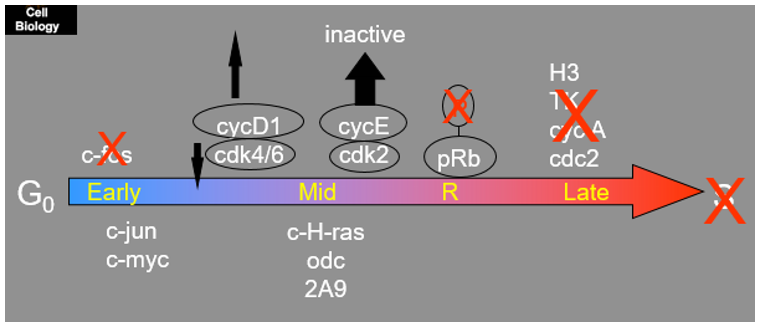
Senescent cells are blocked in G1: post mitotic. This may be because cells are unable to phosphorylate the retinoblastoma protein (pRb), which is essential in the expression of late-stage genes. Growth factors can stimulate entry into S phase.
The transition from low serum induced sleep state (quiescence) to re-stimulation of division (entering S-phase) spikes production of a number of transcriptional activator genes. These can be expressed at different times: early, mid, restriction point (R), and late. In a normal proliferating cell, certain factors are present during the transition from G0 to S phase, whereas in senescent cells there are differences (crosses and arrows mark this in image). Phosphorylation of pRb does not happen, so any genes down the road from that cannot be expressed.
There is no early response of c-fos expression in senescent cells, but c-jun and c-myc are still expressed. Lots of cycD1 is expressed, but cdk4/6 is under expressed. CycE/cdk2 are over expressed, but they do not work. As they are responsible for the phosphorylation of pRb, there is no phosphorylation of pRb in senescent cells. This means they cannot pass the restriction point into S phase and stimulate cell division.
Senescent cells are blocked at R (restriction point) because pRb is not phosphorylated.
What are the mechanisms that cause arrested cell growth during senescence?
There is dominant activity in senescent cells that stops cell division and causes growth arrest. In many cases the senescent phenotype is dominant over the immortal phenotype (shown by creating cell fusions/heterodikaryons).
mRNA from young cells inhibits replication by 3.3%, mRNA from senescent cells inhibits replication by 76%. A polyA mRNA in senescent cells therefore inhibits replication. This mRNA is converted into a more robust cDNA library. The cDNA library from the mRNAs is screened for inhibitors of DNA replication:
- Sdi-1 (senescence-derived inhibitor 1): inhibits proliferation. This mRNA is known under different names (p21/Waf1/Cip1).
- p21: interacts with replication machinery.
- Waf1: p53 interacting factor
- Cip1: cyclin inhibitor protein 1
Sdi-1/p21 levels increase in response to cell damage, and it inhibits cellular replication in order to give the cells time to repair damage. In senescent cells p21 is overexpressed because senescent cells contain DNA damage (critically shortened telomeres).
Hitchhiker’s guide to cellular senescence
What is the signature of DNA damage in senescent cells?
The presence of permanent cell cycle arrest, acquisition of major morphological change, expression of SA-b-GAL, accumulation of SAHFs and SDFs, acquisition of SASPs, mitochondrial dysfunction and increased ROS production and autophagy in a senescent cell are collectively known as the ‘cellular senescence signature’.
- Senescent cells undergo major morphological changes that are visualised readily under the light microscope. Senescent cells become enlarged and flattened with enlarged nuclei. Senescent cells also display one large nucleolus and punctate DNA foci (visualised by DAPI staining) instead of several small nucleoli and a more uniform DAPI staining of nucleus.
- Senescent cells, but not pre-senescent or terminally differentiated cells, express senescence-associated bgalactosidase (SA-b-GAL) detectable at pH 6. SA-bGAL is characteristic of senescent cells and differs from both lysosomal b-Gal (expressed in most cells and is optimally active at pH 4) and bacterial b-Gal reporter enzyme (optimal activity at pH 7.5). SA-b-GAL is detected in single cells by histochemical staining using the artificial substrate X-gal, which forms a local blue precipitate upon Cellular senescence. The underlying mechanism responsible for increased SA-b-GAL activity in cellular senescence is unknown and so far, it has not been connected to any signalling pathways involved in senescence.
- Nuclear accumulation of both senescence-associated heterochromatic foci (SAHF) and senescence associated DNA-damage foci (SDF) are distinctive features of cellular senescence.
- SAHFs are heterochromatic structures, which encompass transcriptionally inactive regions of the genome that are packaged into highly dense chromatin fibres. SAHFs are detected by the preferential binding of DNA dye or the presence of proteins such as heterochromatin protein-1 (HP1) that bind to heterochromatin-associated histone modifications, including H3 lysine 9 methylation and High-Mobility Group A (HMGA) proteins that bind to the minor groove of ATrich DNA sequences, both of which are found in abundance in SAHFs. These proteins are essential for the formation of SAHFs, induce senescence when over-expressed and are required for stable suppression of proliferation-associated genes such as E2F.
- On the other hand, SDFs contain proteins associated with the DDR such as γ-H2AX and p53BP1.
- Senescent cells secrete a wide variety of factors, a phenotype known as the senescence-associated secretory phenotype (SASP). These secreted factors are involved in the induction and maintenance of senescence, alteration of the microenvironment, chemo-attraction of immune cells and tumourigenesis.
- Mitochondrial dysfunction and increased ROS production.
Name an ageing-related disease.
- Werner syndrome
- Hutchinson Guilford progeria syndrome (HGPS)
How can the accumulation of senescent cells be detected?
Assay to detect senescent cells: senescent-associated β-galactosidase activity (SA-βGal). The assay detects the activiy of β-galactosidase, and if X-gal substrate is supplied it is processed and can be detected (blue stain).
In aged skin there is an accumulation of senescent cells, and in younger cells there are no/very few senescent cells. This shows that senescent cells accumulate with age.
How does the senescent transcriptome differ from non-aged cells?
Overexpressed
- MMP1 (collagenase)
- MMP3, MMP10
- TIMP-2
- Fibronectin
- ICAM-1
- IGF-BP2, 3 & 5
- PAI 2
- Gas 1
- IL1 (alpha & beta), IL15
Repressed
- c-Fos
- Cyclins A & D
- IGF1
- TGFbeta
- IL6
- Transcription factors: EPC1, MPA, Mitf
What happens when p16INK4A is removed from senescent cells?
p16Ink4a is a CDK inhibitor and tumour suppressor that enforces growth arrest through activation of pRb. A study marked senescent cells (p16Ink4a) and induced their elimination through INK-ATTAC. A universal marker for senescent cells has not been identified as of yet, but most cells express p16Ink4a. Expression also increases with age in rats and humans.
Life-long removal of p16Ink4a positive cells in tissues particularly affected by age-related pathologies (adipose tissue, skeletal muscle, and eye) delayed the onset of pathological phenotypes (in mice).
These results suggest that cellular senescence is implicated in age-related phenotypes, and their removal delays tissue dysfunction.
The results of this experiment could potentially open up a new way to therapeutically treat ageing-related pathologies.
What is the consequence of upregulated MMP1 in senescent cells?
Matrix metalloproteinases (MMPs) are enzymes that degrade structural proteins. MMP1 degrades collagen. Normally, these are only switched on in repair of wounds, for example to heal cuts. In the absence of wounding, senescent cells overexpress collagenases, which degrades the collagen around them. Skin: sagging, wrinkling.
How do senescent cells differ from quiescent cells?
Senescent cells are distinct from quiescent cells; quiescent, but not senescent cells, resume proliferation in response to appropriate signals. In contrast, senescent cells are unresponsive to mitogenic stimuli, but remain metabolically active.
What causes the activation of senescence?
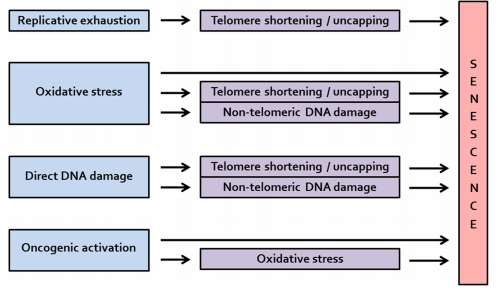
Senescence is activated in response to various forms of cellular stresses which can be categorised broadly into telomere-dependent and telomere-independent senescence, or replicative and stress-induced senescence, depending on the aetiology.
Senescence is activated once a cell has suffered a critical level of damage, regardless of the nature of the trigger. A cell may be subjected to multiple stresses, which can exert a cumulative effect on the cell. For example, extrinsic factors such as oxidative stress impact on intrinsic factors such as accumulation of DNA damage and the rate at which telomeres shorten.
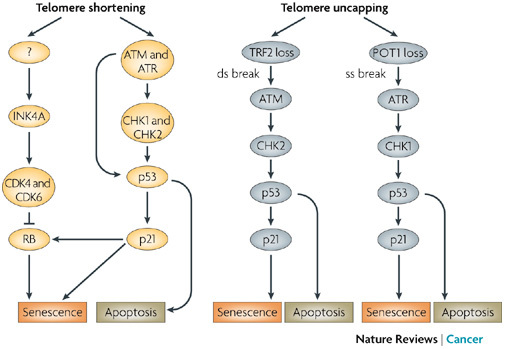
- Replicative senescence occurs due to gradual telomere attrition and telomere uncapping.
- DNA damaging agents induce senescence through telomeric and non-telomeric DNA damage, while oxidative stress causes damage to both proteins and DNA (telomeric and non-telomeric).
- Overexpression of oncogenes and inactivation of tumour suppressor genes induce senescence directly and through oxidative stress by increasing intracellular reactive oxygen species.
How are telomeres involved in senescence?
Each cell division leads to gradual shortening of telomeres in somatic cells, partly due to a lack of telomerase, at a rate of 30–200 bp per cell division. In addition, the telomere overhang is eroded during replicative senescence, independent of telomere shortening, potentially disrupting the protective T-loop. A critically short telomere leads to disruption of the protective cap, thus exposing its end (known as telomere uncapping). An uncapped telomere leads to irreversible cell cycle arrest and cellular senescence. Intrinsic telomere length is heterogeneous among various chromosomes and it has been argued that critical shortening of even one telomere in a cell would induce cellular senescence in that cell.
What different pathways can senescence be activated through?
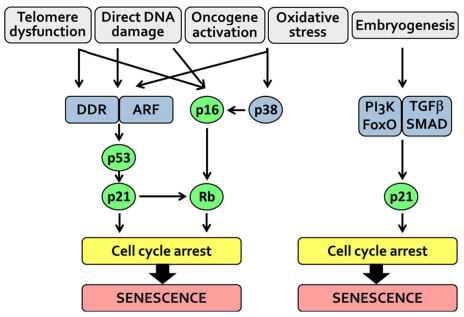
The senescence programme is activated once a cell has suffered a critical level of damage of any kind. Senescence is established and maintained by the p53 and p16- Rb tumour suppressor pathways. Both p53 and Rb pathways are activated in parallel and are able to induce cell cycle arrest independently; however, both interact at various levels and cross-regulate each other, making them a highly complex stress-signal integration and processing unit. Both, p53 and Rb are transcriptional regulators with upstream regulators and downstream effectors.
Outline the Rb pathway in senescence.
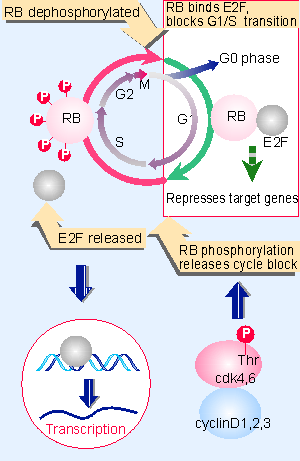
Phosphorylation of Rb by Cdk/cyclin A, D & E inactivates the growth inhibitory function of Rb. Rb is activated either by p21 or by p16; both exert their effect by inhibiting Cdk/cyclin.
Rb, in its active hypo-phosphorylated form, binds to E2F proteins and represses their transcriptional activity and thereby inhibits cell cycle progression.
Outline the p53 pathway in senescence.
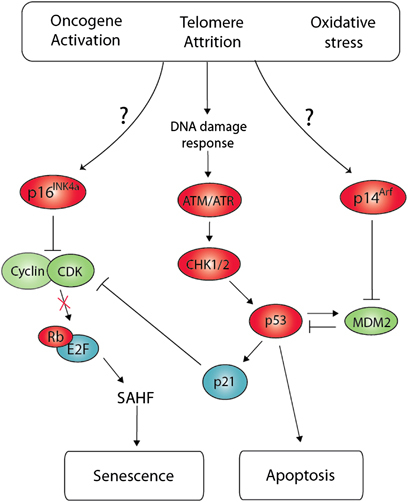
In senescence, p53 is regulated by two major pathways, namely the DDR pathway and the ARF pathway.
- The DDR pathway is mediated by ATM/ATR and Chk1/Chk2 proteins, which stabilise p53 through phosphorylation.
- The ARF activates p53 by inhibiting Mdm-2, which facilitates p53 degradation.
The p53 protein, once stabilised, activates p21, an important transcriptional target of p53. Induction of p21, a universal cell cycle inhibitor, results in Cdk/cyclin inhibition and cell cycle arrest at the G1/S phase transition. In addition, p21 activates Rb through inactivating Cdk/cyclin complexes that phosphorylate and inactivate Rb and thus mediates the activation of Rb by p53.
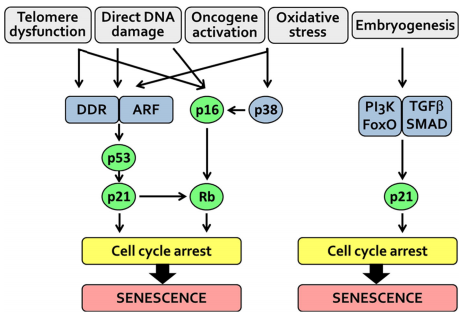
List some of the triggers of senescence.
- Uncapped telomeres are recognised as damaged DNA and trigger the DDR through activating ATM/ATR and Chk1/ Chk2 pathways to stabilise p53.
- Direct DNA damage stabilises p53 through both DDR and ARF pathways to induce senescence. DNA damage also activates Rb through p16.
- Oxidative stress induces senescence through both p53 and p16-Rb pathways. Oxidative stress causes DNA damage, activates the DDR, and thereby induces and stabilises p53 leading to senescence.
- Senescence from oncogene activation represents cellular tumour-suppressive mechanism. In vivo studies demonstrate increased levels of p16 in oncogene-induced senescence. p38 has been shown to play a significant role in oncogene-related activation of the p16-Rb pathway, leading to senescence. Induction of p53 and p21 has also been demonstrated in oncogene-induced senescence in human fibroblasts. Oncogene overexpression increases intracellular ROS, likely to be derived from mitochondria, which plays a crucial role in inducing senescence.
- Signalling pathways involved in cellular senescence in embryogenesis are significantly different to replicative and stress-induced senescence. Cellular senescence in embryogenesis does not involve DDR, p53, p16 or p19 but p21 and p15. Unlike in other situations, the p21 induction in embryogenesis is regulated by the TGFb/SMAD and PI3K/FoxO pathways.
What is a hallmark of senescence induced by persistent DDR?
During the DDR, γ-H2AX spreads hundreds of kilobases away from the DNA-damage site and recruits checkpoint signalling complexes and DDR factors leading to formation of DNA-damage foci. If DNA damage is repaired, then the DNA-damage foci are disassembled as cells resume normal function. However, if DNA damage persists, then the DNA-damage foci enlarge as the cells become senescent (known as senescence-associated DNA-damage foci)
How is cell cycle arrest mediated in senescence?
Cell cycle regulation is mediated by Cdk, which are activated by cyclins. These Cdk/cyclin complexes control specific transitions between the subsequent phases of cell cycle. The Cdk activity is counteracted by two distinct families of cell cycle inhibitory proteins, the INK4 family and the Cip/Kip family.
- The INK4 family, which includes p15INK4b, p16INK4a, p18INK4c and p19INK4d, inhibits Cdks involved in G1 exclusively (Cdk4 and Cdk6).
- The Cip/Kip family, which includes p21CIP1/WAF1, p27KIP1, p57KIP2, inhibits the activity of all Cdks (universal Cdk inhibitors).
In addition, p21 also inhibits DNA synthesis by inhibiting proliferating cell nuclear antigen (PCNA). G1/S transition is a decisive point in the cell cycle, beyond which cells are committed to completing DNA replication. G1/S transition is the classical site of cell cycle arrest in cellular senescence. Thus, senescent cells typically display a DNA content characteristic of the G1 phase of cell cycle.
Outline the SASP.
Senescent cells have long been known to influence their microenvironment through secreting a variety of factors into the immediate vicinity. The senescence-associated phenotype (SASP) is only induced by triggers which initiate the DDR such as DNA-damaging agents, telomere dysfunction, oxidative or oncogenic stress; triggers that do not involve the DDR such as overexpression of cell cycle inhibitors, despite inducing senescence, do not induce the SASP.
The p38 mitogen-activated protein kinase (p38MAPK) pathway is known to regulate SASP, independent of the DDR. Both the DDR and p38MAPK pathways induce the SASP through activation of nuclear factor kappa beta (NF-κB). More recently, mTOR has also been implicated in regulation of the SASP.
SASP factors play a significant role in maintaining senescence in a self-regulatory autocrine manner and induce senescence in neighbouring cells in a paracrine fashion. The paracrine effect has been shown to arise from induction of the DDR in neighbouring cells.
How is senescence linked to ageing?
Senescent cells are resistant to apoptosis and thus accumulate with age. Accumulation of senescent cells, which are insensitive to mitotic stimuli, at the expense of normal cells with proliferative potential, may impair the reserve for tissue regeneration. Senescence of stem cells and progenitor cells with age further reduces the regenerative capacity of tissue.
Accumulation of senescent cells contributes to ageing through exhausting the regenerative capacity, altered cellular and metabolic function and alteration of the tissue microenvironment. The presence of senescent cells at sites of age-related pathology corroborates the deleterious effect of cellular senescence in ageing.




