NECK PAIN - PATHOANATOMIC FEATURES
May be associated with degenerative processes or pathology ID’d with imaging; tissue causing a patient’s neck pain is most often unknown.
Clinicians should assess for impaired function of muscle, connective, and nerve tissues associated with the identified pathological tissues when a patient presents with neck pain.
(Recommendation based on theoretical/foundational evidence.)
NECK PAIN - RISK FACTORS
Predisposing factors for the development of chronic neck pain.
- Age > 40
- coexisting low back pain
- long hx of neck pain
- cycling as regular activity
- loss of strength in the hands
- worrisome attitude,
- poor quality of life
- less vitality
(Recommendation based on moderate evidence.)
DIAGNOSIS / CLASSIFICATION
Neck pain, without symptoms or signs of serious medical or psychological conditions, associated with
- motion limitations in cx and upper tx regions
- headaches
- referred or radiating pain into an upper extremity
are useful clinical findings for classifying into:
- neck pain with mobility deficits
- neck pain with headaches
- neck with movement coordination impairments
- neck pain with radiating pain
NECK PAIN WITH MOBILITY DEFICITS
- Cervical AROM
- Cervical and thoracic segmental mobility
NECK PAIN WITH HEADACHES
- Cervical AROM
- Cervical segmental mobility
- Cranial cervical flexion test (CCF)
MOVEMENT COORDINATION IMPAIRMENTS
- Cranial cervical flexion test
- Deep neck flexor endurance test
NECK PAIN WITH RADIATING PAIN
- Upper limb tension test
- Spurling’s test
- Distraction test
NECK PAIN - DIFFERENTIAL DIAGNOSIS
Consider DDX of serious pathological conditions or psychosocial factors when:
- patient’s reported activity limitations or impairments of body function and structure are NOT consistent with Dx choices presented in CPG
- when the patient’s symptoms are not resolving with interventions aimed at normalization of the patient’s impairments of body function.
(Recommendation based on moderate evidence.)
NECK EXAMINATION - MEASURES
Validated self-report questionnaires (NDI. Patient-Specific Functional Scale) to identify:
- baseline status relative to pain, function, and disability
AND
- monitoring a change in a patient’s status throughout the course of treatment.
(Recommendation based on strong evidence.)
NECK EXAMINATION - OUTCOME MEASURES
Use easily reproducible activity limitation and participation restriction measures associated with their patient’s neck pain to assess the changes in the patient’s level of function over the episode of care.
(Recommendation based on expert opinion.)
NECK INTERVENTIONS - CERVICAL MOBILIZATION / MANIPULATION
Overall Recommendation - A
Use cervical manipulation and mobilization procedures, to reduce neck pain and headache.
Combining mob/manip with with exercise is more effective for reducing neck pain, headache, and disability than manipulation and mobilization alone.
(Recommendation based on strong evidence.)
NECK INTERVENTIONS - THORACIC MOBILIZATION / MANIPULATION
Thoracic spine thrust manipulation can be used for patients with
- primary complaints of neck pain.
- AND reducing pain and disability in patients with neck and neck-related arm pain.
(Recommendation based on weak evidence.)
NECK INTERVENTIONS - STRETCHING
Flexibility exercises can be used for patients with neck symptoms.
Examination & targeted flexibility exerciess for:
- anterior/medial/posterior scalenes
- upper trapezius,
- levator scapulae
- pectoralis minor/pectoralis major.
(Recommendation based on weak evidence.)
NECK INTERVENTIONS - COORDINATION, STRENGTHENING & ENDURANCE EXERCISES
Coordination, strengthening, and endurance exercises to reduce neck pain and headache.
(Recommendation based on strong evidence.)
NECK INTERVENTIONS - CENTRALIZATION
Specific repeated movements or procedures to promote centralization are NOT MORE beneficial in reducing disability when compared to other forms of interventions.
(Recommendation based on weak evidence.)
NECK INTERVENTIONS - UPPER QUARTER AND NERVE MOBILIZATION
Use upper quarter and nerve mobilization procedures to reduce pain and disability in patients with neck and arm pain.
(Recommendation based on moderate evidence.)
NECK INTERVENTIONS - TRACTION
Use mechanical intermittent cervical traction, combined with other interventions such as manual therapy and strengthening exercises, for reducing pain and disability in patients with neck and neck-related arm pain.
(Recommendation based on moderate evidence.)
NECK INTERVENTIONS - PATIENT EDUCATION AND COUNSELING
To improve recovery in patients with WAD:
(1) educate the patient that early return to normal, non-provocative pre-accident activities is important,
(2) provide reassurance to the patient that good prognosis and full recovery commonly occurs.
(Recommendation based on strong evidence.)
NECK INTERVENTIONS - THORACIC MOBILIZATION/MANIPULATION
Overall recommendation - C
Tx manip for 1o complaints of neck pain
Tx manip for reducing pain & disability for neck-related arm pain
(Level II evidence)
Cleland TSM CPR:
sxs < 30 days; sxs NOT distal to shldr; FABQ-PA< 12; looking up = NW; cx EXT < 30o; decr T3-T5 kyphosis
(Level I evidence)
3xRCTs (Cleland = TSM vs. sham; Saivolanen = TSM vs. exercise; Cleland = TSM vs. thoracic mobilization)
RCT (Fernández de las Peñas) demonstrated WAD neck pain WAD w/ thoracic manip significant reduction in pain. (Level I evidence)
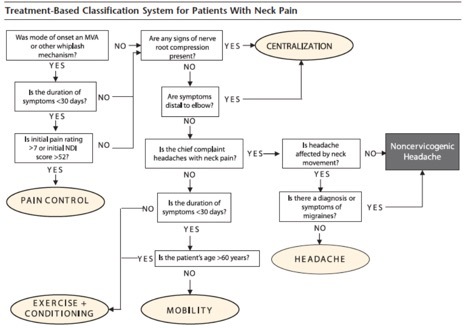
Treatment-based classifications
Cook’s cervical myelopathy
- Gait deviation
- Hoffman’s
- Babinski
- inverted supinator
- >45
>3 +LR 30.9




