QUALITY HIERARCHY IN CHAMPANE
Echelle des crus
- early 20th century rating system established grape prices
- prices were fixed by the Comite Champange the price reflected percentage given to the village
100% Grand cru for 17 Grand Cru villages
90-99% premier cru for 42 Premier Cru villages
80-89% for the other 257 villages
QUALITY HIERARCHY IN CHAMPANE
today’s market prices established?
EU was pressured to disband the Echelle des crus system
today determined by market w/ Moet & Chandon setting the trend
QUALITY HIERARCHY IN CHAMPANE
What would be on the label to signify a single village vs multiple vilages for grand cru and premier cru wines?
Grand Cru Crémant- all grapes com from single village
Grand Cru (with out village)- grapes come from several grand cru
QUALITY HIERARCHY IN CHAMPANE
conterversty between village naming an house naming?
-controversy over naming grand cru or premier cru a village name with all the variation - aspect, soil, size of village
-house tend to focus on blended wine emphasize quality of vintage vs. promote individual villages or vineyards
STRUCTURE OF THE INDUSTRY
size of industry?
16,000 growers own 90% of vineyards
340 Champagne house
- vast majority of growers sell grapes to houses or co ops
- Grower Champagnes- keep their grapes and make own wine
- Co-op bridge growers and houses
- Brokers find wine for houses, act as go between
QUALITY HIERARCHY IN CHAMPANE
business types reflected in the codes on bottle include?
NM: Negotiant manipulant
RM: Recoltant manipulant
CM: Cooperative de manipulation
QUALITY HIERARCHY IN CHAMPANE
negociant manipulant
NM designation
-business referred to as houses
-buy grapes, must, or wine to make champagne on own premise
-use own label
-often just called negociant and the group is called negoce
QUALITY HIERARCHY IN CHAMPANE
Recoltant manipulant
RM designation
-business commonly referred to as growers
-make & market own label from grapes exclusively from own vineyard
-processed on their own premise
QUALITY HIERARCHY IN CHAMPANE
Cooperative de manipulation
CM desiganation
- business are co-ops that market under own member’s label
- top 5 groups account for 2/3 of all sales by value
QUALITY HIERARCHY IN CHAMPANE
list Co op major groups
LVMH = largest and owns Moet & Chandon, Dom Perignon, Mercier, Veuve Clicquot, Ruinart and Krug
Vranken Pommery Monopole owns Vranken, Pommery, monopole Heidsieck, Charles Lafitte and Bissinger
COMMERCIAL CONSIDERATIONS
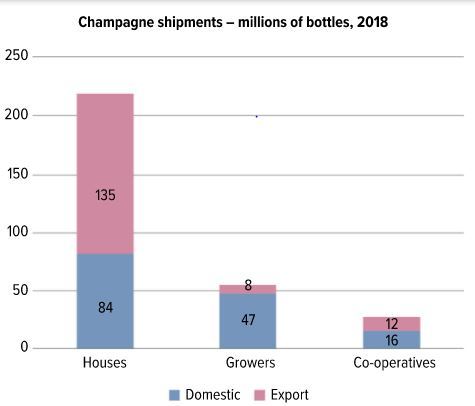
domestic vs. export
half is sold to domestic and half exported
COMMERCIAL CONSIDERATIONS
sell by busines type?
Houses- biggest sales, strong in export markets, 73% of all sales and 87% exports
Co-Ops- small and evenly split home and export
Growers- mostly sell in home market
COMMERCIAL CONSIDERATIONS
role of Comite Champagne?
manage relations between houses, co-ops and growers
co -ops have been diversifying sell base wine to large houses & promote own brand
Large houses -moved to buy grapes from growers via agent, less with co -ops
SUPPLY AND DEMAND -influencing the supply
vineyard side is able to influence supply by?
the region is in review of
1 Setting the max yield for grape that can be madeinto champagne in the coming harvest (kilos per hecter)
2 Reviewing potentially adding / subtracting land available for the production of Champagne - what is in/out of the appellation
SUPPLY AND DEMAND -influencing the supply
how is the max yield determined for a harvest?
1 grape yield for base wine in that year
2 plus an allowance for wine to go into reserves
- decision is made with respect to current hold levels, world demand, and progress of season (decisoin in late july)
- average yield 10,500 kilos/hectar
SUPPLY AND DEMAND -influencing the demand
-price of a bottle of champagne?
-price is low due to volume sold in supermarkets
France is cheapest and has dropped steadily recently
SUPPLY AND DEMAND -influencing the demand
main export markets?
UK, USA, Japan, Germany, Belgium (2018 order)
2 most valuable market w/ highest price paid per bottle US & Japan
UK biggest market by volume and lowest average price / bottles
SUPPLY AND DEMAND -influencing the demand
price ques?
rebranding for more exclusivity
move away from volume markets in light of growth of mid-priced sparkling wine (prosecco)
- new focus on higher prices
- volume dropped 10% but value rise
SUPPLY AND DEMAND -cost of production v. sought price
what factors contribute to the price produces seek?
Champagne is expensive to produce and is large cost of product
grand cru/ premier cru increase cost (longer ageing , more labor, longer time product not transferred to cash income)
Vintage> NV -likely made from better quality fruit
Rose – more wine required
use of oak for primary ferm or base wine ageing
ROUTE TO MARKET
Marketing costs?
For large houses, marketing can account for 20% of the bottle $ =cost of production =30% and 20% to commercialization
-push to own/ run distribution systems
ROUTE TO MARKET
cost from producer to market?
- major brands are apart of conglomerates that have distribution system in place to support several brands
- more control, economy of scale to control end price sold – hold price ques
- some house prefer to use agents to distribute and typically provide a budget for promoting their wines.
- small producers use specialist for specialist wine ships, private clients, and hospitality sectors
NEW PRODUCTS AND TRENDS
- niche market for Brut nature wines in specialist wine shops
- dry category gain ground- Brut Nature and Extra Brut
- launched sweet wines intended to be drunk over ice in cocktail Moet & Chandon Ice Imperal that is Demi Sec
- Rose increasing in market share
- increasing interest in single vineyard champagnes
- Grower Champagnes gaining attraction

-
ch 1 part 139
-
Ch 1 part 233
-
Ch 2 part 134
-
Ch 2 part 228
-
Ch 2 part 322
-
Other Trad & Alsace17
-
Burgundy18
-
Loire17
-
Sparking wine is prone to Fungal Disease and Virus infections21
-
Cava Pt 125
-
Cava pt 221
-
Sparkling Wine in Italy & Prosecco27
-
Prosecco pt227
-
Asti20
-
Lambrusco26
-
Franciacorta22
-
Trentodoc15
-
Germany24
-
England & Wales22
-
USA25
-
Chile12
-
Argentina16
-
South Africa23
-
Australia27
-
New Zealand16



