Akinetopsia
AKINETOPSIA – A disruption of movement perception, with other aspects of perception still intact.
- Completely unable to perceive motion — even though other aspects of her vision (e.g., her ability to recognize objects, to see color, or to discern detail in a visual pattern) seemed normal.
- Can detect that an object now is in a position different from its position a moment ago, but she reports seeing “nothing in between.”
- It was hard to cross the street because she couldn’t tell which of the cars in view were moving and which ones were parked.
- Other problems caused by akinetopsia:
- difficulties in following conversations, because she was essentially blind to the speaker’s lip movement or changing facial expressions.
- If more than two people were moving around in a room, she felt anxious because “people were suddenly here or there, but [she had] not seen them moving”
- Trouble in everyday activities like pouring a cup of coffee. She couldn’t see the fluid level’s gradual rise as she poured, so she didn’t know when to stop pouring. For her, “the fluid appeared to be frozen, like a glacier”
Visual System & Photoreceptors
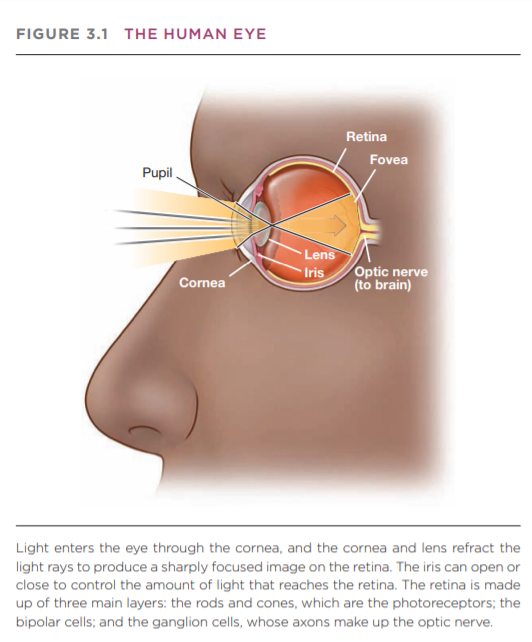
VISUAL SYSTEM – For humans, vision is the dominant sense. This is reflected in how much brain area is devoted to vision compared to any of the other senses.
- It’s also reflected in many aspects of our behavior.
- EX: If visual information conflicts with information received from other senses, you usually place your trust in vision over other senses.
- The process begins with light. Light is produced by many objects in our surroundings — the sun, lamps, candles — and then reflects off other objects.
PHOTORECEPTORS (part of the Visual System) – specialized neural cells that respond directly to the incoming light.
- It’s this reflected light – reflected from this book page or from a friend’s face – that launches the processes of visual perception.
- Some of this light hits the front surface of the eyeball, passes through the CORNEA and the LENS, and then hits the RETINA, the light-sensitive tissue that lines the back of the eyeball
- The CORNEA and LENS focus the incoming light, just as a camera lens might, so that a sharp image is cast onto the retina.
- Adjustments in this process can take place because the lens is surrounded by a band of muscle.
- When the muscle tightens, the lens bulges somewhat, creating the proper shape for focusing the images cast by nearby objects.
- When the muscle relaxes, the lens returns to a flatter shape, allowing the proper focus for objects farther away.
On the RETINA, there are two types of PHOTORECEPTORS (RODS & CONES) – specialized neural cells that respond directly to the incoming light.
- One type, the RODS – are sensitive to very low levels of light and so play an essential role whenever you’re moving around in semidarkness or trying to view a fairly dim stimulus.
- But the rods are also color-blind: They can distinguish different intensities of light
- But they provide no means of discriminating one hue from another
INSERT FIGURE 3.1
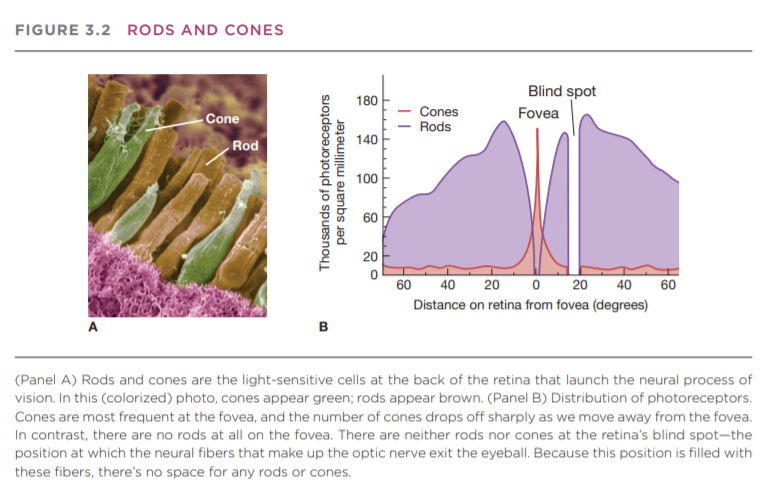
INSERT FIGURE 3.2
- Another type, CONES, in contrast, are less sensitive than rods and so need more incoming light to operate at all. But cones are sensitive to color differences.
- More precisely, there are three different types of cones, each having its own pattern of sensitivities to different wavelengths
- You perceive color, therefore, by comparing the outputs from these three cone types:
- Strong firing from only the cones that prefer SHORT WAVELEGNTHS.
- Ex: accompanied by weak (or no) firing from the other cone types, signals purple.
- Blue is signaled by equally strong firing from the cones that prefer short wavelengths and those that prefer MEDIUM WAVELENGTHS,** with only modest firing by cones that prefer **LONG WAVELEGNTHS** And so on, with other patterns of firing, across the three cone types, corresponding to different perceived hues_._**
- Strong firing from only the cones that prefer SHORT WAVELEGNTHS.
- Cones have another function: They enable you to discern fine detail.
INSERT FIGURE 3.3
- The ability to see fine detail is referred to as ACUITY, and acuity is much higher for the cones than it is for the rods.
- This explains why you point your eyes toward a target whenever you want to perceive it in detail.
- What you’re actually doing is positioning your eyes so that the image of the target falls onto the FOVEA .
- FOVEA– the very center of the retina.
- Here, cones far outnumber rods (and, in fact, the center of the fovea has no rods at all). As a result, this is the region of the retina with the greatest acuity.
- In portions of the retina more distant from the fovea (i.e., portions of the retina in the so-called visual periphery), the rods predominate; well out into the periphery, there are no cones at all.
- This distribution of photoreceptors explains why you’re better able to see very dim lights out of the corner of your eyes.
- Sailors and astronomers have known for hundreds of years that when looking at a barely visible star, it’s best not to look directly at the star’s location. By looking slightly away from the star, they ensured that the star’s image would fall outside of the fovea and onto a region of the retina dense with the more light-sensitive rods.
Lateral Inhibition
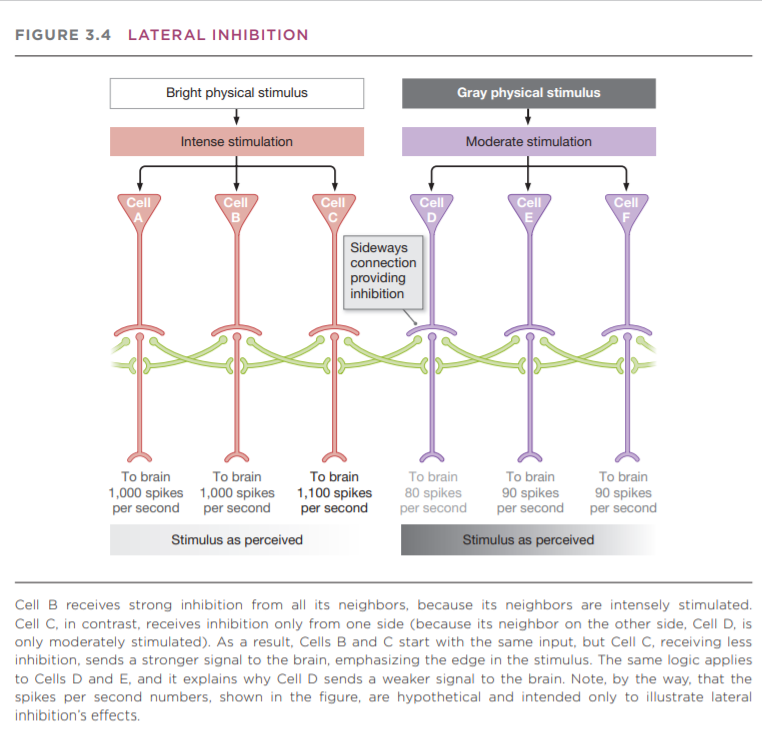
LATERAL INHIBITION – a pattern in which cells, when stimulated, inhibit the activity of neighboring cells.
- The pattern of lateral inhibition highlights a surface’s edges. lateral inhibition actually exaggerates the contrast at the edge – a process called EDGE ENHANCEMENT.
- EX: See the “Mach Bands” below. The shades of gray appear darker next to the lighter gray to the right than the darker gray to the lerft (Hint: They aren’t really darker). This illusion is caused by the enhanced contrast created by lateral inhibition.
- RODS and CONES do not report directly to the cortex.
- Instead, the photoreceptors stimulate BIPOLAR CELLS** which in turn excite **GANGLION CELLS.
- The Ganglion Cells are spread uniformly across the entire retina, but all of their axons converge to form the bundle of nerve fibers that we call the OPTIC NERVE.
OPTIC NERVE – This is the nerve tract that leaves the eyeball and carries information to various sites in the brain.
- Information is sent first to a way station in the thalamus called the Lateral Geniculate Nucleus (LGN); from there, information is transmitted to the primary projection area for vision, in the OCCIPITAL LOBE.
- The optic nerve is not just a cable that conducts signals from one site to another. Instead, the cells that link the RETINA to the brain are already analyzing the visual input.
- One example lies in the phenomenon of Lateral Inhibition, a pattern in which cells, when stimulated, inhibit the activity of neighboring cells.

Visual Coding
VISUAL CODING – the relationship between activity in the nervous system and the external stimulus that is somehow represented by that activity.
- What’s the code through which neurons manage to represent the shapes, colors, sizes, and movements that you perceive?
- EX: What is the code for a poodle? Each time you see a poodle, the same neural activity (code)) unfolds to represent that poodle.
Single-Cell Recording
SINGLE-CELL RECORDING – Is a procedure through which investigators can record, moment-by-moment, the pattern of electrical changes within a single neuron.
When a neuron fires, each response is the same size; this is the ALL-OR-NONE LAW.
- But neurons can vary in how often they fire.
- And when investigators record the activity of a single neuron, what they’re usually interested in is the cell’s FIRING RATE measured in “spikes per second.”
- The investigator can then vary the circumstances in order to learn what makes the cell fire more or less.
- In this way, we can figure out what job the neuron does within the broad context of the entire nervous system.
- EX: What kind of detector is a given neuron? Is it responsive to any light in any position within the field of view? In that case, we might call it a “light detector.”
- EX: Or is it perhaps responsive only to certain shapes at certain positions (and therefore is a “shape detector”)?
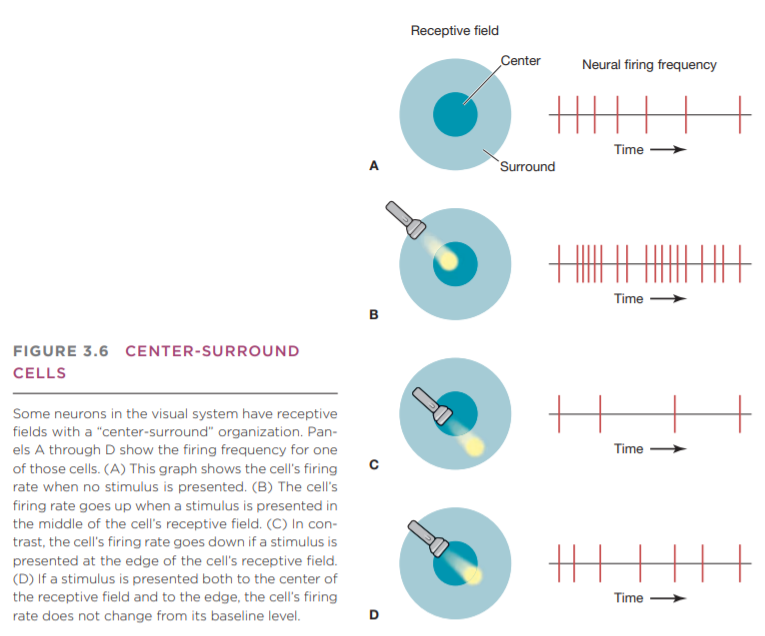
- This procedure allows us to define the cell’s Receptive Field — that is, the size and shape of the area in the visual world to which that cell responds.
- In this way, we can figure out what job the neuron does within the broad context of the entire nervous system.
- The investigator can then vary the circumstances in order to learn what makes the cell fire more or less.
Multiple Types of Receptive Fields
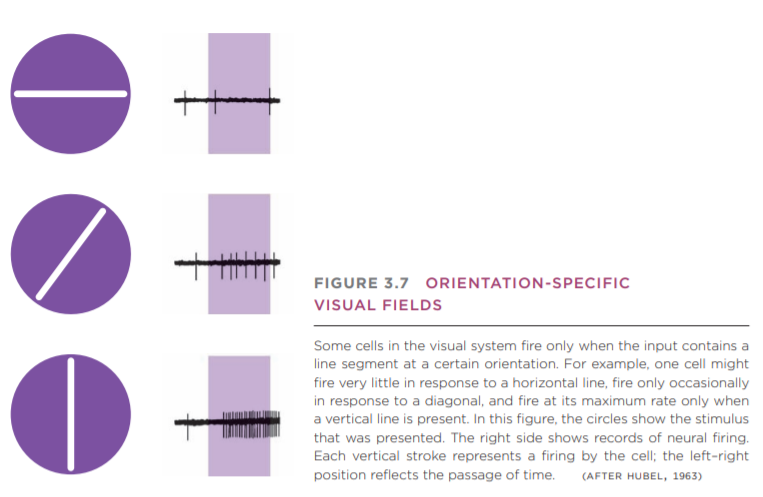
RECEPTIVE FIELD – the size and shape of the area in the visual world to which that cell responds.
Some neurons seem to function as “dot detectors.” These cells fire at their maximum rate when light is presented in a small, roughly circular area in a specific position within the field of view. Presentations of light just outside of this area cause the cell to fire at less than its usual “resting” rate, so the input must be precisely positioned to make this cell fire. These cells are often called CENTER-SURROUND CELLS. (See image below).
- Edge Detectors – Other cells fire at their maximum only when a stimulus containing an edge of just the right orientation appears within their receptive fields. These cells, therefore, can be thought of as “edge detectors.”
- Some of these cells fire at their maximum rate when a horizontal edge is presented; others, when a vertical edge is in view; still others fire at their maximum to orientations in between horizontal and vertical.
- The farther the edge is from the cell’s preferred orientation, the weaker the firing will be.
- Other cells, elsewhere in the visual cortex, have receptive fields that are more specific. Some cells fire maximally only if an angle of a particular size appears in their receptive fields; others fire maximally in response to corners and notches.
- Still, other cells appear to be “Movement Detectors” and fire strongly if a stimulus moves, say, from right to left across the cell’s receptive field.
- Other cells favor left-to-right movement, and so on through the various possible directions of movement.
Parallel Processing in the Visual System
PARALLEL PROCESSING in the VISUAL SYSTEM – The visual system relies on a “divide and conquer” strategy, with different types of cells, located in different areas of the cortex, each specializing in a particular kind of analysis.
AREA VI – The site on the occipital lobe where axons from the LGN first reach the cortex.
- The lateral geniculate nucleus (LGN) – Virtually all the visual information that leaves the retina to be analyzed in the visual cortex is relayed through synapses in this nucleus.
- The collection of cells in this area provides a detector for every possible stimulus, making certain that no matter what the input is or where it’s located, some cell will respond to it.
- EX: In this brain area, some cells fire for images in a horizontal position in the visual world, others for verticals in that position, others to diagonals in specific positions, and so on. (also recognize edges, corners, etc.)
- (V1, V2, V3, V4, PO, and MT) are in the Occipital Cortex; other areas are in the Parietal Cortex; others are in the Temporal Cortex– each area seems to have its own function.
PARALLEL PROCESSING – — a system in which many different steps (in this case, different kinds of analysis) are going on simultaneously.
- The visual system relies on PARALLEL PROCESSING, which is usually contrasted with SERIAL PROCESSING, in which steps are carried out one at a time.
- One advantage of this simultaneous processing is speed.
- Another advantage of parallel processing is the possibility of mutual influence among multiple systems.
- EX: To see why this matters, consider the fact that sometimes your interpretation of an object’s motion depends on your understanding of the object’s three-dimensional shape.
- In other cases, though, the relationship between shape and motion is reversed. In these cases, your interpretation of an object’s three-dimensional shape depends on your understanding of its motion.
- How does the brain deal with these contradictory demands? Parallel processing provides the answer. Since both sorts of analysis go on simultaneously, each type of analysis can be informed by the other.
- EX: To see why this matters, consider the fact that sometimes your interpretation of an object’s motion depends on your understanding of the object’s three-dimensional shape.
- EX: Another example of Parallel processing is easy to document throughout the visual system.
- The Rods detecting stimuli in the periphery of your vision and stimuli presented at low light levels. Simultaneously (in parallel) the Cones are detecting hues and detail at the center of your vision.
- Both types of receptors function at the same time.
- The Rods detecting stimuli in the periphery of your vision and stimuli presented at low light levels. Simultaneously (in parallel) the Cones are detecting hues and detail at the center of your vision.
Within the OPTIC NERVE itself, there are two types of cells:
- P CELLS – provide the main input for the LGN’s PARVOCELLULAR CELLS and appear to be specialized for spatial analysis and the detailed analysis of form.
- P Cells as specialized roughly for the perception of pattern.
- M CELLS – provide the input for the LGN’s MAGNOCELLULAR CELLS and are specialized for the detection of motion and the perception of depth.
- M Cells as specialized for the perception of motion
- BOTH of these systems are functioning at the same time – in parallel.
WHAT and WHERE SYSTEMS:
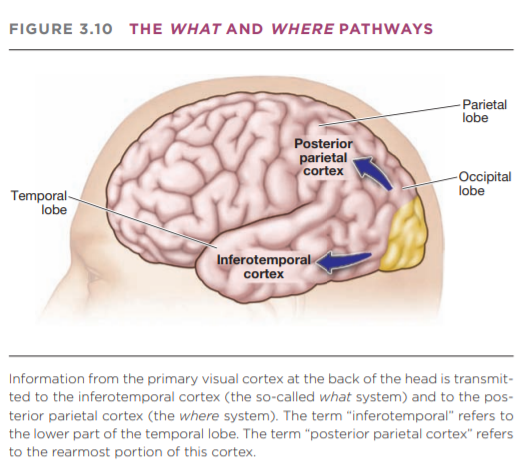
- WHAT SYSTEM – A pathway, often called the WHAT SYSTEM, plays a major role in the identification of visual objects, telling you WHAT something is – whether the object is a cat, an apple, or whatever.
- This pathway extends from the occipital lobe and is passed along to the cortex of the temporal lobe.
- WHERE SYSTEM – A pathway, often called the WHERE SYSTEM, plays a major role in guiding your action based on your perception of where an object is located – above or below you, to your right, or to your left.
- In this pathway, activation from the occipital lobe is also passed along a second pathway, leading to the parietal cortex.
- Patients with lesions in the What System show VISUAL AGNOSIA – An inability to recognize visually presented objects, including such common things as a cup or a pencil.
- The reverse pattern occurs with patients who have suffered lesions in the Where System – They have difficulty in reaching, but no problem in object identification.
- DIFFERENT BRAIN AREAS are critical for the perception of color, motion, and form.
- So someone who has suffered damage in just one of these areas might show problems in the perception of color but not the perception of motion or form, or problems in the perception of motion but not the perception of form or color.
Binding Problem and Solution
BINDING PROBLEM – The task of taking elements that are initially addressed by different systems in different parts of the brain and reuniting them into a single scene.
- Three elements that contribute to the solution: Spatial Position, Rhythm, and Attention.
SPATIAL POSITION – Location information provides a frame of reference used to solve the BINDING PROBLEM.
- Spatial Position is a major organizing theme in all the various brain areas concerned with vision, with each area seeming to provide its own map of the visual world.
- The part of the brain registering an object’s shape is separate from the parts registering its color or its motion.
- But these various brain areas all have something in common. They each keep track of where the target is — where the object was located, and where the blueness was; where the motion was detected, and where things were still.
- As a result, the reassembling of these pieces can be done with reference to position.
- In essence, you can overlay the map of which forms are where on top of the map of which colors are where to get the right colors with the right forms, and likewise for the map showing which motion patterns are where.
RHYTHMS – The brain uses special Rhythms to identify which sensory elements belong with which.
- EX: Imagine two groups of neurons in the visual cortex. One group of neurons fires maximally whenever a vertical line is in view; another group fires maximally whenever a stimulus is in view moving from a high position to a low one. Let’s also imagine that right now a vertical line is presented and it is moving downward; as a result, both groups of neurons are firing strongly. How does the brain encode the fact that these attributes are bound together, different aspects of a single object? There is evidence that the visual system marks this fact by means of NEURAL SYNCHRONY:
- If the neurons detecting a vertical line are firing in synchrony with those signaling movement, then these attributes are registered as belonging to the same object.
- If they aren’t in synchrony, then the features aren’t bound together.
- If the neurons detecting a vertical line are firing in synchrony with those signaling movement, then these attributes are registered as belonging to the same object.
ATTENTION – attention plays a key role in binding together the separate features of a stimulus.
- If we overload someone’s attention, they’re likely to make CONJUNCTION ERRORS – to correctly detect the features present in a visual display, but then to make mistakes about how the features are bound together (or conjoined).
- EX: Thus, for example, someone shown a blue H and a red T might report seeing a blue T and a red H — an error in binding.
- We now see that there is information reflected in:
- which cells are firing,
- how often they are firing,
- whether the cells are firing in synchrony with other cells,
- and the rhythm in which they are firing.
Form Perception
FORM PERCEPTION – Our perception of the visual world adds information to the stimulus input in order to make sense of it.
- This was a point made by “Gestalt psychologists” in the 20th Century who argued that the organization of external stimuli uses the stimulus itself + additional information ADDED by the perceiver.
- This is why, they claimed, the perceptual whole is often different from the sum of the external stimulus’ parts.
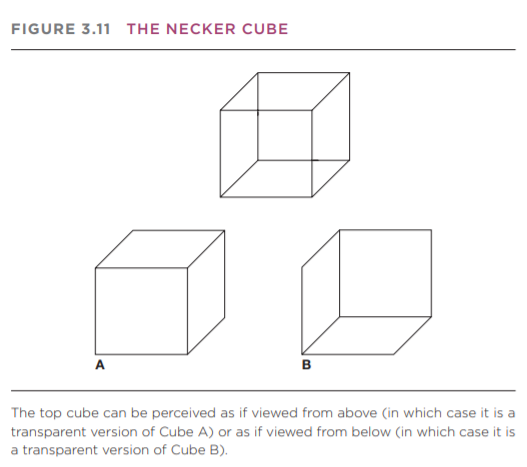
- EX: The NECKER CUBE is an example of a reversible (or ambiguous) figure — so-called because people perceive it first one way and then another. (See below)
- Specifically, this form can be perceived as a drawing of a cube viewed from above (in which case it’s similar to the cube marked A in the figure); it can also be perceived as a cube viewed from below (in which case it’s similar to the cube marked B).
- This isn’t an “illusion,” because neither of these interpretations is “wrong,” and the drawing itself (and, therefore, the information reaching your eyes) is fully compatible with either interpretation.
- Put differently, the drawing is entirely neutral with regard to the shape’s configuration in depth; the lines on the page don’t specify which is the “proper” interpretation. Your perception of the cube, however, is not neutral. Instead, you perceive the cube as having one configuration or the other.
- Your perception goes beyond the information given in the drawing, by specifying an arrangement in depth.
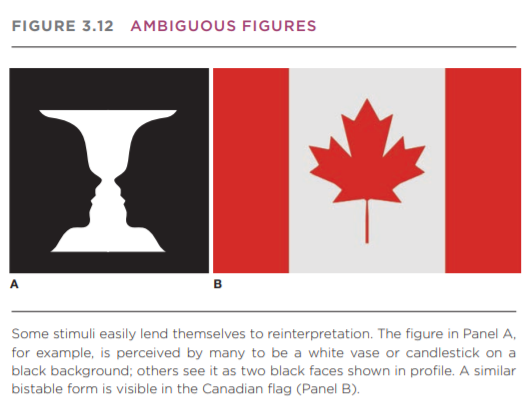
- EX: Image on the ‘Question’ card of this flashcard is neutral with regard to FIGURE-GROUND ORGANIZATION – the determination of what is the figure (the depicted object, displayed against a background) and what is the ground.
- Your perception of this drawing, however, isn’t neutral about this point. Instead, your perception somehow specifies that you’re looking at the profiles and not the vase.
- In each of these examples, then, your perception contains information – about how the form is arranged in depth, or about which part of the form is figure and which is ground – that is not contained within the stimulus itself. Apparently, this is information contributed by you, the perceiver.
Gestalt Principles
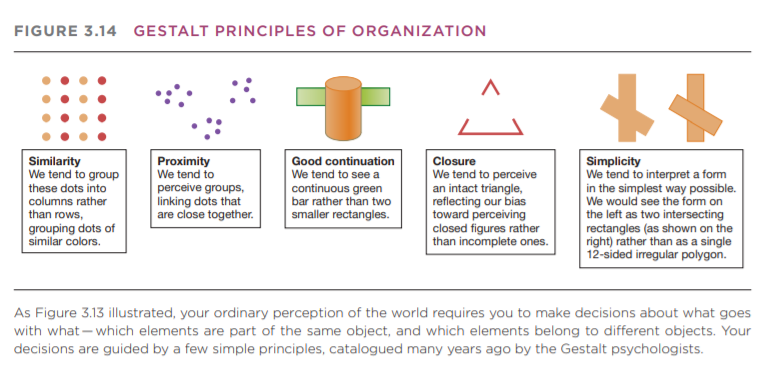
GESTALT PRINCIPLES – In the 20th Century Gestalt Psychologists argued that the organization of external stimuli uses the stimulus itself + additional information ADDED by the perceiver in order to create a whole scene that makes sense.
- This is why the perceptual whole is often different from the sum of the external stimulus’ parts.
AMBIGUOUS STIMULI – Many stimuli are ambiguous and in need of interpretation.
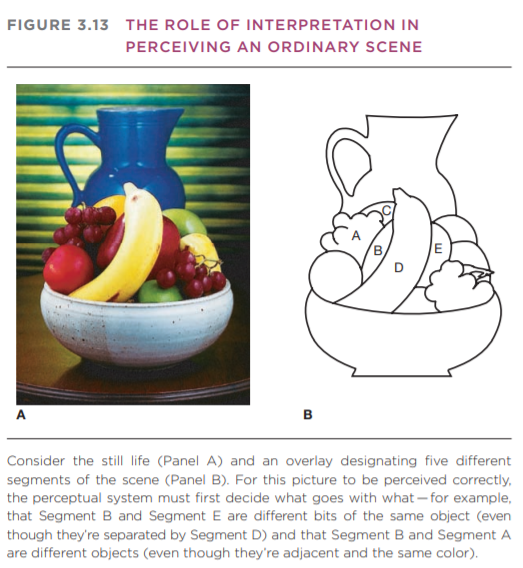
- EX: In the image below, it’s almost certain that you perceive segments B and E as being united, forming a complete apple, but notice that this information isn’t provided by the stimulus; instead, it’s your interpretation.
- It’s also likely that you perceive the banana as entirely banana-shaped and therefore continuing downward out of your view, into the bowl, where it eventually ends with the sort of point that’s normal for a banana. In the same way, surely you perceive the horizontal stripes in the background as continuous and merely hidden from view by the pitcher.
- Even with this ordinary scene, therefore, your perception goes “beyond the information given”
- You don’t feel like you’re “interpreting” this picture or extrapolating beyond what’s on the page. But your role becomes clear the moment we start cataloging the differences between your perception and the information that’s truly present in the photograph.
- GESTALT PRINCIPLES – Your interpretation of any external stimulus is guided by several principles (See image on the ‘Question Card for this Flashcard):
- SIMILARITY – We tend to group things together that are similar.
- PROXIMITY – We tend to perceive groups of things that are close in distance.
- GOOD CONTINUATION – We tend to see things continuing behind other objects that might partially obscure the object we’re looking at.
- CLOSURE – We tend to perceive lines and shapes as being closed rather than incomplete or broken
- SIMPLICITY – We tend to interpret a form in the simplest way possible – as the most basic shape.
- Each of us imposes our own interpretation on the perceptual input, but we all tend to impose the same interpretation because we’re all governed by the same rules.
Organization and Features
INTERPRETATION of INPUT – Contrary to what many think, in many settings, your interpretation of the input happens before you start cataloging the input’s basic features, not after.
- This involves the simultaneous Detection of simple attributes and the Organization of those attributes.
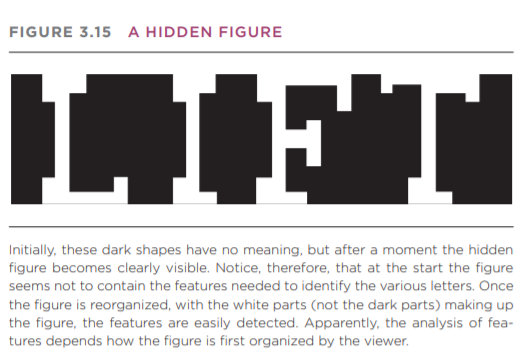
- EX: See the image below. At the start, the form seems not to contain the features needed to identify the L, the I, and so on. Once the form is reorganized, though, it does contain these features, and the letters are immediately recognized.
- With one organization, the features are absent; with another, they’re plainly present. So it seems that the features themselves depend on how the form is FIRST organized by the viewer.
- EX: See the image below. At the start, the form seems not to contain the features needed to identify the L, the I, and so on. Once the form is reorganized, though, it does contain these features, and the letters are immediately recognized.
- On one hand, your perception of a form surely has to start with the stimulus itself and must in some ways be governed by what’s in that stimulus. (After all, no matter how you try to interpret Figure 3.16, it won’t look to you like a photograph of Queen Elizabeth — the basic features of the queen are just not present, and your perception respects this obvious fact.)
- This suggests that the features must be in place before an interpretation is offered because the features govern the interpretation.
- HOWEVER, the features you find in an input depend on how the figure is interpreted. Therefore, it’s the interpretation, not the features, that must be first.
- Many aspects of the brain’s functioning depend on parallel processing, with different brain areas all doing their work at the same time.
- In addition, the various brain areas all influence one another, so that what’s going on in one brain region is shaped by what’s going on elsewhere.
- In other words, neither type of processing “goes first.” Neither has priority. Instead, they work together, with the result that the perception that is achieved makes sense at both the large-scale and fine-grained levels.
Constancy
The PERCEIVER has a role in “going beyond the information given” in the STIMULUS itself. The PERCEIVER is also central to the achievement of perceptual constancy.
PERPETUAL CONSTANCY – Refers to the fact that we perceive the constant properties of objects in the world (sizes, shapes) even though the sensory information we receive about these attributes changes whenever our viewing circumstances change.
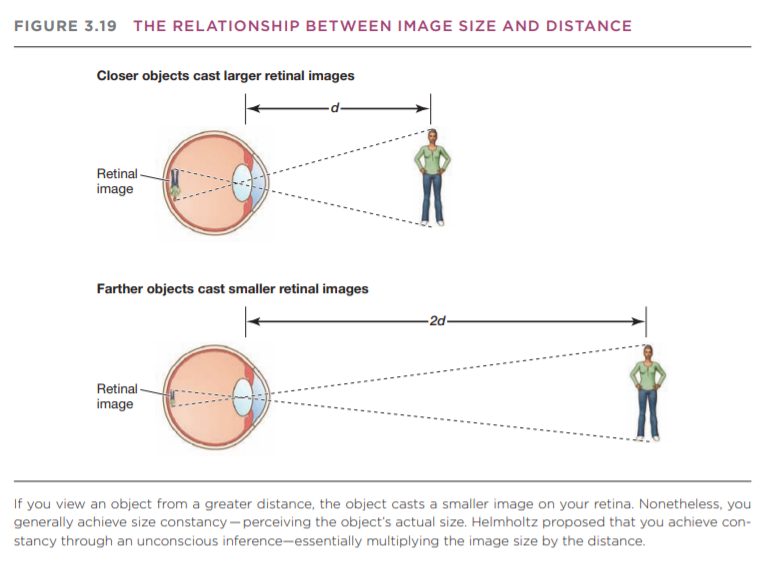
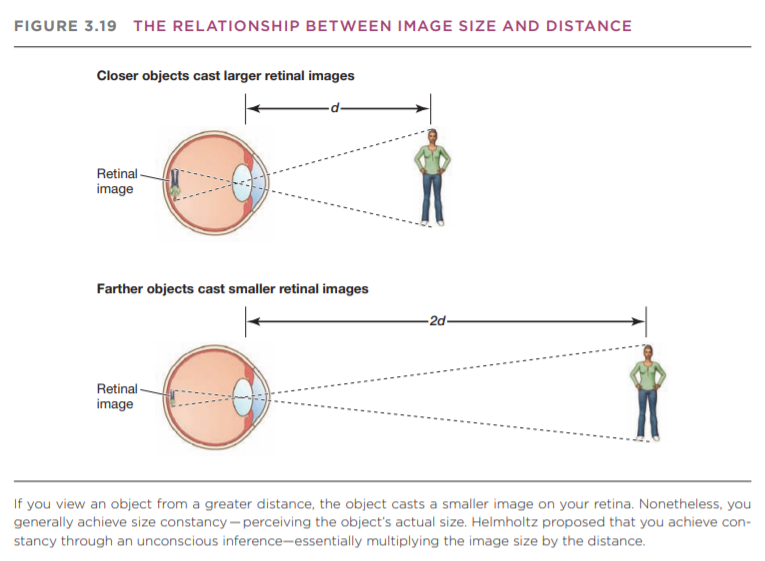
- EX: Consider the perception of size. If you happen to be far away from the object you’re viewing, then the image cast onto your retinas by that object will be relatively small. If you approach the object, then the image size will increase. This change in image size is a simple consequence of physics, but you’re not fooled by this variation. Instead, you manage to achieve size constancy.
SIZE CONSTANCY – you correctly perceive the sizes of objects despite the changes in retinal-image size created by changes in viewing distance.
- In judging size, for example, you generally see objects against some background, and this can provide a basis for comparison with the target object. Size constancy, therefore, might be achieved by focusing not on the images themselves but on these unchanging relationships
- However, Size constancy is achieved even when the visual scene offers no basis for comparison (if, for example, the object to be judged is the only object in view), provided that other cues signal the distance of the target object
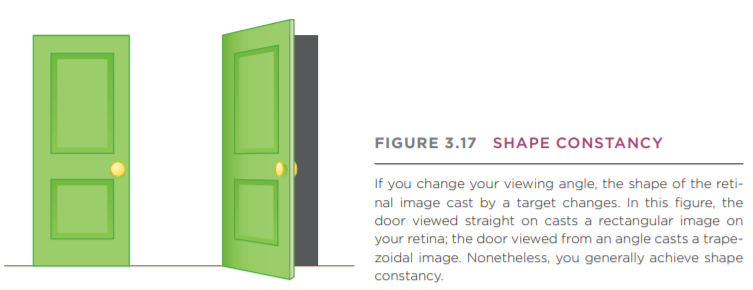
SHAPE CONSTANCY – you correctly perceive the shapes of objects despite changes in the retinal image created by shifts in your viewing angle.
- EX: Similarly, if you view a door straight on, the retinal image will be rectangular; but if you view the same door from an angle, the retinal image will have a different shape. Still, you achieve Shape Constancy.
BRIGHT CONSTANCY – you correctly perceive the brightness of objects whether they’re illuminated by dim light or strong sun.
Unconscious Inference
UNCONSCIOUS INFERENCE – The ability to achieve each of these forms of constancy – Shape, Size, Brightness – without conscious calculation.
German physicist Hermann von Helmholtz developed an influential hypothesis:
- There’s a simple inverse relationship between distance and retinal image size: If an object doubles its distance from the viewer, the size of its image is reduced by half. If an object triples its distance, the size of its image is reduced to a third of its initial size (See image below). This relationship is guaranteed to hold true because of the principles of optics, and the relationship makes it possible for perceivers to achieve size constancy
- EX: We don’t run through a conscious calculation every time we perceive an object’s size, but he believed we’re calculating nonetheless — and so he referred to the process as an Unconscious Inference.
- How people achieve Shape constancy. Here, you take the slant of the surface of a door into account and make appropriate adjustments (See the image on the ‘Question’ card for this flashcard) – again, an unconscious inference.
- Brightness Constancy – Perceivers are sensitive to how a surface is oriented relative to the available light sources (things in shadow or in low-angle lighting will appear darker).
Illusions
ILLUSIONS – Circumstances in which you MISinterpret the information available to you and end up misperceiving the world.
- This process of taking information into account — whether it’s Distance (in order to judge size), Viewing Angle (to judge shape), or Illumination (to judge brightness) — is crucial for achieving constancy.
- It’s another indication that you don’t just “receive” visual information; instead, you interpret it.
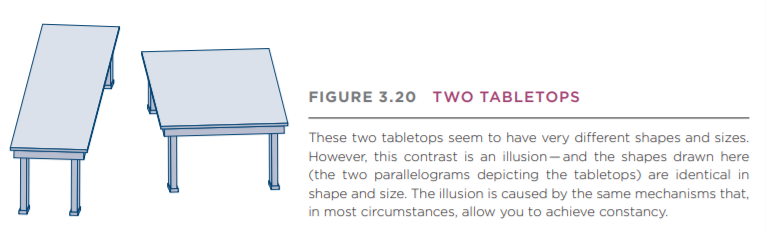
Why do people misperceive these shapes?
- The answer involves the normal mechanisms of shape constancy. Cues to depth in this figure cause you to perceive the figure as a drawing of three-dimensional objects, each viewed from a particular angle. This leads you — quite automatically — to adjust for the (apparent) viewing angles in order to perceive the two tabletops, and it’s this adjustment that causes the illusion. (See the image on the ‘Question’ card for this flashcard)
- Notice that this illusion about shape is caused by a misperception of depth: You misperceive the depth relationships in the drawing and then take this faulty information into account in interpreting the shapes.
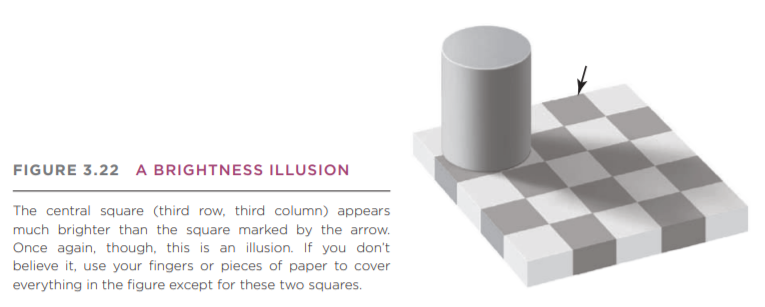
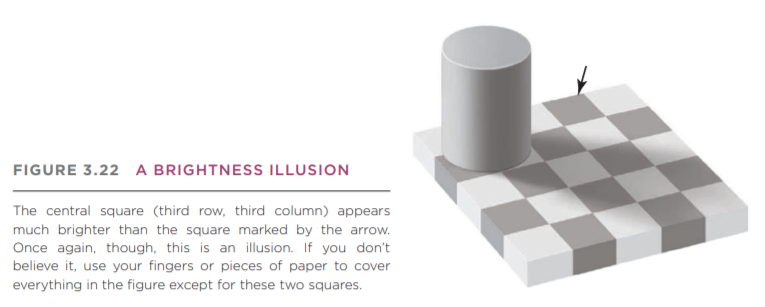
LATERAL INHIBITION** – (described earlier) play a role here in producing a **CONTRAST EFFECT: The central square in this figure is surrounded by dark squares, and the contrast makes the central square look brighter. (See image below)
- The square marked at the edge of the checkerboard, however, is surrounded by white squares; here, contrast makes the marked square look darker.
- But, in addition, the visual system also detects that the central square is in the shadow cast by the cylinder.
- Again, an example of unconscious inference that takes the shadow into account in judging brightness.
Perception of Depth
PERCEPTION OF DEPTH – In discussing constancy, we said that perceivers take distance, slant, and illumination into account in judging size, shape, and brightness.
- But to do this, they need to know what the distance is (how far away is the target object?), what the viewing angle is (“Am I looking at the shape straight on or at an angle?”), and what the illumination is.
- People judge distance using:
- BINOCULAR CUES
- MONOCULAR CUES
- FOCUS ADJUSTMENT
- PICTORIAL CUES
- LINEAR PERSPECTIVE
- RETINAL IMAGE
- TEXTURE GRADIENT
- INTERPOSITION
- MOTION PARALLAX
- OPTIC FLOW
Binocular Cues
BINOCULAR DISPARITY – This difference between the two eyes’ views. This creates two slightly different images that the brain processes in order to judge the distance to the object.
- Binocular disparity can lead to the perception of depth even when no other distance cues are present.
Monocular Cues
MONOCULAR DISTANCE CUES – Depth cues that depend only on what each eye sees by itself.
- FOCUS ADJUSTMENT – One monocular cue depends on the adjustment that the eye must make in order to see the world clearly.
- In each eye, muscles adjust the shape of the lens to produce a sharply focused image on the retina. The amount of adjustment depends on how far away the viewed object is.
- Perceivers are sensitive to the amount of adjustment and use it as a cue indicating how far away the object is.
- In each eye, muscles adjust the shape of the lens to produce a sharply focused image on the retina. The amount of adjustment depends on how far away the viewed object is.
- PICTORIAL CUES – Other monocular cues have been exploited by artists for centuries to create an impression of depth on a flat surface. These cues rely on straightforward principles of physics.
- INTERPOSITION – the blocking of your view of one object by some other object – with the understanding that the thing being blocked is further away.
- LINEAR PERSPECTIVE – Parallel lines seem to converge as they get farther and farther from the viewer.
- RETINAL IMAGE – Distant objects produce a smaller retinal image than do nearby objects of the same size.
- TEXTURE GRADIENT – A related cue – Consider what meets your eye when you look at a pattern on a rug. The retinal projection of the pattern shows a continuous change in which the elements of the pattern grow smaller and smaller as they become more distant.
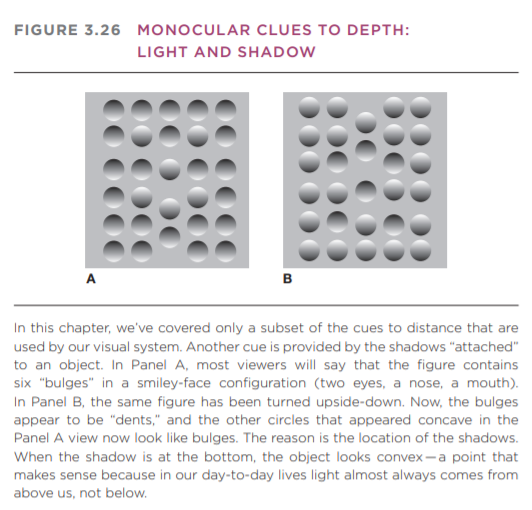
- LIGHT AND SHADOW – The casting of a shadow gives us clues to the distance and shape of the object.
- When the shadow is at the bottom of an object, the object looks convex – a point that makes sense because in our day-to-day lives light almost always comes from above us, not below.
Motion Parallax and Optic Flow
MOTION PARALLAX – Projected images of nearby objects move more than those of distant ones.
- This pattern of motion in the retinal images gives you another distance cue.
OPTIC FLOW – This depth cue relies on the fact that the pattern of stimulation across the entire visual field changes as you move forward.
- This plays a large role in the coordination of bodily movements.
Role of Redundancy
ROLE OF REDUNDANCY – Why is our visual system influenced by so many seemingly redundant cues?
- A: Different distance cues become important in different circumstances. By being sensitive to them all, you’re able to judge distance in nearly any situation you encounter.
Educated Eye
EDUCATED EYE – Can an eye be ‘educated’ to see more?
- A: You are able to see detail only for visual inputs landing on your foveas, so technically, your eyes’ ability to bring in information is limited by the laws of physic and biology.
- HOWEVER, you can be trained (as police are) to know WHERE to look and WHAT to focus on, making you more observant and observing even though you don’t see any more than anyone else.
- In essence, an ‘educated eye’ is one that looks in the right place at the right time.
- As a result, knowledge about where to look has an immense impact on what you’ll be able to see.
- It’s also true that experience can help you to see certain patterns that you’d otherwise miss within the limited data that is brought in through the senses.
- Again, people can have “educated eyes” (or ears or noses or palates). This “education” can’t change the basic biological properties of your sense organs. But knowledge and experience can certainly help you to see things that others overlook, to detect patterns that are largely invisible to other people, and to pick up on combinations that are important.

-
Ch. 1. The Science of the Mind14
-
CH. 2. The Neural Basis For Cognition27
-
Ch. 3. Visual Perception20
-
CH. 4. Recognizing Objects8
-
CH. 5. Paying Attention7
-
CH. 6. The Acquisition of Memories and the Working-Memory System16
-
CH. 7. Interconnections between Acquisition and Retrieval15
-
CH. 9. Concepts and Generic Knowledge14
-
CH. 14. Conscious Thought, Unconscious Thought21



