Introduction
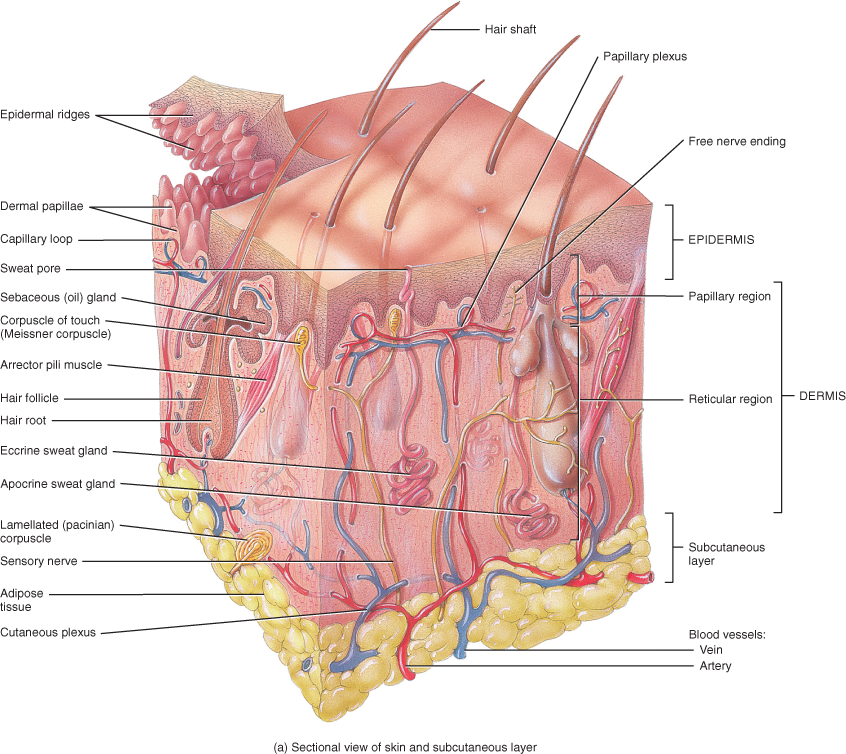
- The organs of the integumentary system include the skin and its accessory structures including hair, nails, and glands, as well as blood vessels, muscles and nerves.
- Note that all 4 of the basic tissue types are well-represented in this organ system: Epithelium in the hair, nails, and the epidermis of the skin; the dermis contains C.T.; muscle is found attached to the hair follicles, and in the substance of arteries and veins; nerves provide an abundance of sensation.
Integumentary System
The Integument is an organ system comprised of many organs such as hair and multiple types
of glands.
Integumentary System
- The integument can also be thought of as a cutaneous membrane that covers the outer surface of the body.
- It is the largest organ by surface area and weight.
- Its area is about 2 square meters (22 square feet) and weighs 4.5–5kg (10–11 lb), about 16% of body weight.
- It is 0.5–4 mm thick, thinnest on the eyelids, thickest on the heels.
- We lose almost a kg of skin epithelium a year that becomes a major part of household “dust”.
- It is the largest organ by surface area and weight.
Functions of the Skin
- Besides protection, the skin contributes to:
- Regulation of body temperature
- Sensory perceptions
- Synthesis of vitamin D
- Emotional expression
- It also serves as an important reservoir of blood.
Structures of the Skin
- The skin has 3 major layers:
- The outer, thinner layer is called the epidermis and consists of epithelial tissue.
- The inner, thicker layer is called the dermis and consists of C.T.
- The subcutaneous (subQ) layer (also called the hypodermis) is located underneath the dermis.
- It is a loose areolar/adipose C.T. that attaches the skin to the underlying tissues and organs.
Structures of the Skin
Dermatologists
Dermatologist are doctors who treat disorders of all layers of the integumentary system
The Epidermis
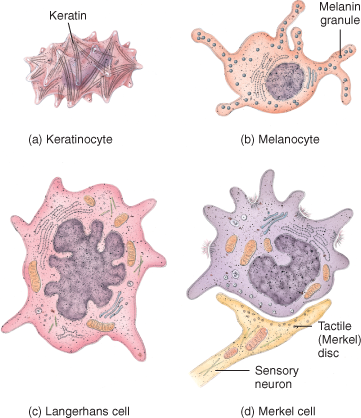
- The epidermis is composed of keratinized stratified squamous epithelium which contains four major types of cells:
- Keratinocytes
- Melanocytes
- Langerhans cells
- Merkel cells
Epidermis
Keratinocytes
make up 90% of the cells. They produce keratin - a tough fibrous protein that provides protection.
Epidermis
Melanocytes
produce the pigment melanin that protects against damage by ultraviolet radiation.
Epidermis
**Langerhans cells **
are macrophages that originated in the red bone marrow. They are involved in the immune responses.
Layers of epidermis
- The epidermis is composed of four layers in thin skin, and five layers in thick skin.
- Stratum basale
- stratum spinosum
- stratum granulosum
- stratum lucidum
- stratum corneum
Epidermis
**stratum basale **
or stratum germinativum is always the bottom (deepest) layer. Continuous cell division occurs here and produces all the other layers.
Epidermis
**stratum spinosum **
is a layer of 8–10 keratinocytes
The non-dividing cells of the 3rd layer (stratum granulosum) are filled with granules of keratin.
epidermis
stratum lucidum
is the 4th layer but is only present in thick skin (the skin of the fingertips, palms, and soles).
Epidermis
**stratum corneum **
- is always outermost, composed of approximately 20 layers of flat cell-remnants that are like “bags of turtle wax” (dead keratinocytes with no cellular organelles filled with only keratin protein.)
- They are continuously shed and replaced by cells from deeper strata.
Epidermis
Keratinization
- is the process of replacing viable cells in the stratum basale with more and more of the waxy keratin protein as cells move from the deepest layer to the surface layer.
- Constant friction can stimulate the process and produce a callus (an even thicker buildup of keratinocytes in the stratum corneum).
- Dandruff is an excess of keratinized cells shed from the scalp.
Epidermis
**Thin (hairy) skin **
covers all body regions except the palms, palmar surfaces of digits, and soles.
Epidermis
Thick (hairless)
skin
covers the palms, palmar surfaces of digits, and soles.
The Epidermis
Skin Pigments
- Melanin is produced by melanocytes in the stratum basale
- Eumelanin (brown to black)
- Pheomelanin (yellow to red)
- Freckles are clusters of concentrated melanin triggered by exposure to sunlight.
- Having more freckles is a genetic trait.
- Nevi (“birthmarks” or moles) are chronic lesions of the skin – they are, by definition, benign.
- Malignant melanoma is a cancer of melanocytes.
- Vitiligo is a chronic disorder that causes depigmentation patches in the skin. The precise pathogenesis, or cause, is not known, but is most likely a combination of
genetic factors coupled with a disorder of the immune system (autoimmune disease). - Albinism is a congenital disorder characterized by the complete or partial absence of pigment in the skin, hair, and eyes due to a defect of an enzyme involved in the production of melanin.
The Dermis
is composed of connective tissue containing collagen and elastic fibers.
The Dermis
**papillary region **
lies just below the epidermis and consists of areolar connective tissue containing thin collagen and elastic fibers, dermal papillae (including capillary loops), corpuscles of touch and free nerve endings.
The Dermis:
**reticular region **
- consists of dense irregular connective tissue containing collagen and elastic fibers, adipose cells, hair follicles, nerves, sebaceous (oil) glands, and sudoriferous (sweat) glands.
- Tears or excessive stretching in this region cause stretch marks (also called striae).
The Dermis
- Lines of cleavage are “tension lines” in the skin that indicate the predominant direction of underlying collagen fibers.
- Plastic surgeons make their incisions parallel to the normal cleavage lines in order to minimize scarring.
- Epidermal ridges reflect contours of the underlying dermal papillae and form the basis for fingerprints (and footprints)
- Function to increase firmness of grip by increasing friction






