System =
regularly interacting and interdependent components forming a unified whole
Ecosystem
= an ecological system;
= a community and its physical environment treated together as a functional system
Ecology
(from Greek: “house”, or “environment”; “study of”) is the scientific analysis and study of interactions among organisms and their environment.
It is an interdisciplinary field that includes biology, geography, and Earth science.
OR, MORE SIMPLY
an ecosystem is composed of
(size)
the organisms and physical environment of a specified area.
SIZE: micro to MACRO
THE RULES OF ECOLOGY
F. A. BAZZAZ
H. T. Odum
F. A. BAZZAZ:
- Everything is connected to everything else.
- Everything must go somewhere.
- There is no such thing as a free lunch.
H. T. Odum:
To understand any system you must understand the next larger system.
ENERGY FLOW IN ECOSYSTEMS
All organisms require energy,
for growth, maintenance, reproduction, locomotion, etc.
Hence, for all organisms there must be:
- A source of energy
- A loss of usable energy
Types of energy
heat energy
mechanical energy (+gravitational energy, etc.)
chemical energy = energy stored in molecular bonds
Transformations of energy
How is solar energy converted to chemical energy?
How does this process influence life as we see it on earth?
The transformations of energy from solar radiation to chemical energy and mechanical energy and finally back to heat are a traditional topic of Ecosystem Ecology.
An ecosystem has ………………….. and …………………… components
An ecosystem has abiotic and biotic components:
An ecosystem has abiotic and biotic components:
ABIOTIC components:
- Solar energy provides practically all the energy for ecosystems.
- Inorganic substances, e.g., sulfur, boron, tend to cycle through ecosystems.
- Organic compounds, such as proteins, carbohydrates, lipids, and other complex molecules, form a link between biotic and abiotic components of the system.
BIOTIC components:
- The biotic components of an ecosystem can be classified according to their mode of energy acquisition.
- In this type of classification, there are: Autotrophs and Heterotrophs
Autotrophs
(=self-nourishing) are called primary producers.
Photoautotrophs
fix energy from the sun and store it in complex organic compounds
(= green plants, algae, some bacteria)
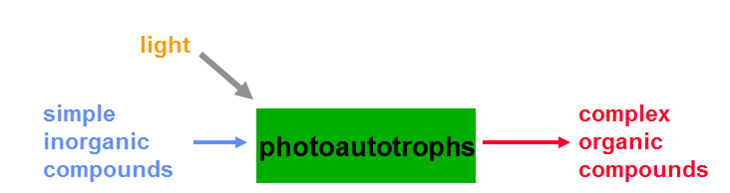
Chemoautotrophs
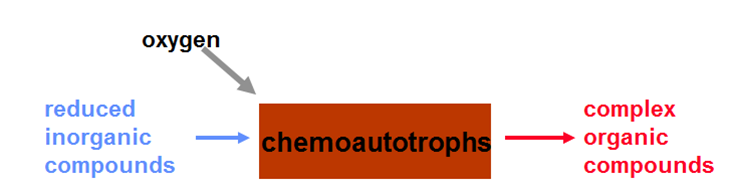
(chemosynthesizers) are bacteria that oxidize reduced inorganic substances (typically sulfur and ammonia compounds) and produce complex organic compounds.
Other chemoautotrophs:
Nitrifying bacteria in the soil under our feet!
Heterotrophs
- Heterotrophs (=other-nourishing) cannot produce their own food directly from sunlight+ inorganic compounds.
- They require energy previously stored in complex molecules.
(this may include several steps, with several different types of organisms)
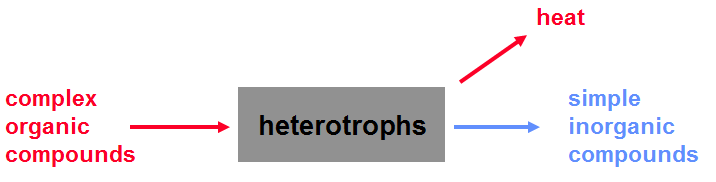
Heterotrophs can be grouped as:
- consumers
- decomposers
Consumers feed on
organisms or particulate organic matter
Decomposers utilize
complex compounds in dead protoplasm.
………………………………………… are the main groups of decomposers
Bacteria and fungi
………………………… are the main feeders on animal material.
bacteria
Bacteria are the main
feeders on animal material






