classification of materials
metals
ceramics
polymers
composites
advanced materials
semiconductors
biomaterials
smart materials
nanoengineered materials
examples of metals
steel
cast iro
aluminum
copper
titanium
alloy
metallic substance composed of two or more elements, as either a compound or a solution
some facts about metal
- Along with Polymers The Most Common Everyday Material
- Typically from the 1st Row of Transition Metals in Periodic
Table (Fe, Cu, Ni, etc.)
- Have LARGE Numbers of NonBound Electrons
metals are good ____ and ____ conductors
metals are good Electrical & Thermal conductors
some properties of metal
Strong but Deformable (Ductile)
high thermal & electrical conductivity
opaque, reflective.
some examples of ceramics
Glass, Concrete, Brick, Alumina, Zirconia, SiN, SiC,
typical properties of ceramics
- HARD & BRITTLE, GLASSY
- HIGHEST Temperature Resistance
- Little Temperature-SHOCK Resistance
- Corrosion Resistant
- Electrically Resistive, non-conductive (Insulative)
- Difficult to Join
- Do Not Weld
examples of polymers
Plastics, rayon, nylon, “glue”
typical properties of polymers
- Very Light Weight, Low Density
- Very Corrosion Resistant
- Best of ANY Class of Material
- Little, if any, Hi/Lo Temperature Resistance
- Low Structural Strength
- Very Deformable (ductile/flexible)
- Lowest $-Cost: Volume Ratio for Any class of material
Composites
materials that consist of more than one material type
common composite examples
fiber glass = glass ( ceramic) + polymer [strength and flexibility]
reinforced concrete = steel + concrete [tension strength + compression strength]
semiconductors
are materials which have a conductivity between conductors (generally metals) and nonconductors or insulators (such as most ceramics).
SEMICONDUCTORS
May be made _________ or _________ (or Something
in-between) by the Addition of Miniscule Amounts of
IMPURITIES
SEMICONDUCTORS
May be made CONDUCTIVE or INSULATIVE (or Something
in-between) by the Addition of Miniscule Amounts of
IMPURITIES
Most SOLID STATE (no moving parts) Electronic
Devices are __________
Semiconductors
Major applications for Semi conductor Transistors
Voltage Amplifiers
On/Off switches
What are biomaterials
Defined as Those Materials Which Are compatible with Human Tissue
• Classic Example = Stainless Steels
used For Bone repair (Screws, Staples, Plates, Hip-Joints)
At least a few of ALL other Classes of Materials are BioCompatibIe
• Including Silicon
What are smart materials
Smart Materials are Materials That Can Sense Changes in the
Environment and Respond with a Material Shape/Property
Change
6 materials properties
mechanical
electrical
thermal
magnetic
optical
deteriorative
* quick reference *
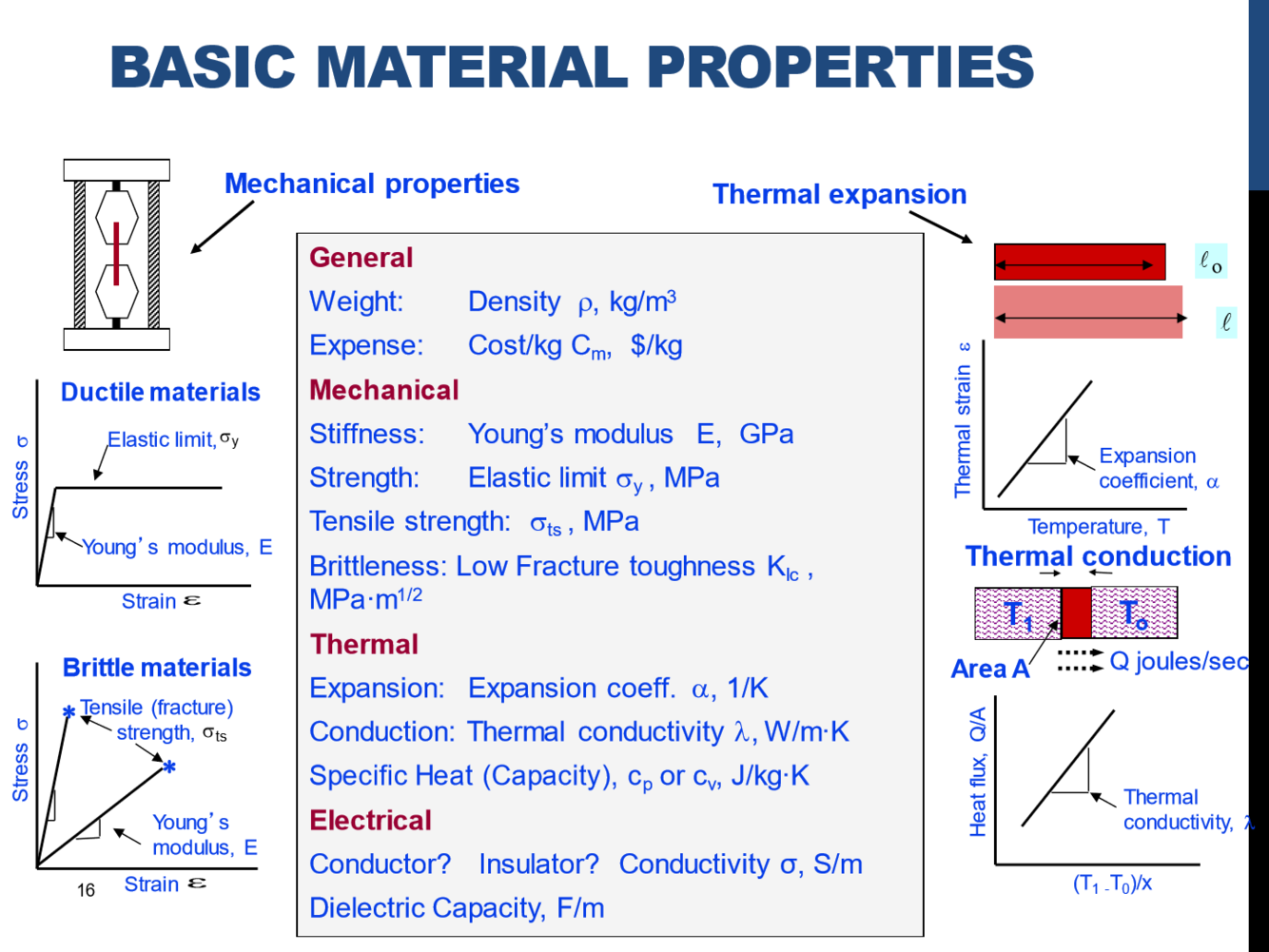
basic material properties
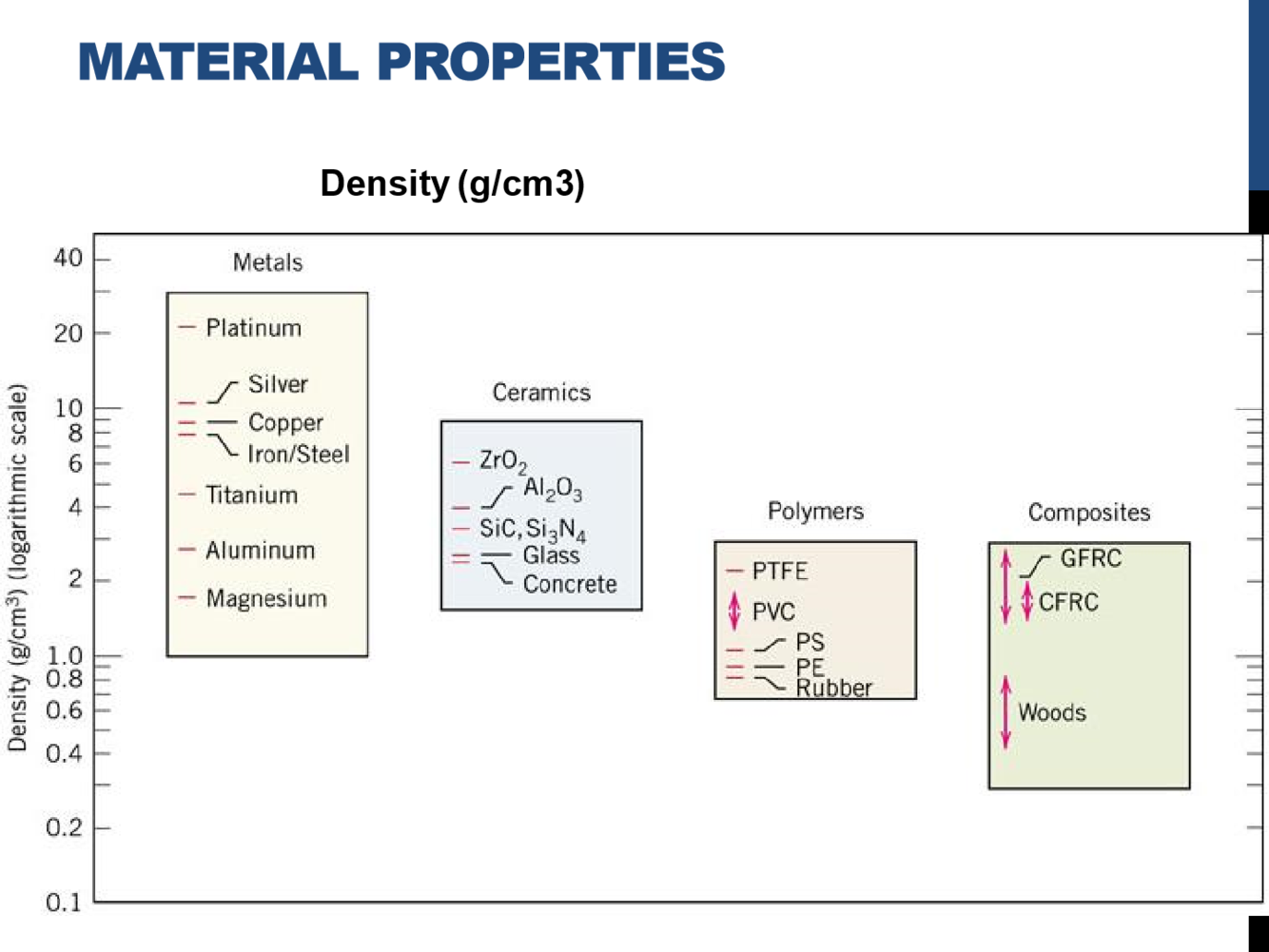
density
is a measure of how heavy an object is for a given size, i.e. the mass of material per unit volume. Changes in temperature do not significantly affect the density of a material
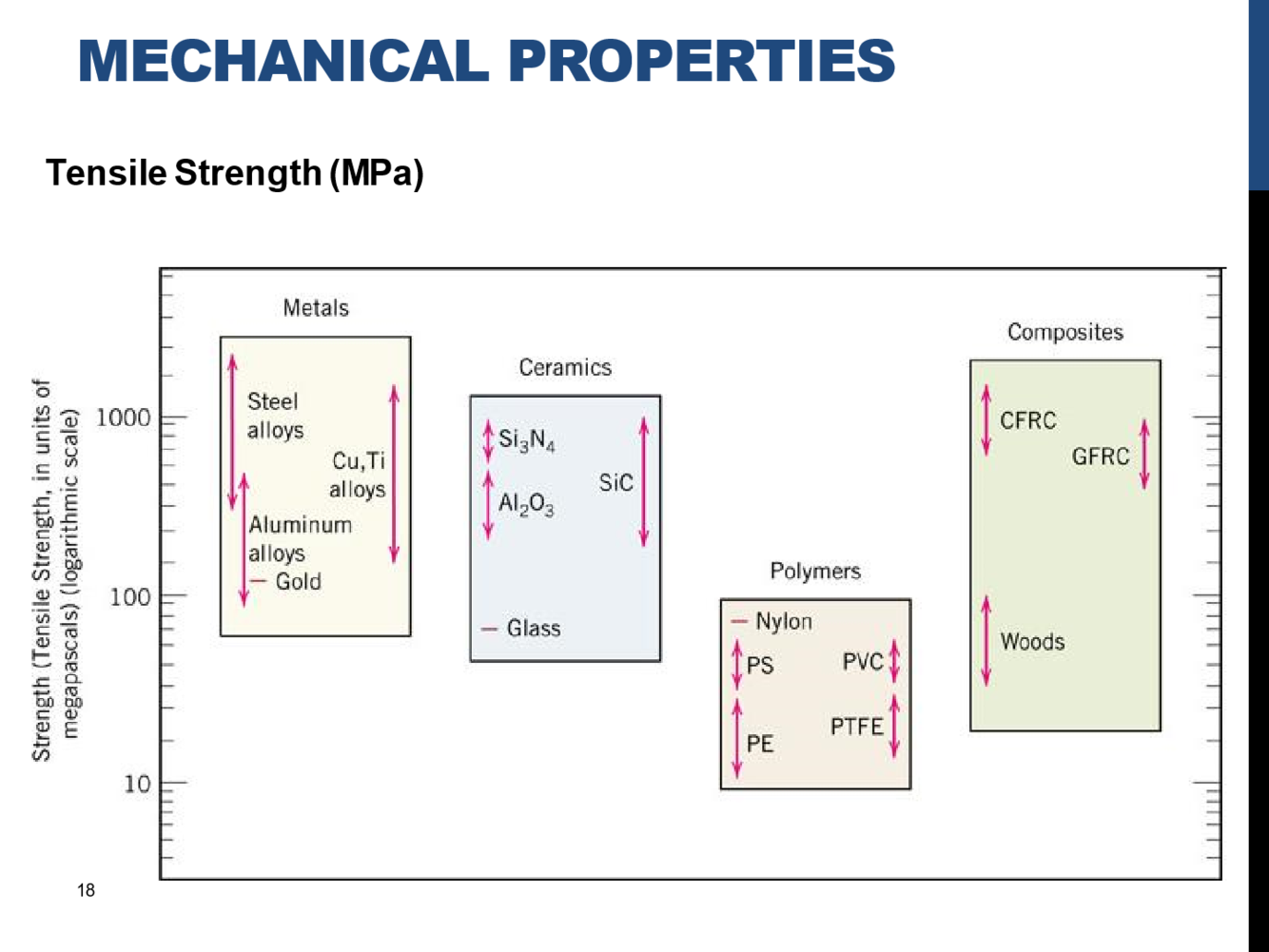
Tensile Strength
is the maximum stress that a material can withstand while being stretched or pulled before failing or breaking.
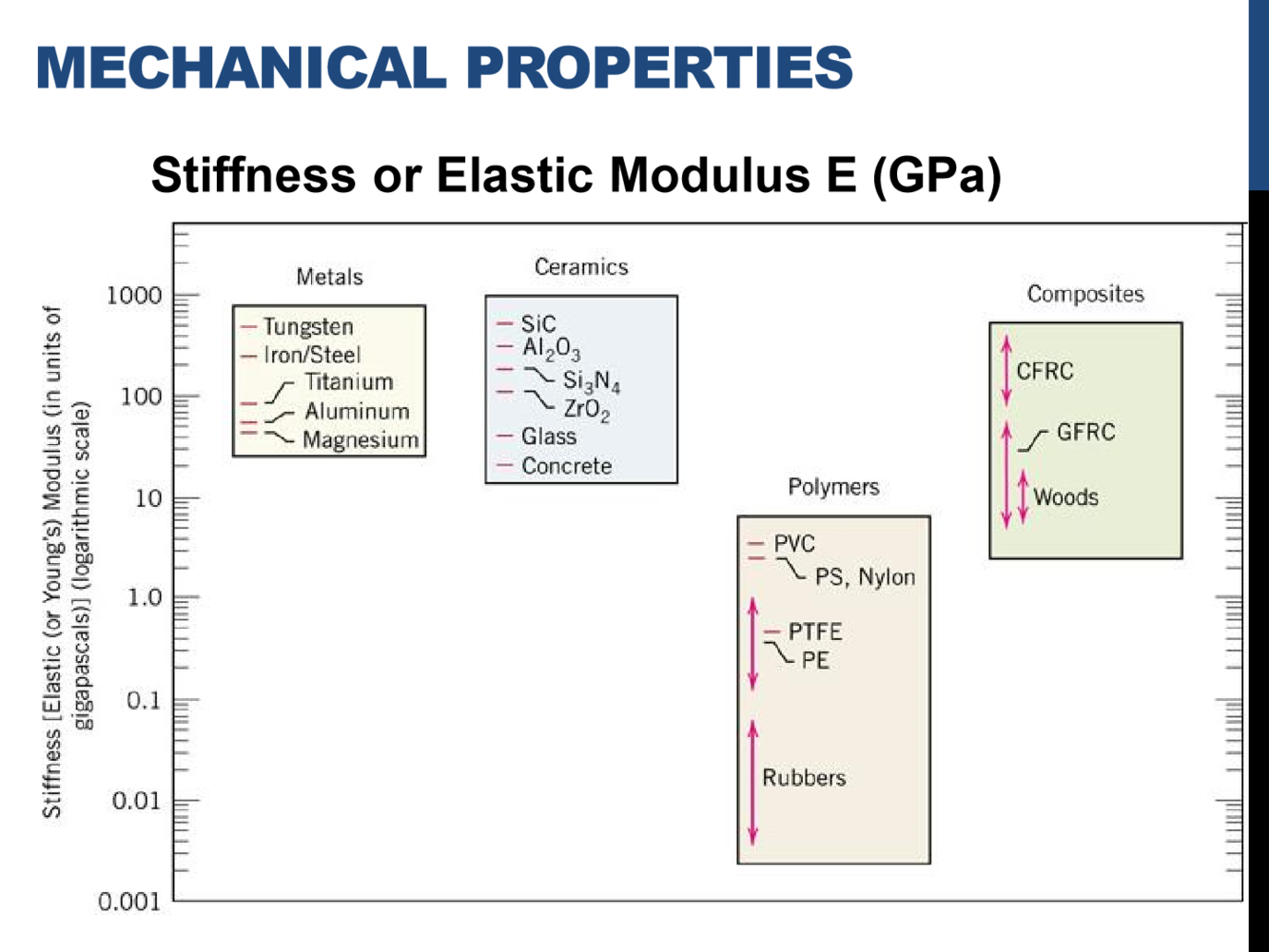
stiffness or elastic modulus
The Young’s Modulus (or Elastic Modulus) is in essence the stiffness of a material. In other words, it is how easy it is bent or stretched


-
Chapter 1 introduction36
-
Chapter 2 interatomic bonding36
-
Chapter 3 Structure of Crystalline Solids42
-
Chapter 4 defects in solids35
-
Chapter 5 Diffusion19
-
Chapter 6 Mechanical Properties34
-
Chapter 7 Deformation and strengthening mechanisms19
-
Chapter 8 Failure34
-
Chapter 9 Phase diagrams31
-
Chapter 10 phase transformations15
-
Chapter 11 Processing of metal alloys40
-
Chapter 12 Structures and properties of ceramics24
-
Chapter 13 Applications and Processing of Ceramics26
-
Chapter 14 Polymer Structures21
-
Chapter 15 characteristics, application and processing of polymers24
-
Chapter 16 composites22
-
Chapter 17 corrosion and degradation of materials10



