Development
explores both changes and constancies in physical growth, feelings and ways of thinking
- Lifespan development is the field of study that explores patterns of stability, continuity, growth and change that occur throughout a person’s life, from birth to death*
- Lifespan development researchers methodically apply scientific methods to develop theories about development, validate the accuracy of assumptions and systematically investigate human development*
Theory
a set of ordered, integrated statements that seek to explain, describe and predict human behaviour
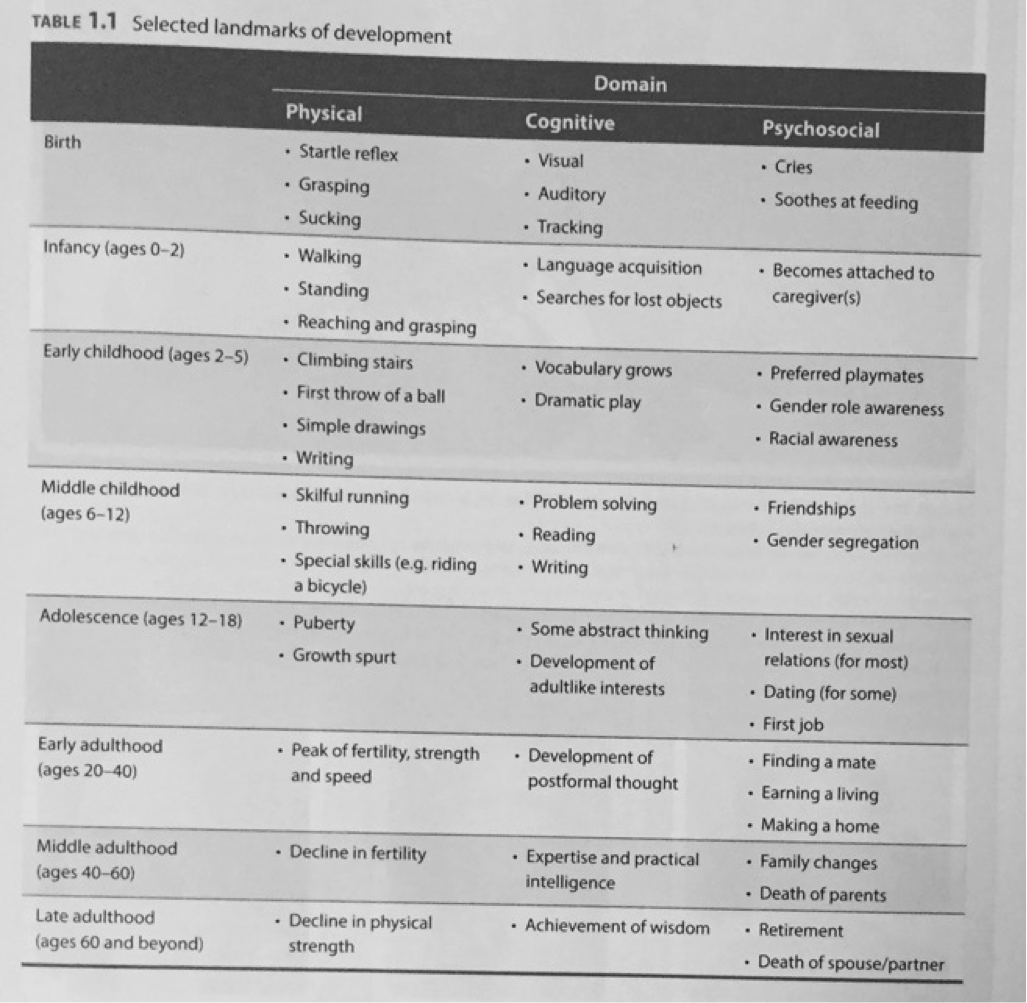
3 major domains of human development
- Physical: biological development
- Cognitive: changes in methods and styles of thinking, language ability, use and strategies for remembering and recalling information
- Psychosocial: changes in feelings or emotions as well as changes in relations with other people
Findings across cultures show parental acceptance is consistently associated with high self-esteem, independence and emotional stability, whereas the opposite is true
Landmarks of development
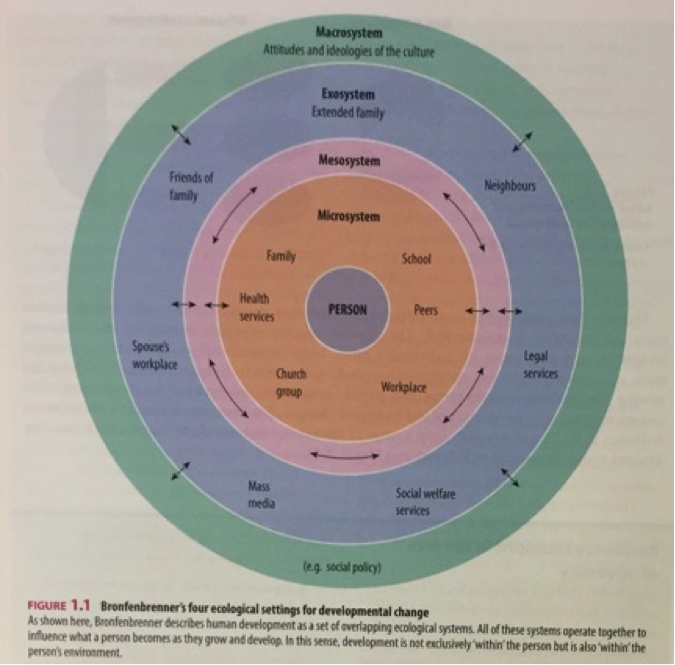
Bronfenbrenner’s developmental framework:
- Microsystem: refers to situations in which the person has face-to-face contact with influential others
- Mesosystem: refers to the connections and relationships that exist between two or more microsystems and that influence the person because of their relationships
- Exosystem: consists of settings in which the person does not participate but still experiences decisions and events that affect them directly
- Macrosystem: the overarching institutions, practices and patterns of belief that characterize society as a whole and take the smaller micro-, meso- and exosystems into account
Baltes and Nesselroade’s (1979) theory of development:
- Normative age-graded influences: have a strong relationship with chronological age
- Normative history- graded influences: are associated with historical time, such as plague and famine, which are examples of strong biological determinants of development
- Non- normative influences: do not occur in any normative age- graded or history- graded manner
Ford and Lerner’s (1992) developmental systems perspective:
This perspective investigates how an individual carries out transactions with their environment and how, through these transactions, their biological, psychological behavioral and environmental elements change or remain constant
It attempts to understand how multiple elements interact and shape a person’s life
Dynamic systems approach:
to studying and explaining lifespan development views the individual’s mind, body, physical and social worlds and experiences as constantly in motion, creating an integrated system that is dynamic, constantly evolving and moving
Four underlying foundations of developmental study:
- Continuity within change: how do we account for the underlying continuity in qualities, behaviours and skills in spite of apparent change?
- Lifelong growth: what is the potential for growth- emotional, cognitive and physical?
- Changing vantage points: how do key life events change in meaning as a result of changing roles and experiences?
- Developmental diversity: what factors create differences in individual’s development across?
Continuity within change
- Discontinuous development:
- Continuous development:
Discontinuous development: is a process in which a development occurs in distinct stages or steps, with each step resulting in behaviour that is qualitatively (a change in kind or type) different from the behavior at earlier steps
Continuous development: gradual development wherein achievements at one level build quantitatively (a change in amount)
Scientific method
consists of procedures to ensure objective observations and interpretations of observations, including the posing and answering of questions using carefully controlled techniques
Scientific method research procedure
- Formulating research questions
- Stating questions as hypotheses (a prediction derived from theory)
- Testing the hypothesis
- Interpreting and publicizing the results
Methods of studying human development
- cross sectional study
- longitudinal study
- naturalistic study
- emperimental study
- correlational study
- survey
- interview
- case study
- ethnography
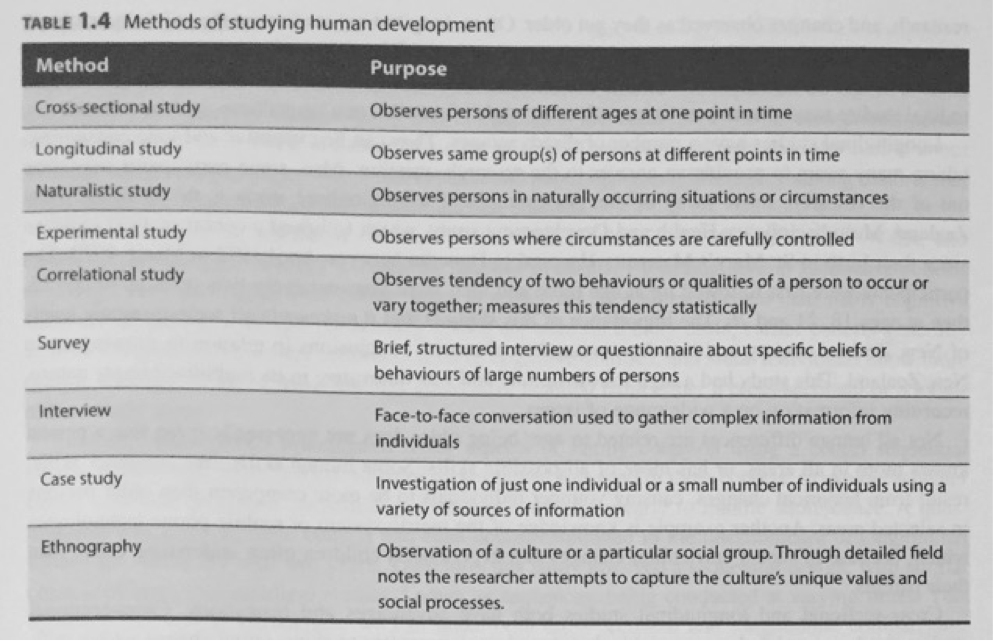
Cross-sectional study
Cross-sectional study: compares persons of different ages or groups (cohorts) in relation to such psychological variables as emotional development, cognitive ability, parenting styles, self-esteem and relationships at a single point in time
- These studies are useful in describing age-related trends in a relatively short time frame, which is convenient and ensures that the findings are not obsolete and outdated by the time the study is completed
- Although, these studies do not provide information about individual differences, as comparisons are limited to age-group averages
- Has an inability to distinguish between cohorts
Longitudinal study
observes the same participants periodically over a relatively long period
- These studies permit researchers to look at sequences of change and individual consistency and inconsistency over time
- These studies reveal more truly ’developmental’ change
- They can be expensive, time consuming and participants can drop out of the research
Cohorts
groups of people born at the same time
Sequential studies
combine the elements of cross-sectional and longitudinal studies
- At least cohorts are observed longitudinally and comparisons are made both within each cohort across time and between the cohorts at particular points in time
- This approach provides information about actual developmental changes within individuals, and about historical differences among cohorts that might create the impression of truly developmental changes
Naturalistic studies
purposely observe the behaviour as it normally occurs in natural settings such as at home, at school or in the workplace
Experimental studies
arrange circumstances so only one or two factors or variables vary at a time
Validity
accurately measuring or observing the characteristics that they intended to measure
- One way to improve validity is by including an experimental group and a control group
Correlation
a systematic relationship, or association, between two behaviours, responses or human characteristics
Case studies
try to pull together a wide variety of information, including test scores, questionnaires and observations about the individual case and then present the information as a unified whole, emphasising relationships among specific behaviours, thoughts and attitudes in the individual
Informed consent
when people or groups being studied understand the nature of the research, believe their rights are being protected and feel they van volunteer or refuse to participate without an repercussions
- Informed consent occurs when confidentiality, full disclosure of purposes and respect for individual’s freedom to participate, are closely followed
The nature of development
•Explores patterns of constancies and change
- Change can be specific or general
- Constancy can be short or long term

-
Chapter 5: Psychosocial Development in the First 2 Years34
-
Chapter 1: Introduction31
-
Chapter 2: theories of development32
-
Chapter 3: biological foundations, genetics and prenatal development36
-
Chapter 4: physical and cognitive development in the first two years30
-
Chapter 6: physical and cognitive development in early childhood30
-
Chapter 7: psychosocial development in early childhood29
-
Lecture 8: physical, cognitive and psychosocial development in adolescence42
-
Lecture 9: physical, cognitive and psychosocial development in early adulthood38
-
Lecture 10: physical, cognitive and psychosocial development in middle adulthood34
-
Lecture 11: physical and cognitive development in late adulthood38



