Logistics changed in a global world. What are important driving/pushing trends for the change in industry transportation?
Pushing trends are:
- Globalization of markets and technologies
- The pressure for inventory reduction in the entire SC
- The focus on core competencies by intensified outsourcing of logistics activities
- The increasing SC complexity in a global context
How would you characterize the industrial globalization and its impact on the globalization of logistics and transportation?
Globalization takes place in three different areas:
- Globalization of Markets → Globalization of Consumption
- international companies (multinational giants but also specialized SMEs)
- International not regional competition § International (mobile) customers - Globalization of Production & Technology → Globalization of Production (Transformation)
- International outsourcing of goods and services)
- International production and R&D facilities (increasing FDI)
- Derived from the first two trends: Globalization of Logistics &
Transportation → Globalization of Transfer-Activities
- International, global Logistics Service Providers
- International distribution structures and alliances
For what stands the abbreviation GATT?
What was the function of GATT?
GATT stands for “General Agreement on Tariffs and Trade”.
It was a legal agreement after World War II between many countries, whose overall purpose was to promote international trade by reducing or eliminating trade barriers such as tariffs or quotas.
GATT was signed by 23 nations in Geneva on 30 October 1947, and took effect on 1 January 1948.
The WTO is a successor to GATT, and the original GATT text (GATT 1947) is still in effect under the WTO framework, subject to the modifications of GATT 1994.
Source: Wikipedia
Please name and characterize in brief main drivers of the globalization process!
The main drivers of the globalization process are:
- Global customers and market channels with common customer needs (converge in the direction of a global norm). As a result, global market channels and transferable marketing are strategies of global market players
- Lower costs (labor, land, energy, knowledge) in foreign countries enable a cost-based re-allocation of production and R&D facilities. An important base for this development are global communication standards (like EDIFACT)
- Intensified competition of foreign competitors in home markets and declining trade and investment barriers (FDI). This trend is forced by the economic interdependence among countries, based on economical constructions like the EU or NAFTA.
For what stands the abbreviation NAFTA?
Which countries are involved in NAFTA?
NAFTA is the “North American Free Trade Agreement” originally signed by the states of America, Mexico and Canada.
Remark:
On September 30, 2018, it was announced that the United States, Mexico, and Canada had come to an agreement to replace NAFTA with the United States–Mexico–Canada Agreement (USMCA). The USMCA is the result of the renegotiation of NAFTA that the member states undertook from 2017 to 2018, though NAFTA will remain in force until the USMCA is ratified by its members.
Source: Wikipedia
What are FDIs and which role do FDIs play in globalization process?
FDI = Foreign Direct Investments.
FDIs are are all investments of a foreign country in the infrastructure, in local production and logistics facilities and in the education/knowledge system (R&D) of another country.
The idea behind FDIs is the establishment of long-term economic relations and reduce the trade-related domestic market entry barriers for the investor in the future.
Please explain the following statement using an example out of the lecture:
“From the logistics point of view, worldwide transports are characterized by a high level of imbalance and therefore logistics professionals have to deal with a lot of geographical and technological constraints!”
The world trade is characterized by a missing parity of freight flows. If you take China as an export country, for example, there are 53% more containers exported to the Mediterranean /Europe than vice versa. This imbalance reduces the possibilities for EoS on complete roundtrips.
The same problem is existing in air cargo. The missing parity of exports vs. imports and the restrictions of available air corridors between the world economic centers/triads reduces the throughput capacities on sea and air routes. Larger container ships, airplanes and the corresponding ports and airports are one result.
What changed in the global trade and SC networks after the financial crisis in 2008/9? What were the reasons for this change?
Because of the increased economic uncertainty after the financial crisis, the multiplier effect between international trade and economic growth declined, means the international trade grows nowadays at the same speed as the general economic growth.
Reasons for this change were:
- Developed countries – including the Eurozone – have yet to fully recover and therefore there is less demand for imports of consumer goods.
- Developing countries have been forced to focus their own domestic infrastructure to maintain their rate of economic growth.
- The downturn has created more protectionist policies that have acted as a drag on international trade.
- Most manufacturing that can be outsourced to Asia has been out-sourced. The gains to international trade could be regarded as being ‘one-off’.
Please explain the following statement using some evidences in the current global trade:
The world’s economy is moving from globalization to regionalization of supply chains!”
The evidence for this statement are the following trends:
- Global flows of goods are becoming more desperate. (In 1990, 63 percent of global flows of goods moved through the top 50 routes. By 2011, this had fallen to 54 percent.)
- Cross-border flows of goods, services, and finance from emerging markets in 2012 accounted for 38 percent of the total, up from 14 percent in 1990.
- South–South trade has grown from 6 percent of goods flows in 1990, to 24 percent in 2012.
- The development of Mega-Cities in the emerging markets
Please explain the term “Mega-Cities” in the context of the global urbanization trend! What will be the challenges and consequences for logistics because of these developments?
Urbanization:
- By 2030, 60% of the world’s population will live in urban areas (vs. 47% in 2000) = urbanization.
- The trend to urbanization is very strong in underdeveloped countries – the results are “Mega-Cities of over 10 Mio. people (Example of Lagos in West Africa: Growing population from 2 mio. In 1970 to 15 mio. in 2013)
Combined with this trend are new challenges in housing, infrastructure, health care, security etc. Therefore, Logistics development will increasingly be focused around cities rather than countries.
Please explain the following chart showing the change in the cost structure in global SCs over the last decades. What were the main reasons for this trend?
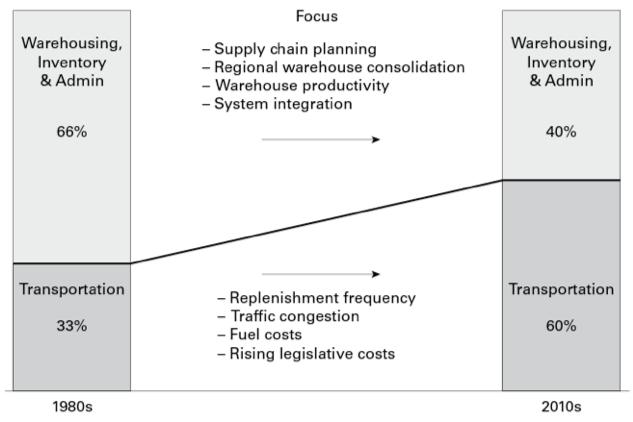
- Distribution strategies have been largely influenced by the trade-off between the cost of moving goods to market and the cost of holding inventories.
- The relatively cheap cost of transport has allowed manufacturers and retailers to store goods in centralized locations, and supply them over longer distances.
- When goods are stored in close proximity to the end market, transport costs are low.
- If a regional distribution strategy is implemented, the number of national warehouses fall and so do stock levels. However, transport costs rise, due to the increasing distance to market.
- With a distribution structure with regional DCs the SC-Costs for transportation increased in the last 30 years significantly.
Why should a company enter a global market? Give some reasons!
- Increased revenue (e.g. open up to new markets, expand beyond competitors)
- Achieve EoS / reduce direct costs (e.g. consolidated global demand with higher EoS, lower labor costs)
- Advance technology (e.g. access to intl. expertise or restricted technologies)
- Reduce the firm’s global tax liability (e.g. obtain local/regional tax benefits, reduction in value-added tax-costs)
- Reduce market access uncertainty (e.g. less transportation uncertainty, security constraints)
- Enhance sustainability (e.g. ongoing availability of resources in foreign countries)
Why are the size of the population and the age distribution important to the economic development of a country?
The size of the population in a country is the base for:
- the volume of the potential consumer market
- the source of cheap and/or qualified workers
The pure size is not important alone - probably more important is the status and the development of the age distribution. The reasons:
- the older a society is, the smaller is the potential market of qualified and/or cheap workers
- the older a society is, the more a company has to adapt their product/service portfolio to the needs of older people. The critical question in this context is the countries specific amount of available money in the (older society) for spending out on new products and services.
Why and how have mega-cities an impact on (global) supply chains?
- Mega-cities will create their own economies of scale, supplied by local/regional production facilities.
- Consumer goods will be customized to local tastes.
- Each city will develop its own unique ecosystem, which takes into account the movement of people, data, finance, energy, waste, goods and services.
- Transport demands will be specific to each city’s needs and capabilities: poor planning and infrastructure will result in high logistics costs.
- Fulfillment, packaging, miniaturization and reverse logistics will require an increased intensity of logistics provision.
Technology is named as a “game changer” in the development of global Supply Chains.
Please name three key such technology “game changers” and in which context they are used in the industry and/or by LSPs!
- The Internet in E-Business and Ecommerce
- Industrial Robotics for automized manufacturing and picking / packing activities
- The digitalization of manufacturing with additive manufacturing or 3-D-printing



