What is Strategy
Strategy is the art of matching the resources and capabilities of a firm to the opportunities and risks in its external environment for the purpose of developing a sustainable competitive advantage.
Note: Be wary of any advice you read that claims to identify critical resources or capabilities that successful companies have to develop in order to gain a competitive advantage.
Define basic business strategy and its goal
Strategy is simple: Gain a sustainable competitive advantage through
- Increase performance,
- Increase P (price)
- Reduce C (cost).
When does a company have a sustainable advantage?
When they can
- Deliver the same product or service benefits as their service competitors but at a lower cost or
- Deliver superior product or service benefits at a similar cost
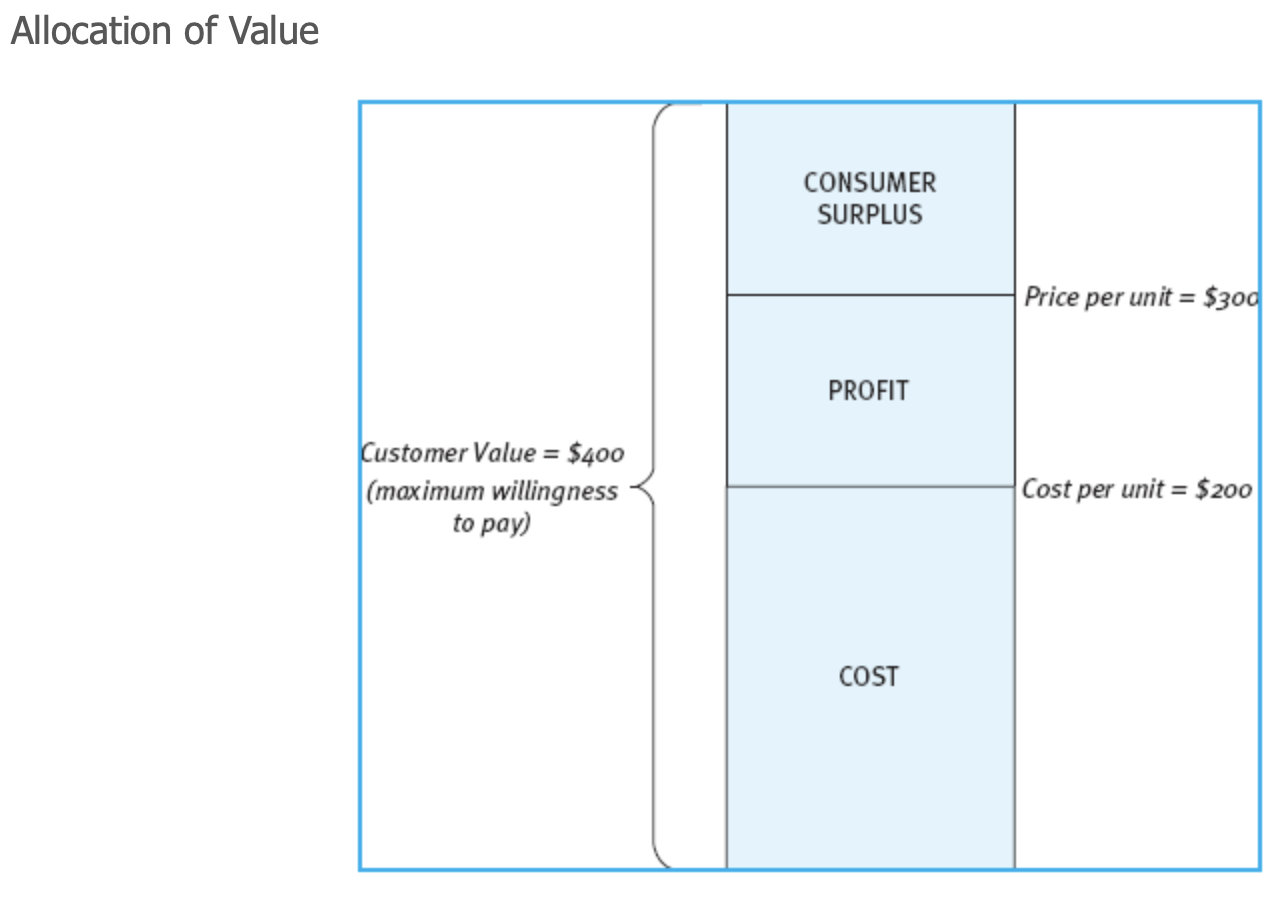
Define the Allocation of Economic Value
- Height of column is the total value of the product (i.e., the maximum amount a buyer is willing and able to pay)
- Cost represents value is captured by suppliers
- Price is the difference b/t price and cost
- Consumer Surplus is difference b/t value and price
Strategy is about increasing the size of the profit box (Raise prices or Lower costs)
What is a Stock Price
A stock price is a discounted flow of future profits
What are the two schools of thought on economic profit
- Industrial Organization (IO) economics perspective - locates the source of advantage at the industry level (External view)
- Resource-based View (RBV) - locates economic profit at the individual firm level (Internal view)
Describe the Industrial (IO) View
Assumes that the industry structure is the most important determinant of long-run profitability
The way to earn economic profits is to choose an attractive industry and then develop the resources that will allow you to successfully compete in the industry.
An “external” view
Describe Michael Porter’s Five Forces model
The best industries are characterized by
- low buyer power,
- low supplier power,
- low threat of entry (high barriers to entry),
- low threat from substitutes, and
- low levels of rivalry between existing firms.
Describe how the Five Forces model defines “industry”
An industry is a
- group of firms
- producing products that are
- close substitutes to each other
- to serve a market.
Note: It’s important to realize that firms often operate in multiple industries.
Describe how the Five Forces model defines “low supplier power”
Suppliers are the providers of any input to the product or service.
(E.g., labor, capital, and providers of raw/partially finished materials)
Supplier power tends to be higher when
- Inputs they provide are critical inputs or highly differentiated.
- Concentration among suppliers - firm will have fewer bargaining options.
- Significant costs to switching between suppliers.
Describe of the Five Forces model defines “low buyer power”
Buyers are more powerful if:
- They are concentrated
- if it is easy for buyers to switch from firm to firm, buyer power will tend to be higher.
(More power means these buyers will find it easier to capture value, taking value away from your firm.)
Describe how the Five Forces model defines “low threat of entry”
Economic profits tend to draw new entrants. Barriers to entry keep them out.
Barriers include:
- government protection (e.g., patents or licensing requirements),
- proprietary products,
- strong brands,
- high capital requirements for entry, and
- lower costs driven by economies of scale.
Describe how the Five Forces model defines “low threat of substitute”
Comparable products of like value. If close substitutes to a product are available and buyers find it inexpensive to switch to them.
Describe how the Five Forces model defines “low threat of rivalry”
the force most directly related to our typical view of “competition.” If a large number of similarly situated firms compete in an industry with high fixed costs and slow industry growth, rivalry is likely to be quite high.
Rivalry also tends to be higher when products are not very well differentiated and buyers find it easy to switch back and forth.
What is the Force that Porter Forgot
Cooperation from complements.
A company must decide whether to pursue a “product” or a “platform” strategy:
- a product is largely proprietary and under one company’s control,
- an industry platform… requires complementary innovations to be useful, and…is no longer under the full control of the originator..”
1 of the biggest mistakes a co. can make is to pursue a product strategy & fail to recognize the platform value of their product
Define the Resource-based View (RBV)
Assumes that superior resources are the most important determinant of long-run profitability
The way to earn economic profits is to leverage immobile resources as differentiators.
- Tangible like equipment, real estate, and financial capital as well as
- Intangible like brand, knowledge, and organizational culture.
Define the Two primary assumptions that underlie the RBV
- resource heterogeneity
- resource immobility
What makes a resource “rare”
It must not be available simultaneously to a large number of competitors
What makes a resource “valuable”
A valuable resource must allow a business to conceive of and implement strategies that improve its efficiency or effectiveness
What conditions create inimitability of resources
- Resources that flow from a firm’s unique historical conditions
- If the link between resources and advantage is unclear
- If a resource is socially complex (e.g., organizational culture)
What are 3 Basic Strategies of firms looking to generate superior economic performance
- cost reduction
- product differentiation, or reduction of the elasticity of demand for a product
- reduction in competitive intensity
the optimal margin of price over marginal cost is related to the elasticity of demand
(P - MC) / P = 1 / |e|
To use the Five Forces model, what must one consider
To use the Five Forces model, one must consider “value capture”
- Just because you are in an industry that creates value doesn’t mean that you are going to capture it
- Value is created in each industry and distributed across suppliers, industry rivals, and buyers
- The Five Forces model helps you think about how much of the industry value your firm is likely to capture
Limitation of the Five Forces
Portrays an industry as a zero-sum game
- i.e., the way you get a bigger piece of the pie is to take it from one of the other participants in the industry
- Although this is one way to view competition, companies can also work with other industry participants to try to build a larger pie
- With a larger pie, everyone’s slice grows bigger
- Some economists recommend that as a complement to a Five Forces analysis, which focuses on threats in the industry, that firms also evaluate the Value Net of the industry for cooperative opportunities
Two Strategies of a Platform
- “Coring” - using a set of techniques to create a platform by making a technology “core” to a particular technological system and market
- E.g., Google Inc. in Internet search; Qualcomm in wireless technology.
- “Tipping” - the set of activities that helps a company “tip” a market toward its platform rather than some other potential one
- E.g., Linux’s growth in the market for Web server operating systems



