Switch:
Turn the circuit on (closed), or off (open)
Fixed resistor:
A resistor limits the flow of current. A fixed resistor has a resistance it cannot change
Variable resistor:
A resistor with a slider that can be used to change its resistance. Used often in dimmer switches and volume controls
Thermistor:
The resistance of a thermistor depends on its temperature. As its temperature increases, its resistance decreases and vice versa
Light-dependent resistor (LDR):
The resistance of an LDR depends on the light intensity. As the light intensity increases, its resistance decreases and vice versa
Diode:
A diode allows current to flow in one direction only. They are used to convert AC to DC current
Light-emitting diode (LED):
This is equivalent to a diode and emits light when a current passes through it. These are used for aviation lighting and displays (TVs, road signs)
Ammeter:
Used to measure the current in a circuit. Connected in series with other component
Voltmeter:
Use to measure the potential difference of an electrical component. Connected in parallel with component
Electromotive Force
- When charge passes through a power supply such as a battery, it gains electrical energy
- The electromotive force (e.m.f) is the amount of chemical energy converted to electrical energy per coulomb of charge (C) when charge passes through a power supply
- e.m.f is measured in Volts (V)

e.m.f is also
- the potential difference across the cell when no current is flowing e.m.f can be measured by connecting a high-resistance voltmeter around the terminals of the cell in an open circuit
potential difference
- Potential difference describes the loss of energy from charges; ie. when electrical energy is transferred to other forms of energy in a component

-e.m.f. describes the transfer of energy
- from the power supply to electrical charges within the circuit
Internal Resistance
- All power supplies have some resistance between their terminals
- This is called internal resistance (r)
internal resistance causes the
- charge circulating to dissipate some electrical energy from the power supply itself
- This is why the cell becomes warm after a period of time
e.m.f equation
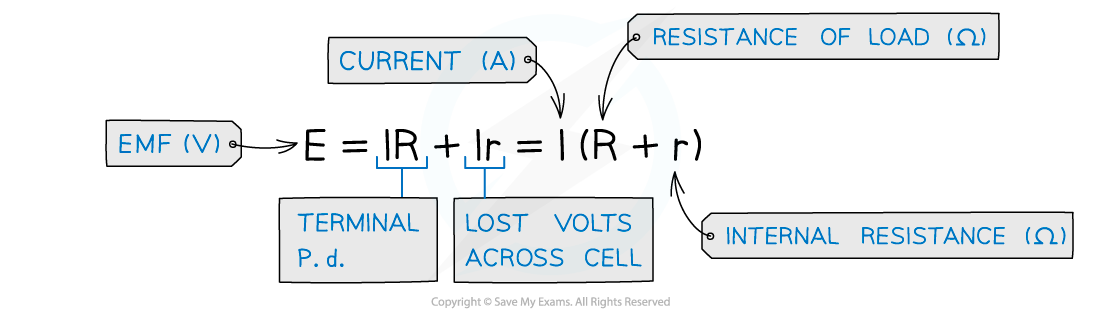
The internal resistance therefore causes
- loss of voltage or energy loss in a power supply
- This voltage is not available to the rest of the circuit so is called the ‘lost volts’
- Vr is the lost volts
- This is the voltage lost in the cell due to internal resistance, so, from conservation of energy:
- Lost volts = e.m.f − terminal p.d
- Lost volts = I × r (Ohm’s law)
Kirchhoff’s First Law
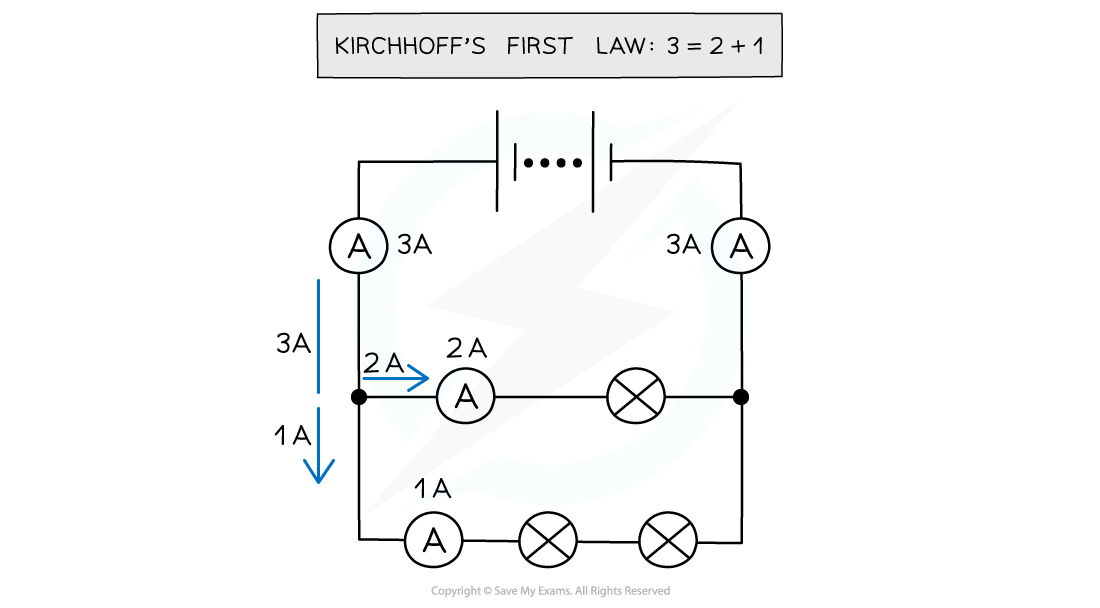
- The sum of the currents entering a junction always equal the sum of the currents out of the junction
- This is a consequence of conservation of charge
- current shouldn’t decrease or increase in a circuit when it splits
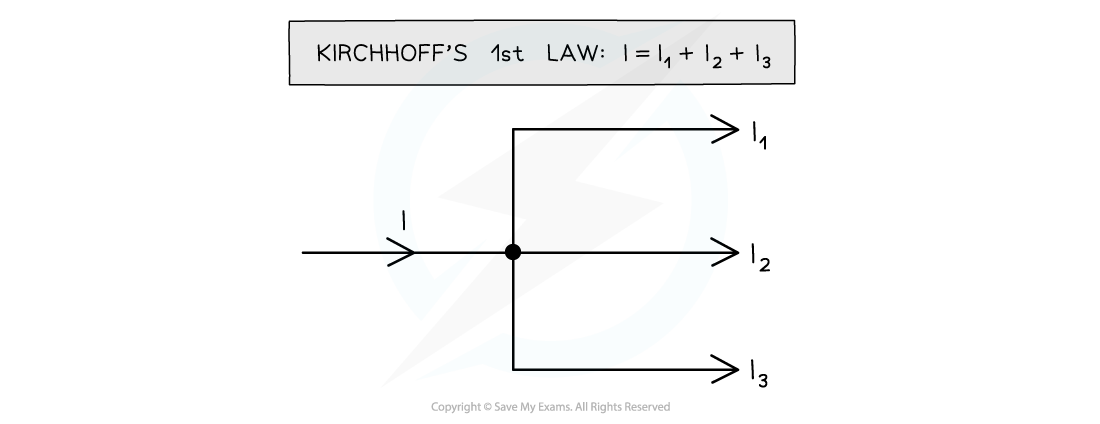
In a circuit:
- A junction
- A branch
- A junction is a point where at least three circuit paths meet
- A branch is a path connecting two junctions
In a parallel circuit, the current …. at the junctions and each branch has a different value. Kirchhoff’s first law applies at each junction
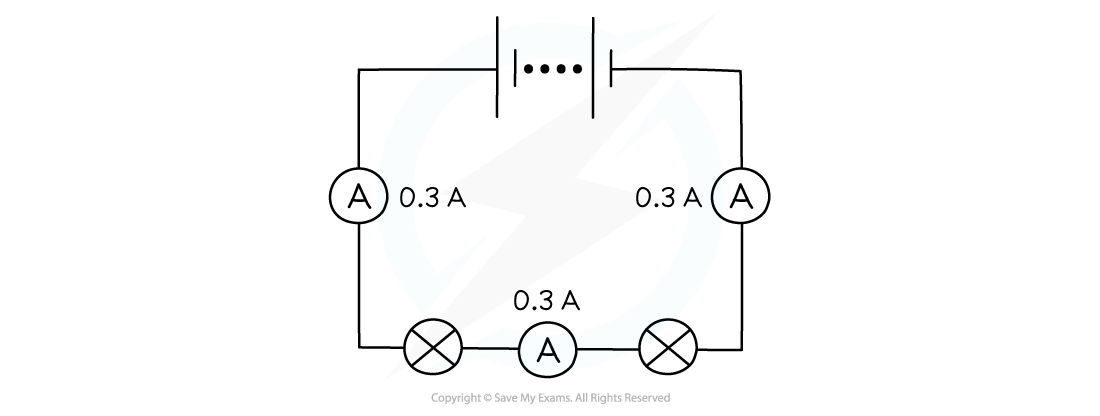
In a series circuit, the current is the … at any point
Kirchhoff’s Second Law
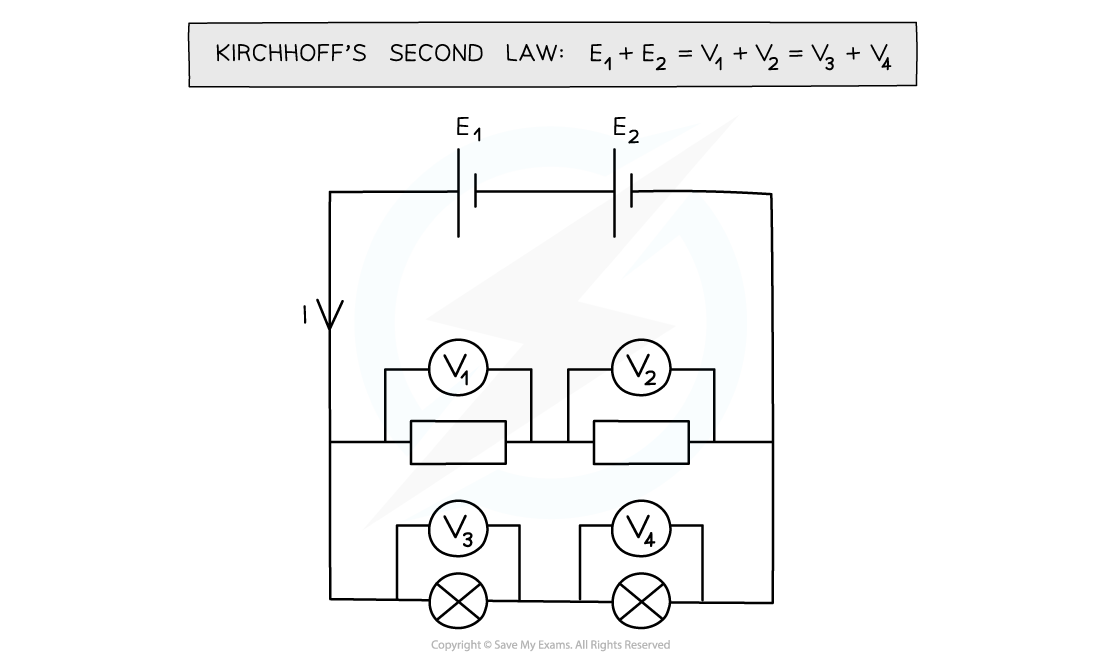
- The sum of the e.m.f’s in a closed circuit equals the sum of the potential differences
- This is a consequence of conservation of energy
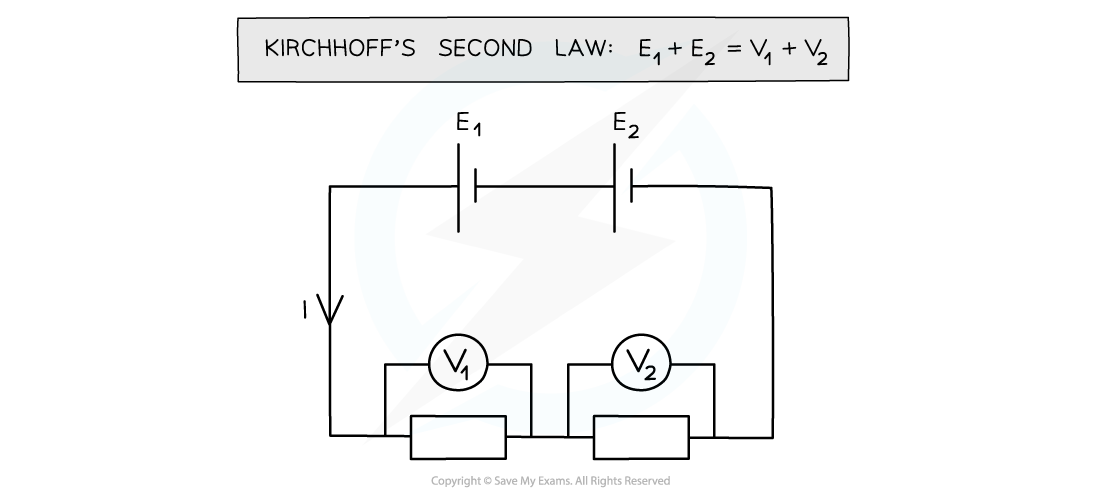
In a series circuit, the voltage is … across all components depending on their resistance
- split
- The sum of the voltages is equal to the total e.m.f of the power supply
In a parallel circuit, the voltage is the … across each closed loop
- Same
- The sum of the voltages in each closed circuit loop is equal to the total e.m.f of the power supply:


-
Chapter 1 Physical Quantities & Units27
-
Chapter 2 Kinematics15
-
Chapter 3 Dynamics29
-
Chapter 4 Forces, Density & Pressure34
-
Chapter 5 Work, Energy & Power24
-
Chapter 6 Deformation of Solids30
-
Chapter 7 Waves56
-
Chapter 8 Superposition37
-
Chapter 9 Electricity32
-
Chapter 10 D.C. Circuits41
-
Chapter 11 Particle Physics42



