What is the management approach for a claudicant?
1- Recognize the presence of lower extremity ischemia. 2- Quantify the extent of the local and systemic disease.
3- Determine the degree of functional impairment related to PAD.
4- Identify and control modifiable risk factors.
5- Establish a comperhensive treatment plan.
What is the pathophysiology of the ischemic pain?
1- Ischemic neuropathy involving small unmyelinated A delta and C sensory fibers.
2-Local intramuscular acidosis from anaerobic metabolism enhanced by the release of substance P.
What is the definition of Intermittent Claudication?
- It is an ischemia related symptom that varies from fatigue to pain most commonly affecting the calf muscles but it might affect the thigh or the buttock.
- Intermittent in nature.
- Reproducible with the same walking distance.
- Relieved by rest.
What are the major patterns of arterial obstruction/ stenosis?
1- Inflow disease.
2- Outflow disease.
3- combination of both.
What is the definition of Inflow disease?
It refers to lesions in the suprainguinal vessels:
1- Infrarenal aorta.
2- Iliac arteries.
What is the classic presentation of patients with inflow disease?
- Commonly leads to buttock and thigh claudication.
- In men, if the stenosis or occlusions are bilateral and are proximal to the origins of the internal iliac arteries, vasculogenic erectile dysfunction may be present as well.
- Although buttock and thigh claudication may be the first symptoms, with continued ambulation, these patients may exhibit classic symptoms of intermittent calf claudication.
Which group of patients tend to have an inflow disease?
1- Male patients.
2- Smokers.
What is the definition of Outflow disease?
It refers to lesions in the infrainguinal vessels, from the common femoral artery to the pedal vessels.
What is the classic presentation of patients with outflow disease?
- Superficial femoral artery stenosis or occlusion is
associated with intermittent calf claudication with no specific thigh or foot symptoms. - Popliteal and tibial artery occlusions are more commonly associated with limb-threatening ischemia.
What is the most common lesion associated with intermittent claudication of the calf muscles?
Superficial femoral artery stenosis or occlusion.
Why isolated superficial femoral artery occlusion without distal disease is rarely the cause of critical leg ischemia?
Because the deep femoral artery provides
collateral circulation and reconstitution of the popliteal
artery.
Why Popliteal and tibial artery occlusions are more commonly associated with limb-threatening ischemia?
owing to the paucity of collateral vascular pathways beyond these lesions.
Which group of patients tend to have an outflow disease?
1- Elderly.
2- Diabetics.
3- End stage renal disease.
4- Long-term corticosteroid therapy.
What is the classic presentation of patients with a combination of inflow and outflow disease?
- They may have widespread symptoms of IC affecting the buttock, hip, thigh, and calf.
- These symptoms frequently begin in the buttock and thigh and then involve the calf muscles with continued ambulation; however, they may appear in reverse order if the distal disease is more severe than the inflow disease.
- Severe combined inflow-outflow disease may result in limb-threatening ischemia.
What are the Nonatherosclerotic Causes of Claudication?
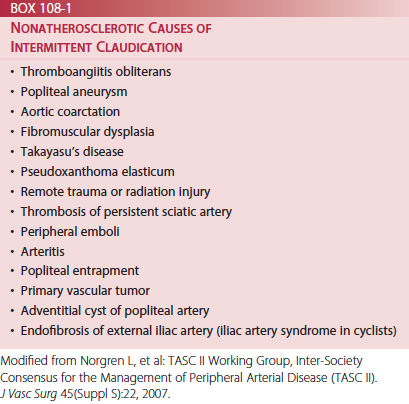
Waht is the pathopysiological mechanism of the pain caused by chronic compartment syndrome?
- Chronic compartment syndrome causes exercise-related discomfort only in the anterolateral aspect of the calf.
- The cellular basis for the anterior compartment muscular pain associated with chronic compartment syndrome is ischemia resulting from diminution of the muscular arteriovenous pressure difference owing to venous congestion and compartment tissue hypertension.
What is the definition of Critical limb ischemia (CLI)?
It is the most severe form of PAD and represents approximately 1% of the total number of patients with PAD.
How does the natural history of CLI differs significantly
from that of claudication?
CLI is associated with a higher risk of limb loss in the absence of revascularization, whereas claudication rarely progresses to the point of requiring
amputation.
What are the manifestattions of CLI?
- Rest pain.
- Ischemic ulceration of the forefoot or toes.
- Ischemic Gangrene of the forefoot or toes.
What does CLI represent?
It represents a reduction in distal tissue perfusion below the resting metabolic requirements.
What is Rest pain?
- It is a burning sensation or an uncomfortable coldness or paresthesia of sufficient intensity to interfere with sleep.
- The ischemic neuropathy in CLI may also cause numbness, which is diffucult to distinguish in patients with diabetic neuropathy.
Why does rest pain worsen by leg elevation?
Because of the loss of the gravitational pull of blood to
the foot; and that is why it is relieved by placing the limb in a dependent position, such as dangling it off the side of the bed.
What are the hemodynamic measurements in a patient with CLI?
- Systolic ankle pressure < 50 mm Hg.
- Toe pressure < 30 mm Hg.
- ABI < 0.40.
What are the characteristics of arterial ulceration in non diabetic patients?
It is characterized by a shallow, nonhealing, pallid erosion of the skin in the forefoot and/or toes.






