The interaction of the IS curve and the LM curve together determine:
- the price level and the inflation rate.
- the interest rate and the price level.
- investment and the money supply.
- the interest rate and the level of output.
4
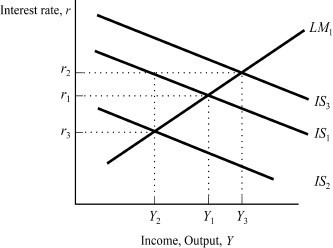
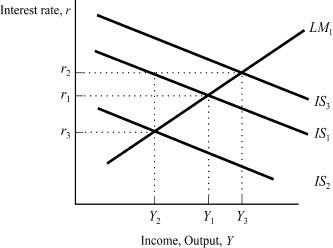
Based on the graph, starting from equilibrium at interest rate r1 and income Y1 a decrease in government spending would generate the new equilibrium combination of interest rate and income:
- r2, Y2
- r3, Y2
- r2, Y3
- r3, Y3
2
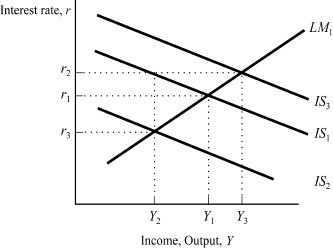
Based on the graph, starting from equilibrium at interest rate r1 and income Y1 an increase in government spending would generate the new equilibrium combination of interest rate and income:
- r2, Y2
- r3, Y2
- r2, Y3
- r3, Y3
3
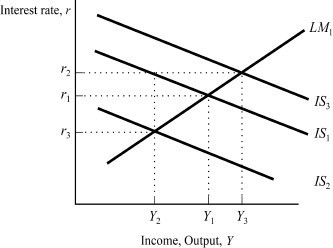
Based on the graph, starting from equilibrium at interest rate r1 and income Y1 a tax cut would generate the new equilibrium combination of interest rate and income:
- r2, Y2
- r3, Y2
- r2, Y3
- r3, Y3
3
In the IS–LM model when government spending rises, in short-run equilibrium, in the usual case the interest rate ______ and output ______.
- rises; falls
- rises; rises
- falls; rises
- falls; falls
2
In the IS–LM model, a decrease in government purchases leads to a(n) ______ in planned expenditures, a(n) ______ in total income, a(n) ______ in money demand, and a(n) ______ in the equilibrium interest rate.
- decrease; decrease; decrease; decrease
- increase; increase; increase; increase
- decrease; decrease; increase; increase
- increase; increase; decrease; decrease
1
In the IS–LM model, the impact of an increase in government purchases in the goods market has ramifications in the money market, because the increase in income causes a(n) ______ in money ______.
- increase; supply
- increase; demand
- decrease; supply
- decrease; demand
2
In the IS–LM model when taxation increases, in short-run equilibrium, the interest rate ______ and output ______.
- rises; falls
- rises; rises
- falls; rises
- falls; falls
4
If the LM curve is vertical and government spending rises by G, in the IS–LM analysis, then equilibrium income rises by:
- G/(1 – MPC).
- more than zero but less than G/(1 – MPC).
- G.
- zero.
4
If MPC = 0.75 (and there are no income taxes) when G increases by 100, then the IS curve for any given interest rate shifts to the right by:
- 100.
- 200.
- 300.
- 400.
4
If MPC = 0.75 (and there are no income taxes but only lump-sum taxes) when T decreases by 100, then the IS curve for any given interest rate shifts to the right by:
- 100.
- 200.
- 300.
- 400.
3
In the IS–LM model under the usual conditions in a closed economy, an increase in government spending increases the interest rate and crowds out:
- prices.
- investment.
- the money supply.
- taxes.
2
The increase in income in response to a fiscal expansion in the IS–LM is:
- always less than in the Keynesian-cross model.
- less than in the Keynesian-cross model unless the LM curve is vertical.
- less than in the Keynesian-cross model unless the LM curve is horizontal.
- less than in the Keynesian-cross model unless the IS curve is vertical.
3
Using the IS–LM analysis, if the LM curve is not horizontal, the multiplier for an increase in government spending is ______ for an increase in government purchases using the Keynesian-cross analysis.
- larger than the multiplier
- the same as the multiplier
- smaller than the multiplier
- sometimes larger and sometimes smaller than the multiplier
3
The reason that the income response to a fiscal expansion is generally less in the IS–LM model than it is in the Keynesian-cross model is that the Keynesian-cross model assumes that:
- investment is not affected by the interest rate whereas in the IS–LM model fiscal expansion raises the interest rate and crowds out investment.
- investment is not affected by the interest rate whereas in the IS–LM model fiscal expansion lowers the interest rate and crowds out investment.
- investment is autonomous whereas in the IS–LM model fiscal expansion encourages higher investment, which raises the interest rate.
- the price level is fixed whereas in the IS–LM model it is allowed to vary.
1
In the IS–LM model, changes in taxes initially affect planned expenditures through:
- consumption.
- investment.
- government spending.
- the interest rate.
1
In the IS–LM analysis, the increase in income resulting from a tax cut is usually ______ the increase in income resulting from an equal rise in government spending.
- less than
- greater than
- equal to
- sometimes less and sometimes greater than
1
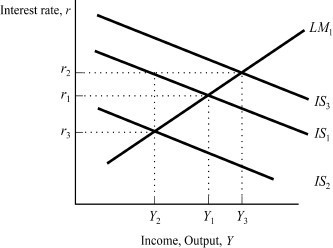
Based on the graph, starting from equilibrium at interest rate r1 and income Y1 decrease in the money supply would generate the new equilibrium combination of interest rate and income:
- r2, Y2
- r3, Y2
- r2, Y3
- r3, Y3
1
Based on the graph, starting from equilibrium at interest rate r1 and income Y1 an increase in the money supply would generate the new equilibrium combination of interest rate and income:
- r2, Y2
- r3, Y2
- r2, Y3
- r3, Y3
4
If the money supply increases, then in the IS–LM analysis the ______ curve shifts to the ______.
- LM; left
- LM; right
- IS; left
- IS; right
2
In the IS–LM model when M/P rises, in short-run equilibrium, in the usual case the interest rate ______ and output ______.
- rises; falls
- rises; rises
- falls; rises
- falls; falls
3
In the IS–LM model when M rises but P remains constant, in short-run equilibrium, in the usual case the interest rate
______ and output ______.
- rises; falls
- rises; rises
- falls; rises
- falls; falls
3
In the IS–LM model when M remains constant but P rises, in short-run equilibrium, in the usual case the interest rate
______ and output ______.
- rises; falls
- rises; rises
- falls; rises
- falls; falls
1
If the demand for real money balances does not depend on the interest rate, then the LM curve:
- slopes up to the right.
- slopes down to the right.
- is horizontal.
- is vertical.
4






