General principle/assuptions for Task-oriented approaches to Motor control training
- Proposes that motor control is determined by interactive systems, behavioral tasks, and adaptive/anticipatory mechanism
- movement is controlled by the integration and interaction of multiple systems (environemtnal influences, sensorimotor factors, musculoskeletal factors
- Control is not simply over muscle actions but over the interactions of kinematic variables
Principles of Carr and Shepherd’s Motor Relearning Program (MRP)
- Person is an active participant whose goal is to relearn effective strategies for performing funcitonal movment.
- In the learning process, Postural adjustments and limb movment are linked.
- the learning of skills does not follow a developemntal sequence
- continued practice of compensatory strategies limits functional recovery
- Intervention is focused on learnign general strategies for solving motor problems, no learning specific movements
Principles of the Contemporary Task-Oriented Approach
- After a patient has identified the most important role and occupation, therapist analyzes the task to identify the subsystems and/or environmental factors that are limiting funcitonal performance
- Intervention focused on
- Practice funcitonal tasks or simlate to find effectve and efficient strategies for performance.
- Provide opportunities for practice outside of therapy time
- Remediating client factors
- Adapt the environment
- Modfy the task
- Use assistive tech
Motor Learning
General principles
- Remediating motor control in persons with CNS dysfunction. focuse on the acquisition of functiona skills that can be generalized to multiple situations and environment
- Stages
- Skill acquisition(cognitive stage)
- Skill retention state (associated stage)
- Skill transfer stage (autonomous stage)
Motor learning Stages and training strategies
Cognitive stage (skill acquisition stage)
- Strategies
- feedback
- organize practice
- structure environment
- Cognitive stage - learning the demands of the task. cognitive mapping assesses abilities, task demands, identifies stimuli, contacts memory, selects response, performs initial approximation of task, structures motor program. “What to do” decisions
- Strategies - Demonstrate ideal performance of task to establish correctness, have patient verbalize task
- select appropriate feedback (emphazise intact sensory systems, have patient watch movement for visual reference) acknowledge of successful moment outcomes
- have learning evaluate performance, identify problmes and solutions
- Organized initial practice. stress controlled movement to minimize errors. use manual guidance
- blocked (repeated ) practice of same task to improve performance
- use variable parctice (serial or random practice order ) to increase depth of cognitive processing and retention
- use mental practice
- Structure environment - reduce extraneous environemtnal stimuli to ensure attention, concentration,. emphasize closed skills progressing to open skills
*
Associated Stage (Skill Retention)
- Strategies
- feedback
- organize practice
- structure environment
Patient practices movements, refines motor programs; spatial and temporal organization, decreases errors, extraneous movements. dependence on visual feedback decreases, increases for use of proprioceptive feedback, cognitive monitoring decreases “how to do” decisions.
- Feedback/feedback schedule - Provide Knowledge performance (KP) focus on errors that become consistent, do not cue on large number of random errors. assist learning to improve. provide feedback for continuing motivatin. focus on variable feedback to improve retention
- Organize Practice - Encourage consistency of performance. Focus on variable practice order random to improve retention
- Structure environment - progress toward open, changin environment, prepare the learner for home, community, work environment.
*
Autonomous stage (Skill transfer stage)
- Strategies
- feedback
- Organize practice
- structure environment
Client practices movements, continues to refine motor responses, spatial, and temporal highly organized, movemnts are largely error free, minimal level of cognitive monitoring. “how to succeed”
- Strategies - assesses need for concious attention, automaticity of movements
- Feedback - learner demonstrates appropriate self evaluation, decision-making skills, provide occasional feedback when errors are evident
- Organize Practice - stress consistency of perfomance in variable environments. variations of task
- Structure environement - Vary environments to challenge learner, ready the learner for home, community, work environments
- Structure environment -
Types of Ptractice within the Motor learning FOR
- Random (variable ) - proactice involved practice of several tasks that are presented in a random order, encouraging reformualiton of the solution to the presented motor problem
- Blocked - repeated performance of the same motor skill
- Practice of the whole task
- Practice of the parts of the task
- Variable conditions involve practice of skills in various contexts to improve transfer of learning and retention of skills
- Mental practice involves cognitive rehearsal of a skill without actually moving.
*
Feedback types
- Intrinsic feedback
- Extrinsic feedback
- Intrinsic feedback - Information received by learner as a result of performing the task. Infomation is received from tactile, vestibular, and visual systems during and after task
- Extrinsic feedback - feedback provided from an outside source. Verbal feedback about the process or performance known as knowledge of performance. Therapist provides feedback about outcome or end product as a result of the motor action.
Factors/conditions that promote generalization of motor learning
- Capacity to generate intrinsic feedback
- , low extrinsic feedback regarding knowledge of results.
- Practice conditions that are variable.
- Whole task performance.
- high contextual inteference utilizes environmental conditions that increase the difficulty of learning.
- Practice in natrual istic settings
Treatment Sequence to promote generalization of learning
- Initial task if the first actiivty performed by the patient
- Near transfer is an altertante form of the initial task
- Intermediate transfer has a moderate number of changes in task parameters but still has some similarities to the initial task
- Far trasfer introduces an activity that is conceptually the same as but physically different from teh initial task
- Very far transfer requires spontaneous use of the new strategy in daily functional activities
Task Categories
- Closed Tasks
- Variable motionless task
- Consistent motion tasks
- open tasks
- Closed tasks - activities performed in a stable predictable environment with consistance performance
- Variable motionless task - performed in a stable predictalbe envrionment, specific features of the environment will vary between performance trials
- consistent motion tasks - client performes task where the environmental conditions are in motion. The motion is consisten adn predictable between trials
- Open tasks - performed where client is required to make adaptive decision about unbredictable events because objects ithin the environment are in random motion during task.
Gereral infor about sensory motor or traditional approaches such as NDT, PNF, Brunnstrom, and Rood approach
- Approaches are utilized for persons with central nervous systems dysfunciton
- assumptions/principles
- controlled movment is preceded by stereotypic reflex responses
- sensory input regulates motor output and sensation is necessary for movment to take place
- The use of “facilitation” and “inhibition” techniques can improve motor performance.
Nurodevelopmental Treatment (NDT)/ The Bobath Technique
- Principles
- Evaluaiton procedures
- Interventions
- Principles -
- Normalization of postural and limb tone is prerequisite to normal movment (abnormal tone =faccidity(low tone) and spasticity (high tone))
- Avoidance of movments and activities that increase tone. Inhibition of primitive reflexes and abnormal postural and limb movements.
- Improvement of the quality of movment and perfornace of the involved side.
- Focus on improving the quality of movement by 1. normalization of movement patterns 2. Integration of both sides of the body/restablishment of symmetry of the sides of the body to increase functional use. 3. establish the ability to weight bear and weight shift throught the limbs, 4. establish normal righting and equilibrium patterns
- Evaluation procedures - Observe malalignments in teh trunk and limbs in various postures. Evaluate abnormal tonal patterns in the trunk limbs during passive movements. eval ability to hold posture without therapist support.
- postual control - righting reactions, equilibrium reactions, protective responses, weightshifting activities
- abnormal coordination patterns of the limbs focusing specifically on timing of movements, sequencing of meovments, coordination of muscle activation.
- Interventions -
- Handling - provide external stability during movment, normalize movment patterns, facilitate or inhibit specific muscle groups. inhibit abnormal patterns of control, provide sensory input.
- Normalize tone - Weightbearing through the involved trunk and linb to inhibit spastic patterns, and to facilitate underactive muscl egroups, trunk rotation, scapula mobilization, pelvic alighment and weightshift, slow and controlled movements. proper positioning in bed, chair etc
- utilize bilateral movment patterns to indetrate both sides of the body into function.
Proprioceptive Neuromuscular Facilitation (PNF)
- Pinciples/assumptions
- Evaluaiton Procedures
- Interventions
- Principles/ Assumptions -
- Teh response of the neuromuscular mechanisms can be hastened through stimulation of proprioceptors.
- Normal motor development proceeds in a cervicocaudal and proximodistal direction.
- Normal movment and posture depend upon”synergism” and balanced interactions of antagonists
- Evaluations Procedures -
- Eval reflects the develpmental sequence proceeding in a proximal to distal direction,
- eval vital functionas such as respiration, swallowing, voice production, and oral facial movements for asymmetry.
- Diagonal patterns
- During movment, not dominance of flexor or extensor tone, midline alignment, stability and mobility in various patterns, influence of head, neck and trunk patterns, ROM, quality of movement
- Timing of movements
- Interventions - Diagonal patterns or mass movement patterns utilized during functional activities. Patterns are chosen in an effort to remediate missing components,
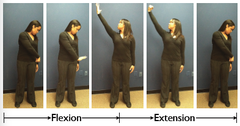
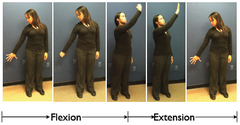
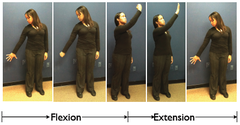
Pattern Analysis of diagonal patterns
- D1 Flexion (UE)
- D1 Extension (UE)
- D2 Flexion (UE)
- D2 Extension (UE)
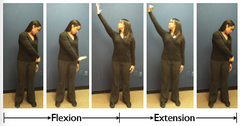
- pg 262 for full diagram refer to the pictures
- D1 Flexion (UE) -
- D1 Extension (UE)
- D2 Flexion (UE)
- D2 Extension (UE)
D2 commands
- Ready look at your hand
- open and turn your hand, thumb toward your face
- lift up and out
- now close your hand
- pull down and across. and repeat and again.
D1 Commands
- Ready, look at your hand
- Close and turn your right hand toward your face,
- pull up and accross
- Now Open your hand
- push down and away, and repeat, and again
PNF techniques to promote reversal of antagonist
- Slow reversals are utilized to gain range of motion. alternating isotonic contraciont of antagonists.
- Rhythmic stabilization is the siultaneous idometric contractions of antagonists, resulting in cocontraction and thereby promoting stability
Brunnstrom levels of motor recovery
stage 1-7
- NOTE!! These principles and techniques are not reflective of current understanding of the motor system
- stage 1 - flaccidity, no voluntary or reflexive activity
- Stage 2 - Minimal voluntary movement, components of the synergies are elicited as reflex reactions. Spasticity begins to develop.
- stage 3 - Marked spasticity, synergies are performed voluntarily
- Stage 4 - Movements that begin to deviat from synergy can be accomplished on a volitional basis
- Stage 5 - Movments which differ greatly from the basic synergies are utilized
- Stage 6 - Spasticity is essentially absent: isolated muscle actions are freely performed
- Stage 7 - normal motor function
Evaluation of Motor Control Dysfunction
Assessing spasticity
- The limb is quickly stretched in a direction opposite the pull of the musle group being tested
- objectively measured by a 5 point ashworth scale 1-5 (5 severe hypertonus/rigidity) or Modified Ashworth Scale 0-4
- graded min/mod/severe (Minimal if “catch” is felt at end range and severe if catch is felt at beginign of end range
Evaluation of Motor Control Dysfunction
Reflex testing
- reflexes may be released after brain injury or not integrated during early development secodary to CNS pathology.
- A resononse to a stiulouse is termed Positive and no response is “negative”
- Example of refelxes tested (review developmental reflexes)
- grasp, flexor withdrawal, crossed extension, ATNR, STNR, tonic labrinthine (prone and supine), positive supporitng reaction, associated reactions, neck righting, optical righting, protective extension, equilibrium reactions
Qualitative descriptions of Motor control
- Intention tremor
- Dysmetria
- Dyssynergia
- Dysdiadochokinesia
- Ataxia
- Resting Tremor
- Intention tremor - is a worsening of action tremor as the limb approaches a target in space.
- Dysmetria - undershooting (hypometria) or overshooting (hypermetria) of a target
- Dyssynergia - a breakdown in movment resulting in joints beign moved separately to reach a desired target as opposed to moving in a smoth trajectory, decomposition of movement.
- Dysdiadochokinesia - is impaired ability to perform rapid alternating movements
- Ataxia - loss of motor control including tremors, dysdiadochokinesia, dyssynergia, and visual nystagmus
- Resting Tremor - an involuntary tremor noted in resting positions
Qualitative descriptions of Motor control
- Rigidity -
- Bradykinesia
- Akinesia
- Athetosis
- Dystonia
- Chorea
- Hemiballismus
- Rigidity - increased resistance to passive movment throught the range; may be “cogwheel” alternative contraction/relaxation of muscles being stretched, “lead pipe” consistent contraction throughout range
- Bradykinesia - overall slowing of movement patterns
- Akinesia - in ability to initiate movement patterns
- Athetosis -dykinetic condition that inclues inadequate timing, force, and accuracy of movements in trunk/ limbs, movments are writing and worm-like
- Dystonia - an invonuntary sustained distorted movement or posture involving contraction of groups of muscles
- Chorea - involuntary movements of the face and extremities which are spasmodic and of short duration
- Hemiballismus - Unilateral chorea characterized by violent, forceful movements of the proximal muscles
Assessing Glenohumeral joint Subluxation
- allow person’s arm to dangle
- palpate the space underneaththe acromion process with inde finger.
- Compare to the intact side and document the width of space in terms of finger breadths.
Purpose of Splint/Orthotic for Neuromotor Dysfunction
- Prevent/Correct deformity via prolonged stretch and proper alignment
- Control spasticity by aligning joints and providing prolonged stretch to spastic muscles
- Prevent/decrease/acccommodate contractures of joint or soft tissue
- Position the hand in a functional posture to promote engagement in activities.
- provide proximal support
- support a painful joint
*



-
Dermatome Distribution17
-
Hand and Upper Extremity Disorders and Injuries34
-
Upper Extremity Movement tests12
-
Assistive Technology1
-
General Assessment5
-
Pediatric assessment2
-
General Intervention1
-
Chapter 16 NBCOT Mastery of Environment Eval and Intervention42
-
Chapter 15 Evaluation and Intervention for Performance in areas of occupation29
-
Chapter 13 Cognitive-perceptual approaches: eval and intervention41
-
Chapter 14 Psychosocial approaches: eval and intervention29
-
Chapter 11 Biomechanical Approaches Evaluation and Intervention30
-
Chapter 12 Neurological Approaches: Eval and Intervention46
-
Chapter 10 Psychiatric and Cognitive Disorders30
-
Chapter 8 Cardiovascular and Pulmonary System disorders18
-
Workbook simulation test 123
-
Therapy Ed test A Review31
-
Reisburg stages for Dementia7
-
Allen Cognitive levels7
-
ADA Ramp specifications4
-
Rancho levels of Cognitive Functioning10
-
Synergy patterns10
-
Chapter 3 The process of Occupational Therapy0
-
Chapter 4 Professional Standards and Responsibilities0
-
Chapter 5 Human Development and Aging: Pediatric and Geriatric Practice considerations for OT0
-
Chapert 6 Musculoskeletal System Disorders0
-
Chapter 7 Neurological System Disorders48
-
Chapter 9 Gastrointestinal, Renal, Endocrine, Immunological System disorders27
-
Glasgow coma scale3
-
Pediatric Development/Milestone36



