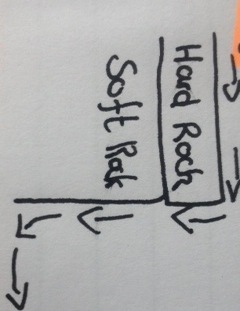
A V-shaped valley is fromed when a
river erodes vertically by hydraulic action and corrasion.
The first step in the formation of a v-shaped valley is
- A small valley begins to form, weatherng of the land besides the river produces loose pieces of soil and rock.
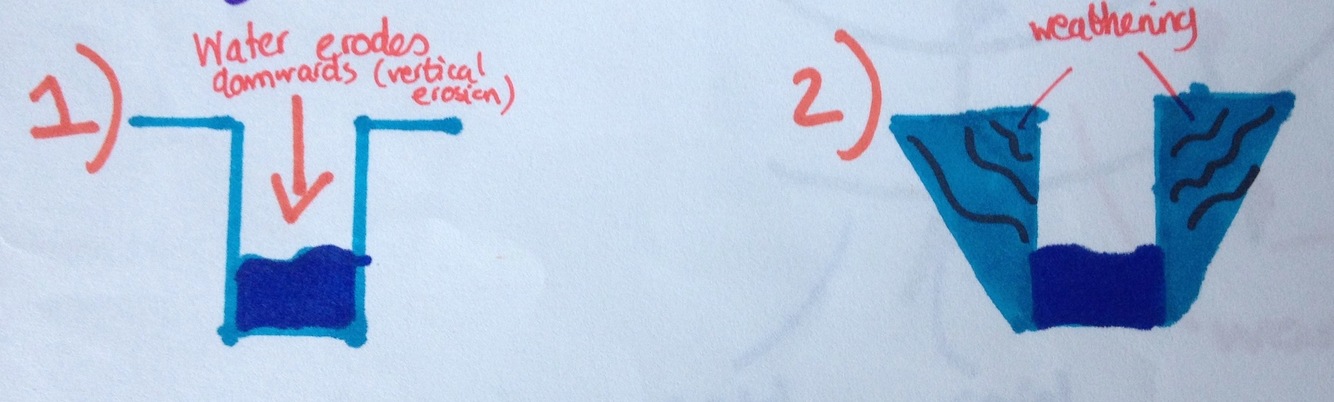
The second step in the formation of a v-shaped valley is
- The soil and rock roll down the sides of the valley and into the river. The river then carries it away.
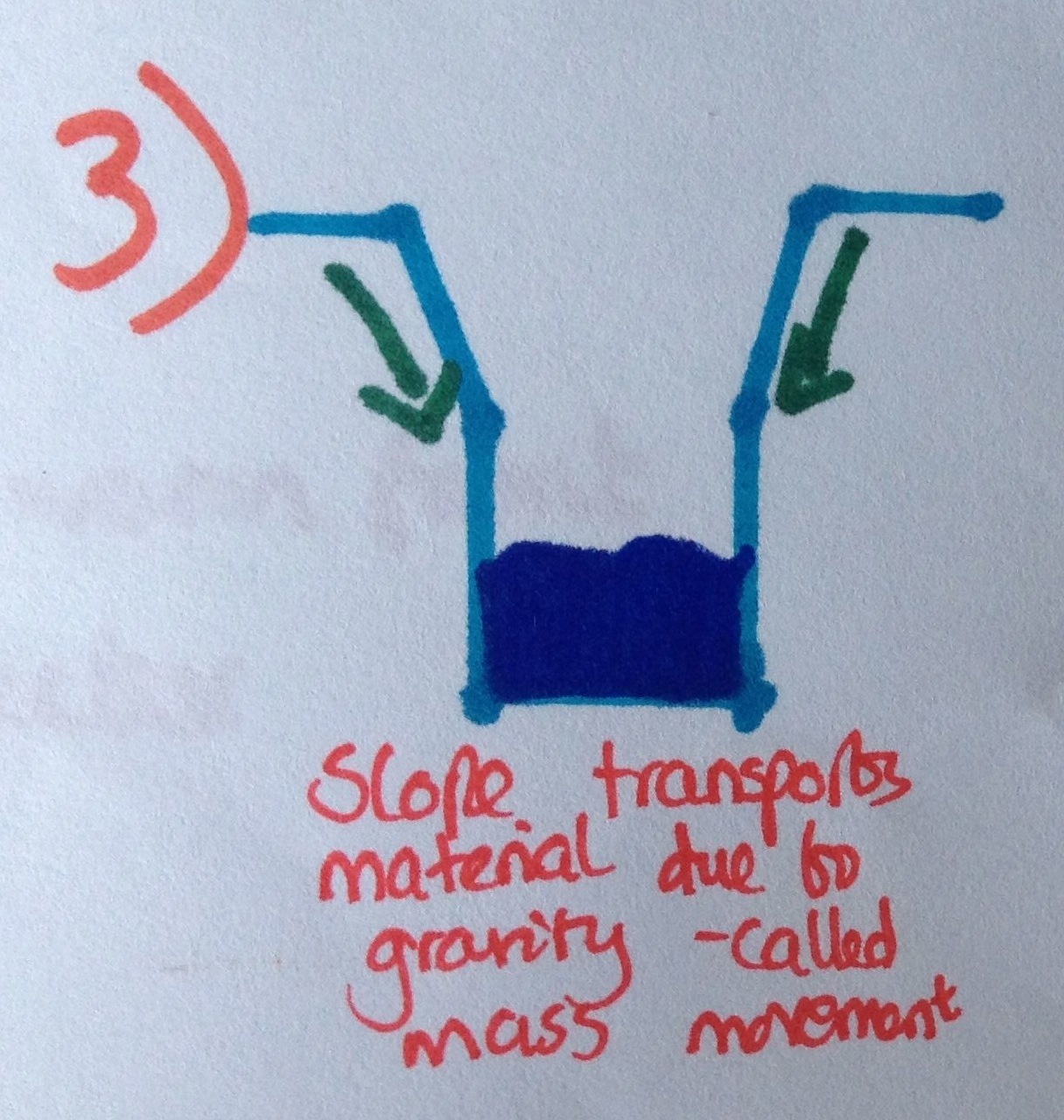
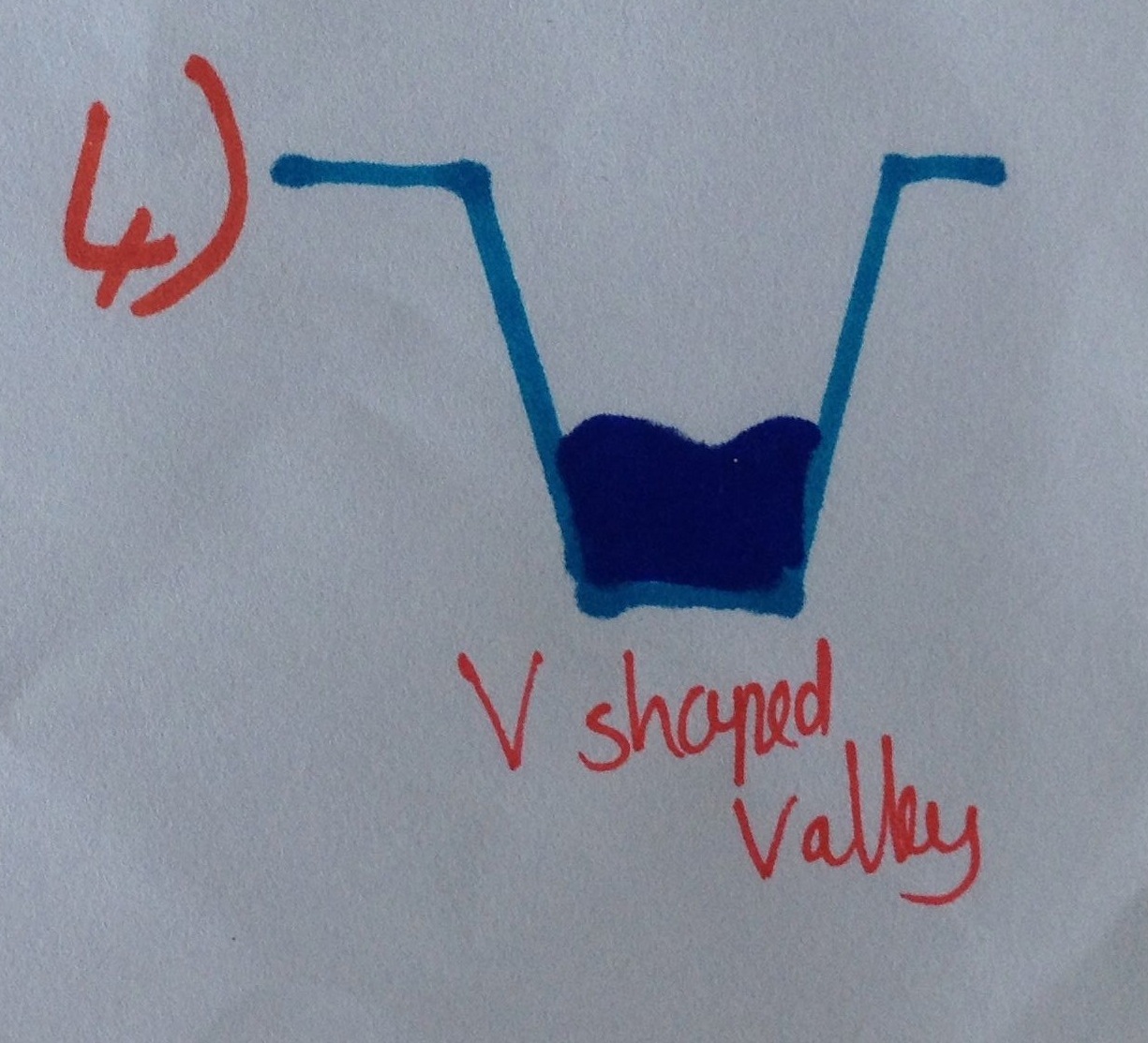
The third and final step in the formation of a v-shaped valley is
The beds and banks of the river are further eroded by rocks as they bounce and scrape along the river bed by corrasion.
If a river flows over hard rock and then over a band of soft rock, the soft rock will be worn away leaving the hard rock. This can lead to the formation of a
waterfall
The first part of the formation of a water fall begins: Water flows over areas of
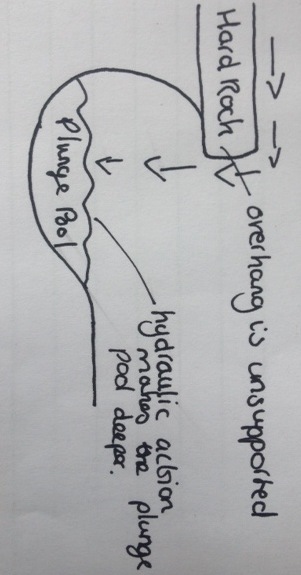
hard and soft rock, eroding the soft rock more quickly by hydraulic action. Overtime the hard rock sticks out over the soft rock to form an overhang.
The second step in the formation of a waterfall is:
- The Bottom of the waterfall has lots of energy so it erodes the soft rock even further by hydraulic action.
- The water wears away a pluge ppol underneath the waterfall
The third step in the formation of a waterfall is:
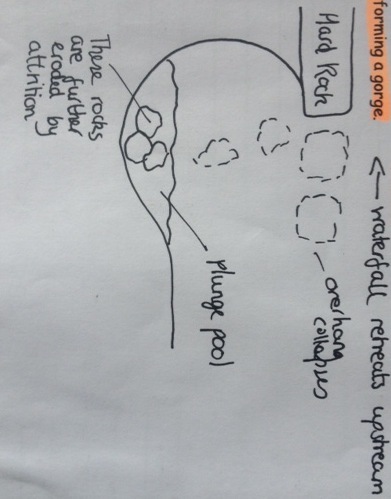
- Over time the overhang above the plunge pool becomes unstable and collapses.
- The pieces of the heard rock help to erode the plunge pool further by corrasion and are themselves eroded by attrition.
- The waterfall continues to move upstream forming a gorge.
A bend in a river is known as a
meander
Step 1 in the formation of a meander is:
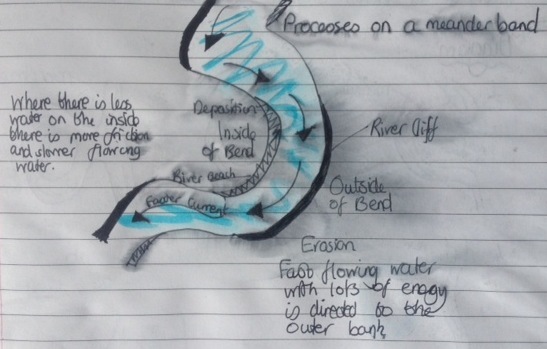
The course of the river is not as straight as the upper course so the river flows towards the outer bank.
Step 2 in the formation of a meander is:
- The river’s energy is concentrated on the outer bank so by hydraulic action and corrasion it is able to erode the bottom of the bank.
- Over time the bank will collapse forming a steep slope called a river cliff.
Step 3 in the formation of a meander is:
- On the opposite inner bank the river is much slower it has little energy so deposits some of its load to form a river beach. (deposition)
Step 4 in the formation of a meander is:
- Over time the bend becomes more pronounced and is called a meander.
- The river is also eroding sideways (lateral erosion) and widens the valley.
Step 1 in the formation of an oxbow lake is:
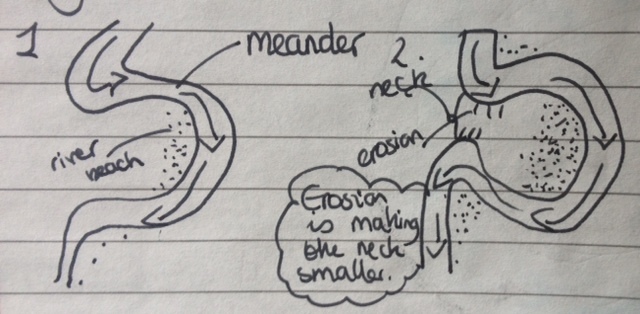
- The river continues to erode at the outer banks of the meander until the neck of land between them becomes very narrow
Step 2 in the formation of an oxbow lake is:
- During a flood when the river has more energy it cuts through the neck and makes a new straighter channel
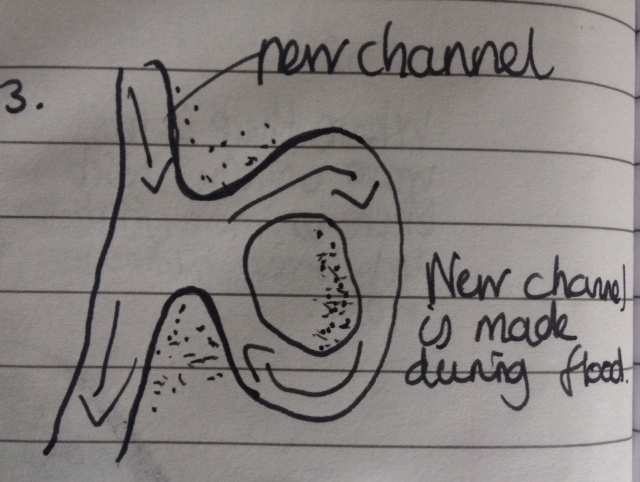
Step 3 in the formation of an oxbow lake is:
- The meander becomes cut off from the new course of the river and is left as an ox-bow lake. Without a water supply it soon dries up.
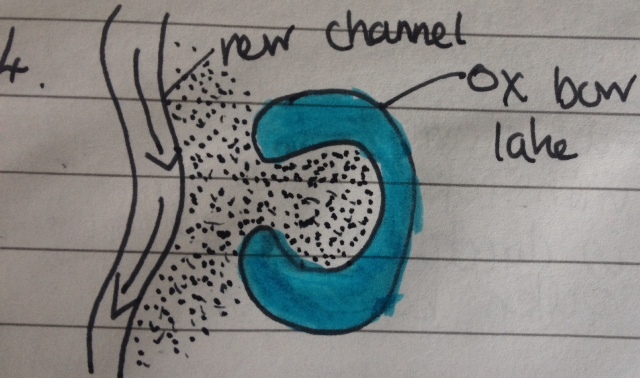
Step 1 in the formation of a levee is:
- When floodwaters spread across the floodplain the spread of the water slows and is no longer able to transport sediment
Step 2 in the formation of a levee is:
- As a result coarser sediments such as sand and gravel are deposited at the channel edge, gradually building up into natural ridges or levees after successive floods.
Step 3 in the formation of a levee is:
- Levees act like natural embankments and are often strengthened as part of flood rpevention measures.
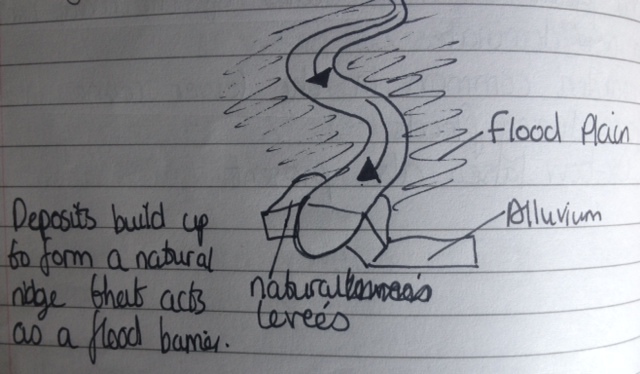
The floodplain is the area of
- allurial (sand&Silt) deposits found beside the river in its lower course.
- When the river floods it deposits the alluvium.
- The smallest particles found at the edge of the floodplain and the largest next to the river.
Braiding is the process by which rivers
divide into seperate channels through material being deposited by the river mid-stream.
An estuary is the mouth of a
river where it meets the sea
A u shaped valley is a valley with very
high, steep sides and a wide flat bottom formed by a glacier flowing through the original valley.
On a map a v-shaped valley can be indentified because the contour lines go
right up to the edge of the river

-
Chapter 1.1 Weather55
-
Chapter 1.2 Physical Environments - Upland Limestone10
-
Chapter 1.3 Physical Environments - Rivers and Valleys26
-
Chapter 1.4 Land Use related to River Valley28
-
Case Study - The Yorkshire Dales (Upland Limestone)32
-
1.5 Variation in Development28
-
Chapter 1.6 Urban19
-
Chapter 1.7 Rural (Farming unit)24
-
Chapter 1.8 Climate change3
-
Chapter 1.9 - Environmental Hazards26
-
AIDS - Worldwide disease6
-
Heart Disease - Developed World Country Disease5
-
Malaria - Developing World Disease5



