What does Glycolysis mean?
Glycolysis
Breakdown of sugar
Glyco - sugar
Lysis - breaking down
Explain what enzymes are
Enzymes
- Proteins that function to speed a chemical reaction
- Enzymes serve as catalysts
- Participates in chemical reaction, but is not used up by the reaction
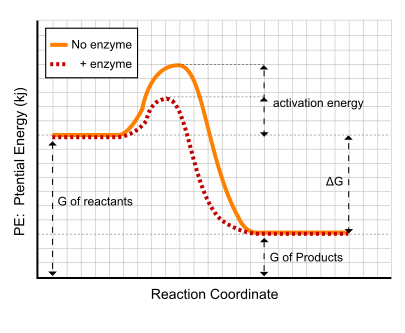
- Lower the Energy of Activation (Ea)
- Energy required to start a chemical reaction
- Energy must be added to get one reactant to react with another
Show how the graph looks like with an enzyme and without an enzyme
Explain how enzymes function
How Enzymes Function
Enzyme binds substrate to form a complex
Substrate binds to active site on enzyme
E + S —–> ES ——-> E + P
Enzyme + Substrate —–> enzyme-substrate comple
—–> enzyme + product
Explain the induced fit model of enzymes
Induced fit model of enzymes
- Substrate and active site shapes don’t match exactly
- Active site is induced to undergo a slight change in shape to accommodate substrate binding
- Change in shape facilitates reaction
Explain enzyme activation
Enzyme Activation
- Cell regulates metabolism by regulating which enzymes are active
- Genes producing enzymes can be turned on or off to regulate enzyme concentration
- Enzyme can be modified by adding or removing phosphates – changes shape
Explain enzyme inhibition
Enzyme Inhibition
- Occurs when enzyme cannot bind its substrate
- Many enzymes are regulated by feedback inhibition
- When product is abundant it binds to the enzyme’s active site and blocks further production
- When product is used up, it is removed from the active site
- Enzyme begins to function again
What are the essential features of Glycolysis?
- Essentially all cells carry out glycolysis.
- Glycolysis consists of ten reactions - essentially the same in all cells but with different reates
- Two phases:
- First phase converts glucose to two G-3-P
- Investm nt Stage
- Primin Reactions
- Second phase produces two pyruvates
- Payoff Stage
- First phase converts glucose to two G-3-P
- Products of glycolysis are pyruvate, ATP and NADH.
- There are three major fates for pyruvate.
How many reactions does glycolysis consist of?
Glycolysis consists of ten reactions - essentially the same in all cells but with different reates
Two phases:
First phase converts glucose to two G-3-P
Investment Stage
Primin Reactions
Second phase produces two pyruvates
Payoff Stage
How many phases is glycolysis divided into and explain each phase.
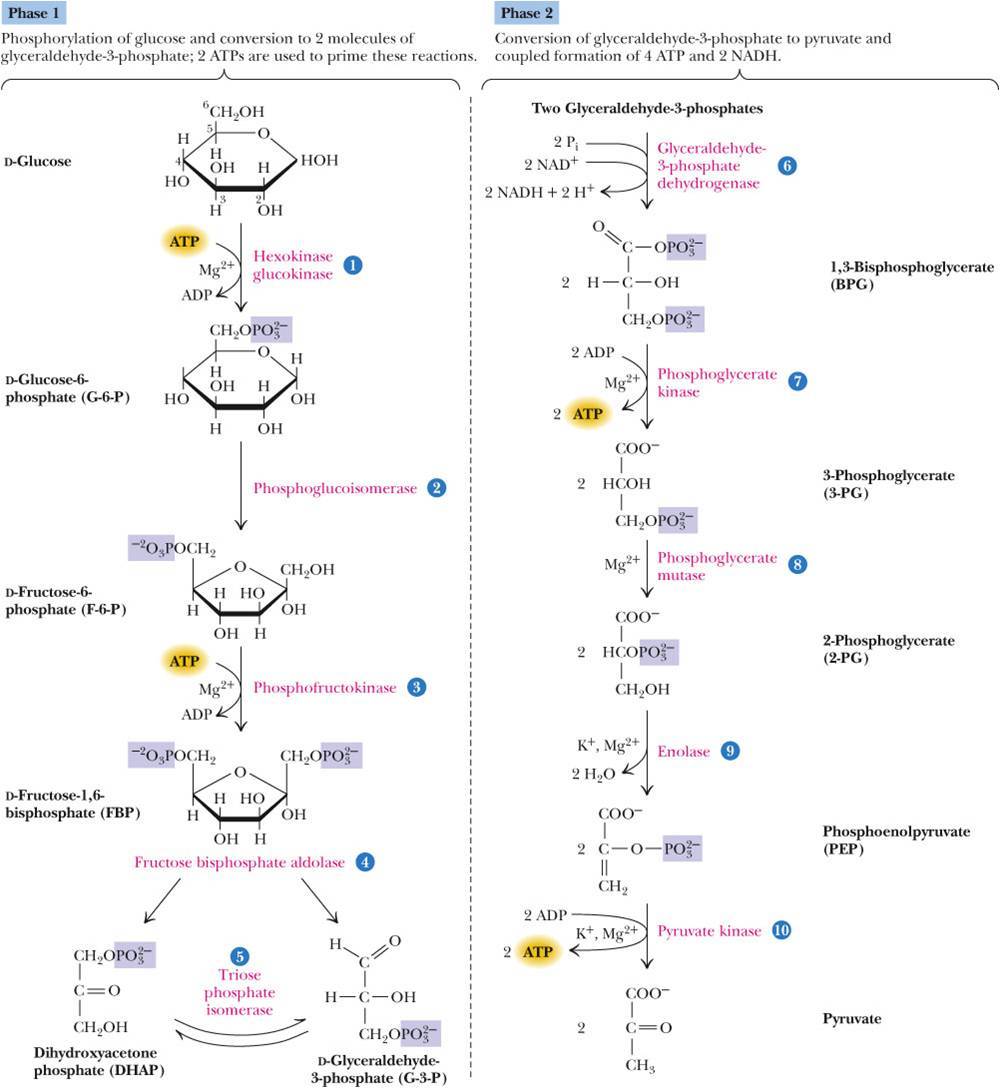
Glycolysis consists of ten reactions. These are divided into two phases.
The first phase:
Energy requiring phase
converts glucose to two molecules of G-3-P
2 ATPs are used to prime these reactions
First phase is divided into 2 stages: investment stage and priming reactions
The second phase
Energy producing phase
generates two pyruvates
Conversion of glyceraldehyde-3-phosphate to pyruvate and coupled formation of 4 ATP and 2 NADH
Second phase has one stage and it is known as the payoff stage.
What are the products of glycolysis?
Products of glycolysis are pyruvate, ATP and NADH.
How many major fates does pyruvate have?
There are three major fates for pyruvate.
Overview of the all the steps in glycolysis and the phases of glycolysis
What are the different fates of pyruvate after glycolysis?
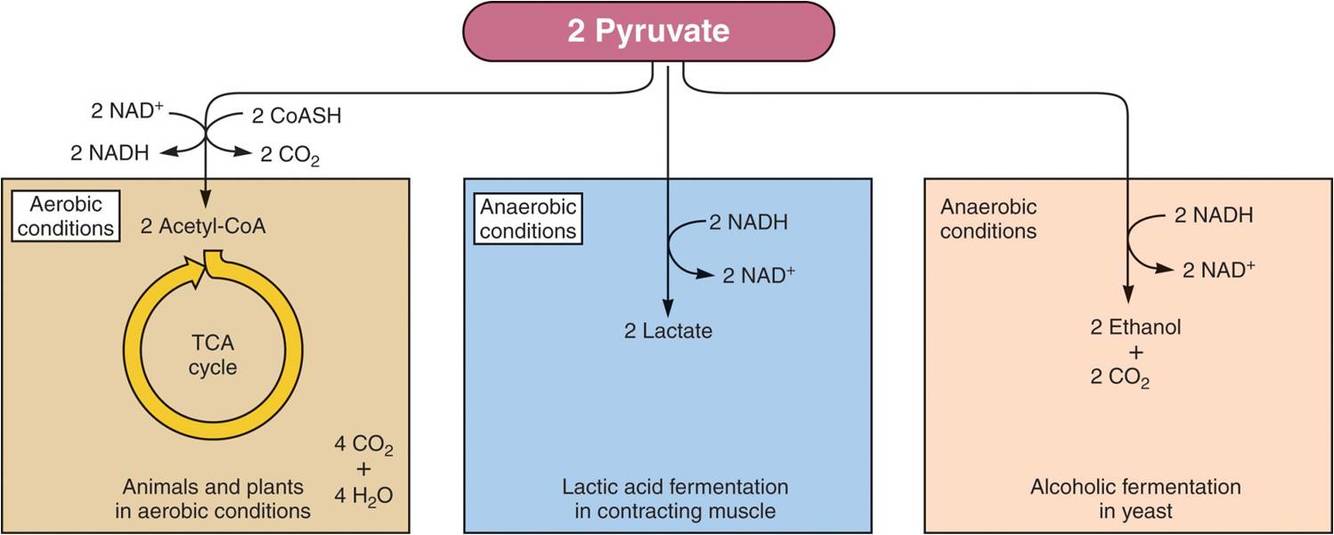
2 pyruvate can go into or can be used for 3 different processes:
Under aerobic conditions:
2 pyruvate can go into the TCA cycle
Under anaerobic conditions:
2 pyruvate can used in lactic acid fermentation (in contracting muscle)
or
2 pyruvate can be used in alcoholic fermentation (in yeast)
What can the pyruvate from glycolysis be concerved into under aerobic and anerobic conditions?
Pyruvate produced in glycolysis can be utilized by cells in several ways.
In animals, pyruvate is normally converted to acetyl-coenzyme A, which is then oxidized in the TCA cycle to produce CO2.
When oxygen is limited, pyruvate can be converted to lactate.
Alcoholic fermentation in yeast converts pyruvate to ethanol and CO2.
Why are coupled reactions important in glycolysis?
Coupled reactions involving ATP hydrolysis are used to drive the glycolytic pathway.
Coupled reactions convert some, but not all of the metabolic energy of glucose into ATP.
Under cellular conditions, approximately 5% of the energy of glucose is released in glycolysis.
Explain reaction 1 of glycolysis
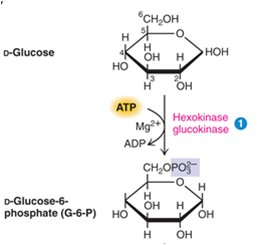
Reaction 1 of glycolysis:
Enzyme: hexokinase or glucokinase
Phosphorylation of glucose
Glucose to Glucose - 6 - phosphate (G-6-P)
Glucose + ATP —–> G-6-P + ADP
Known as the first priming reaction of glycolysis
ΔGo‘ for the 1st step is large and negative and the reaction is extremely favorable
Energy required to make G-6-P comes from the hydrolysis of ATP
What are the advantages of phosphorylation of Glucose
Advantages of phosphorylation of Glucose:
It keeps intracellular concentration of glucose low so reaction proceeds forward
Glucose is kept in the cell by phosphorylation to G-6-P, which cannot easily cross the plasma membrane
Explain the enzyme Hexokinase
- Requires Mg 2+ for the reaction
- Substrate is MgATP2-
- Four Isozymes of hexokinase
- Hexokinase I (Brain)
- Hexokinase II (Skeletal)
- Hexokinase III
- Glucokinase (Pancreas liver)
Explain the regulation of Hexokinase
- Allosterically inhibited by glucose-6-phosphate
- At high levels of G-6-P, hexokinase activity is downregulated
- Inhibition is reversible
- At high levels of G-6-P, hexokinase activity is downregulated
- As G-6-P is consumed through subsequent glycolysis reactions, hexokinase becomes activated again
In liver, how is glucose converted when glucose levels are high and when glucose levels are low
- In liver: Glucokinase converts glucose to glucose-6-phosphate and directs it to a pathway to be converted to glycogen
- Only active when glucose levels are high (Km is high)
- Induced by insulin
- Under normal conditions (lower levels of glucose) hexokinase I is active in liver and directs glucose to glycolysis
Explain Reaction 2 of glycolosis
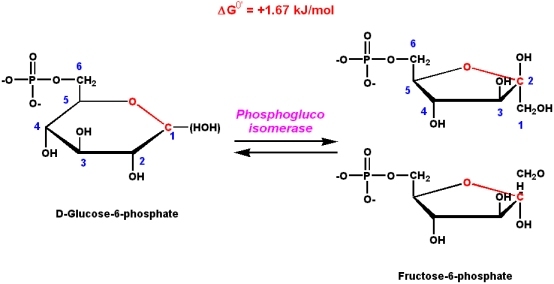
Reaction 2 of Glycolysis
Enzyme: Phosphoglucoisomerase
Phosphoglucoisomerase catalyzes the isomerization of G6P to fructose-6-phosphate
Reaction occurs at a ΔG that is near 0 so it’s near equilibrium and it is freely reversible
Explain reaction 3 of glycolysis
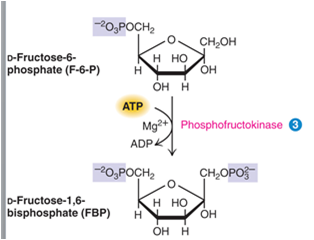
Reaction 3 of Glycolysis
Enzyme: Phosphofructokinase
Phosphorylation of Fructose-6-phosphate to Fructose-1,6-biphosphate
This reaction is coupled to the hydrolysis of ATP.
Known as the second priming reaction of glycolysis
Reaction 3 is the major point of regulation during glycolysis
The phosphofructokinase catalyzed reaction commits the glucose to the glycolysis pathway
Which reaction step is known as the most regulated reaction in glycolysis pathway
Reaction 3 - phosphofructokinase (PFK)
The phosphofructokinase (PFK) catalyzed reaction commits the glucose to the glycolysis pathway (i.e. it will not be converted to another sugar, or stored as glycogen).
The PFK reaction, therefore, is the most important step to regulate in the glycolysis pathway.



-
Chapter 17 - Metabolism Overview65
-
Chapter 18 - GLYCOLYSIS53
-
metabolism online question22
-
10 reaction of glycolysis - online questions12
-
Chp 17 - Glycolysis / TCA / ETC OVERVIEW42
-
Chapter 19 = TCA cycle87
-
Basic organic chemistry159
-
ETC - online questions33
-
phytosynthesis - online questions1



