Every somatic cell nucleus contains the same complete genome established in the fertilized egg. The DNA of all differentiated cells are identical. The unused genes aren’t destroyed or mutated. How does differential gene expression happen?
- Only a small percentage of the genome is expressed in each cell
Regulation of gene expression: (4)
- Differential gene transcription - Pre-m RNA processing - Selective mRNA translation - Differential protein modification
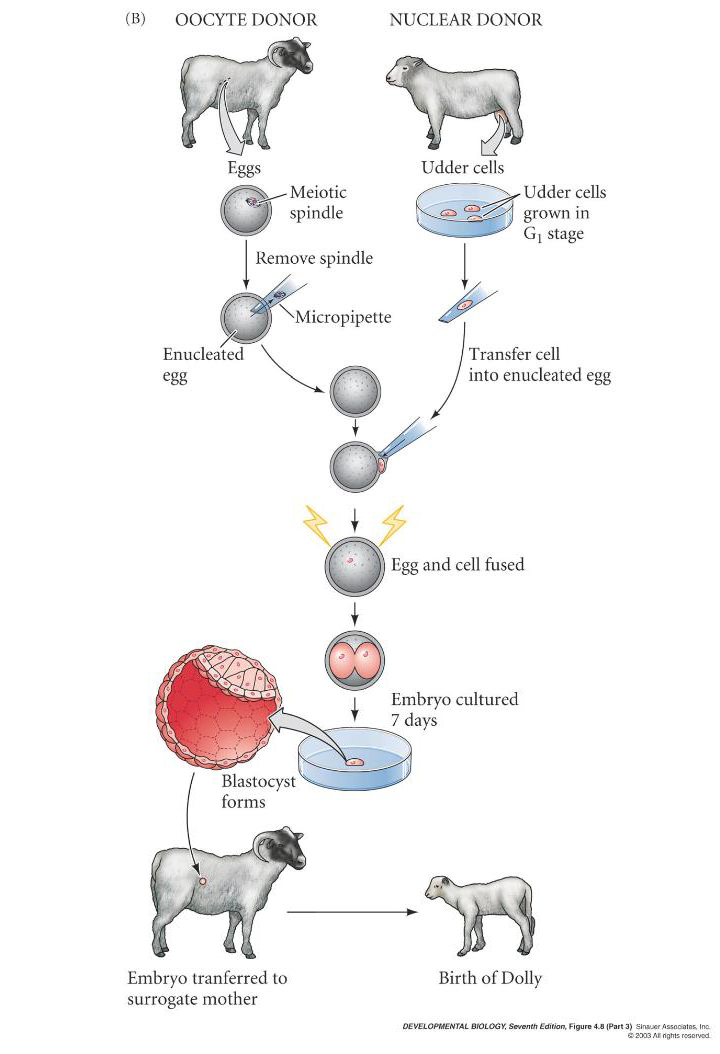
Cloning method: (Dolly) Somatic cell nuclear transfer
- Nuclear donor provides somatic cells. Ensure nuclei at G1 stage of cell cycle (diploid). Reprogrammed through demethylation. - Oocyte donor provides egg (oocyte). Important at the second meiotic metaphase (stage at which it’s normally fertilized). Nucleus removed - Donor cell and enucleated oocyte are brought together and electric pulses / chemicals destabilize the cell membranes allowing the cells to fuse - These same signals activates the egg to begin development - Implanted at blastocyst stage in surrogate mother
Methylated DNA
Used to regulate transcription No gene expression (depending on lysine/cytosine methylated) Works by stabilizing nucleosome, preventing TFs from binding. Methylation gives negative charge => more attractive to positive nucleosome Methylation pattern of a cell changes during development Repressed states of chromatin will also attract proteins that facilitate DNA methylation.
Acetylated DNA
gene expression Destabilizes nucleosome, pga makes DNA more positive => repulsive to positive nucleosome
Differential gene expression through transcription factors, how?
- The enhancer sequences are the same in every cell type; different combinations of TF proteins though - The same gene can have several enhancers, enabling it to be expressed in different cell types. - Allows simultaneous activation of entire groups of genes (coordinated gene expression) - TFs act as bridge between DNA and histone-modifying enzymes (fx HATs – dissociates histones from DNA) - TFs stabilize the transcription pre-initiation complex that enables RNA pol II to bind to the promoter
Trithorax and polycomb family of proteins affects gene transcription how?
They retain the memory of transcriptional state from generation to generation through mitosis. Trithorax proteins keep genes active Polycomb proteins keep the genes in a repressed state
Silencers are ?
DNA regulatory elements that actively repress the transcription of a particular gene. They can silence spatially (in particular cell types) or temporally (at particular times)
Insulator sequences limit ?
They limit the range in which an enhancer can activate gene expression. Insulating a promoter from being activated by another gene’s enhancers.
Reprogramming cells? How? For?
By changing the expression of certain TFs, an entirely new network of gene expression can be effected => changing one adult cell type into another Fx been used to reprogram adult human fibroblasts into functional dopaminergic neurons (degenerates in Parkinson disease).
Two general classes of promoters:
• High CpG-content promoters • Low CpG-content promoters
Sodium bisulfite treatment of genomic DNA
leads to conversion of nonmethylated cytosine to uracil. • PCR amplifies uracil as thymine. • Methylated cytosines (5-methylcytosine) remain as cytosines. • Detection of ”C” in sequencing reaction indicates methylation at this CpG site (C can only be methylated if followed by G), detection of ”T” indicates no methylation.
Promoters can exist in three major states
Active Repressed “Poised” - (intermediate, allowing for rapid response to developmental signals, characterizes high CpG promoters)
How are promoters “poised”?
- DNA is relatively unmethylated and nucleosomes enriched with “activating” H3K4me3. 2. RNA pol II is already present. 3. A small truncated transcript of nRNA is already initiated (but not completed). Rate limiting step is thus not initiation but elongation.
To become an active protein, the nRNA must be
- Processed into mRNA by removal of introns 2. Translocated from the nucleus to the cytoplasm 3. Translated by the protein-synthesizing apparatus 4. (Some cases) Posttranslationally modified to become active. Regulation during development can occur at any of these steps.
Differential RNA processing is?
The splicing of mRNA precursors into messages that specify different proteins by using different combinations of potential exons (splicing isoforms), done by spliceosomes. About 92% of human genes are thought to produce multiple types of mRNA; genome around 20,000 genes => proteome far more complex.
Dosage compensation is?
The equalization of X chromosome encoded gene products in males (one copy, XY) and females (two copies, XX), in drosophila, nematodes and mammals. Three possibilities: • Doubling of male X transcription rate (drosophila) • Partial repression of both X chromosomes so they in total provide the same amount as the single X (C.elegans) • Random irreversible X chromosome inactivation (mammals) => all tissues in female mammals are mosaics of two cell types (mom inactivated or dad) pga happens early in development. Inactivated = Barr body
Heterochromatin
heavily condensed, inactive
Euchromatin
less / not condensed, active
Long nonconding RNAs (lncRNAs) are?
A group of transcriptional regulators often used to silence genes on one of the two chromosomes, fx X chromosome inactivation by Xist
Control of gene expression at the level of translation Can occur by many means: (5)
• Longevity • Stored oocyte mRNAs • Ribosomal selectivity • microRNAs • Cytoplasmic localization
Control of gene expression at the level of translation - Longevity
The longer an mRNA persists, the more protein can be translated from it. Selective stabilization of a message with an otherwise relatively short half-life at a specific time and place, fx often through length of polyA tail.
Control of gene expression at the level of translation - Stored oocyte mRNAs
The oocyte often makes and stores mRNAs that will only be used after fertilization at certain times, most are needed during cleavage, but others encode proteins that determine cell fates. Most translational regulation is negative, pga prevent mRNA from being translated at inopportune times.
Control of gene expression at the level of translation - Ribosomal selectivity
Selective activation of mRNA translation, ribosomal proteins are not the same in all cells, some are necessary for translating certain messages.

-
Chapter 147
-
Chapter 235
-
Chapter 3 - modified for details44
-
Part II12
-
Chapter 550
-
Chapter 747
-
Chapter 481
-
Chapter 6 - The genetics of axis specification in drosophila61
-
Chapter 9 – Early development in vertebrates (birds and mammals)27
-
Chapter 10 - Emergence of the ectoderm68
-
Chapter 9b54
-
Part 326



