What are the four main trends on the “Demand Side” of Logistics and SCM?
Why are these trends called “Demand Side” Trends?
The four main trends in the demand side of Logistics and SCM? are:
- Globalization of the world economy and dislocation of locations of production resources
- Post-industrialization and transition towards a service economy
- Individualization of products and services combined with the trend to an “On-Demand-Economy”
- Ecological and physical limits to the unlimited growth of transport
The trends are called “demand side”-trends because they are driving the demand for logistics and SCM-solutions in the economy.
What are the four main trends on the “Supply Side” of Logistics and SCM?
Why are these trends called “Supply Side” Trends?
The four main trends in the supply side of Logistics and SCM? are:
- The invention of “Flow Management” and the rediscovery of process re-engineering
- Availablity of new technologies, especially for an improvement of information and communication within and between companies
- The invention of new logistics services as a positive consequence of market deregulations.
- Shareholder value thinking, based on a value logic and the rigorous focus on core competencies in the companies (outsourcing!)
The trends are called “supply side”-trends because they are means in the field of logistics and SCM to fulfill the demand-side trends.
What are major impacts of the globalization trend on transport and transport services?
- Globalization (in an economic interpretation) is based on a worldwide division of labor and other resources. As an output of this situation:
- Globalization increases the distances between locations of sourcing, producing and consuming → increase of transport distances
- Globalization open markets not only for production but also for services → intensify of competition between services providers in transport
- Global competition forces companies to check permanently their logistics networks on efficiency and effectiveness → permanent change of transport modes and routes decrease the chance of process standardization
What are major drivers of the transition process to a service economy in developed countries?
Major drivers of the transition process to a service economy are:
- Saturated markets urge industrial companies enhancing their market offers. Very often, this includes an enrichment of the product with service components (e.g. spare parts management, life-cycle financing models, maintenance etc.)
- Growing lifetime and the aging society increase the need for services (e.g. food supply, medical treatments at home etc.). On the other side, there is also more money available for those services.
- The information overkill and the internet are the base for new business models in services
How would you define the term “mass customization”?
“Mass Customization” describes in an industrial context the need to offer individualized products (customization) while at the same time use “Economies of Scale” for cost reduction (mass production).
What are “Economies of Scale”?
Economies of scale are the cost advantages that enterprises obtain due to their scale of operation (typically measured by the amount of output produced), with cost per unit of output decreasing with increasing scale. The reason is the fixed costs which are spread out on more production units when production output grows.
What are the impacts of the transition to a service economy with “Just-in-Time-Production” and an “On-Demand-Economy” on transport and logistics?
The tendency towards Just-in-Time Production (= Non-Stock Production) reduces the average size of shipments (“Atomization” → “Lot Size 1”) while at the same time the Economies of Scale in transports are decreasing because of more replenishment cycles.
What is the “Inventory to Sales Ratio”? What does it mean?
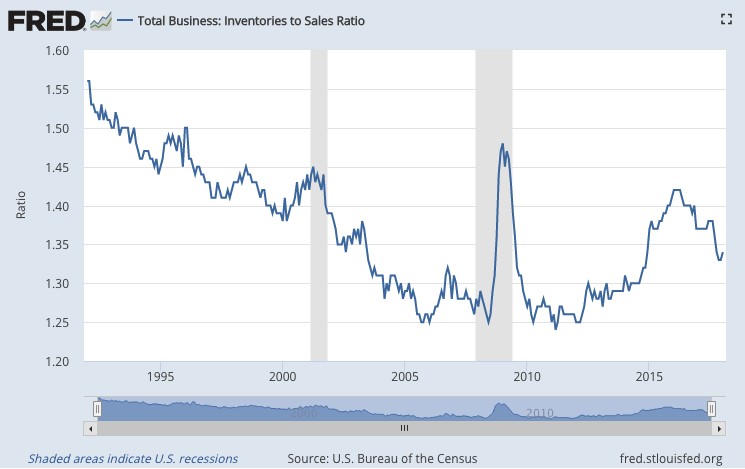
The “Inventory-to-Sales Ratio” describes the relationship between inventory and sales in the (US)-economy. : A factor of 1.25 means that the recent industrial/retail warehouse stock corresponds to a capacity coverage of 1.25 months of the revenues of the US economy.
It is a powerful indicator, how well developed the supply chains in an economy are. Flexible and fast SCM corresponds with low inventory stock and short response times.
Which facts support in an “On-Demand Economy” the following statement:
“The winner is not the largest but the fastest!”
In an “On-Demand-Economy”:
- the speed of order handling and fulfillment is an important competitive factor.
- the trend of long product development times combined with short product-life-cycles needs short and fast introduction times of new products into the market
What are important drivers of the carbon footprint in industrial companies?
Important (ranked) drivers of the carbon footprint in industrial companies are:
- The use of air travel by the business management
- The use of car travel by the commuters
- The use of truck transport for transportation tasks in product distribution and supply chain management
What is “Reverse Logistics” and why is it a potential growing field for Logistics Service Providers?
Reverse logistics are logistics services in which the product/object flow has its orientation from downstream (customer) to upstream (raw material). So it turns upside down the conventional supply chain flow from raw materials to finished goods.
It is a potential growing field for logistics service providers because reverse logistics is a promising candidate for outsourcing. This trend is driven by:
- legislative regulations for a higher share of recycled and refurbished industrial products;
- growing prices for raw materials in high-tech products;
- a growing share of supply chain returns - especially in eBusiness;
- a higher environmental awareness of private consumers.
What is the difference between a “push-“ vs. a “pull-oriented” production system?
A push-oriented production system (“make-to-stock”) is mainly based on forecasts for all value steps in the supply chain. The accuracy of this forecast is the driver for the inventory levels along the supply chain.
A pull-oriented production system (“make-to-order”, Just-in-Time production) is mainly based on real customer demand for all value steps in the supply chain. The chain is steered by the ultimate customer at the end of the supply chain. The speed and quality of communication between the customer(s) and the supplier(s) drive the inventory levels along the supply chain.
Define and explain the abbreviation “RFID”!
RFID stands for Radio Frequency IDentification.
It is a passive technology for the identification of physical objects in a supply chain (for example in a supermarket) using electronic tags. These tags are -machine-readable and (re-)writeable.
Today, RFID technology is used in context in which the (monetary and/or security-related) value of transported objects justify the implementation of electronic and not (only) bar-code readable labels.
At the end of the 1990s in Germany, the transport market was “deregulated”.
What does that mean and which were the significant results of this “deregulation” process?
With the new “Güterkraftverkehrsgesetz” (01.07. 1998) in Germany, the market of truck transport was privatized, and the prices were “deregulated”. The consequences of this market interventions were:
- intensification of competition between the transport modes and between the service providers inside each transport market
- dropping of transport tariffs - up to 50-60% if you compare the prices today with the prices before the deregulation process
- development of new, more profitable business models (e.g., advanced truckload)
What are the three generic goals of logistics and SCM? Explain them by giving the standard question which has to be answered for each goal!
- Problem A - Cost: How to reduce the “flowcosts” and tied-up capital in all generic processes and also for the whole system?
→ Rationalization of each activity along the four generic processes - Problem B - Service: How to maximize the object value in place and time for the customer?
→ Integration between companies, departments and or processes for an increased system throughput - Problem C - Flexibility: How to improve the systems/process ability to adopt on environmental changes in time?
→ Manage trade-offs (= conflicting goals) between companies, departments and or processes for managing damand-fluctuations
What is the “Marketing-Mix”?
What are components of the “Marketing-Mix”?
The Marketing-Mix describes the mix of marketing instruments for a specific customer target group. It consists the following components:
- the price (the price level, instruments of pricing, etc.)
- the product (quantitative and qualitative quality aspects of the sold product)
- the promotion (channels of promotions, means of promotions)
- the place (location and display of product according to customer needs)
What is the relation between the “Marketing-Mix” and the goals of logistics and SCM?
One of the core instruments in the Marketing-Mix (Product, Price, Place, Promotion) is to define in the selling and distribution process the circumstances, how the product should be offered physically for the best selling experience - or in other words to answer the question: what is the right place utility for the targeted customer segment?
The place utility is provided mainly by the design of the logistics system or in other words the “customer service level” (described by the place utility) is an output of the logistics systems design.
On the other hand, the supply of a specific customer service level produces (total-) logistics costs (order processing, inventory carrying costs, transportation costs, etc.). Between these costs exist conflicts or so-called “trade-offs.
Which are the three main standard solutions for the improvement of logistics/transportation systems?
The three main leverages/solutions of logistics systems improvement are:
- Solution #1: Optimal “Network-Configuration”
→ Focus on RESOURCES (shorter chains, simpler networks, higher integration etc.) - Solution #2: Optimal “Network-Programming”
→ Focus on PROCESSES (smooth interfaces, no media-breaks, proactive detection of possible defects etc.) - Solution #3: Optimal “Network Mobilization”
→ Focus on CONTROLLING / STEERING (focus on systems constraints; leveling of flows, speed etc.)
What are the seven basic components of a transportation system?
The seven components of a transportation system are:
- „Object“ = goods (people, info etc.)
- Loading unit [Ladeeinheit – e.g. Container]
- Mode of Transport [Transportmodus] and Transport Medium [Transportmittel],
- Vehicle [Fahrzeug]
- Depot, Location (of Transport Medium) → Dispatching [Disposition]
- Street, Road, Channel
- Source, “Origin”, Shipper [Quelle / Versender]
- Sink, „Destination”, Consignee [Senke / Empfänger]
All these components are important leverages for transport productivity, and they should be regarded during the dispatching process.
What is the content and goal of the “Magic Stick Experiment” and what are the takeaways out of the game for better logistics and SCM?
The “Magic Stick Experiment” is a group activity and training experiment for the demonstration of interactions in teams. Therefore a group of 8 people, positioned face-to-face, try to lay down a light a 3m-long stick - placed on their forefingers - to the ground without losing the stick-contact.
The goal is the demonstration, how important is a coordinated communication in an interdependent group.
From the setting and playing of the game it is possible to derive the three main steps for improving a logistics system:
- Deciding the number, quality, and positions of resources (players)
→ Network Configuration - Deciding what are the rules of communication and processes between the resources → Network Programming
- Deciding, how the correct performing can be monitored and controlled
→ Network Mobilization



