What characteristic distinguish eukaryotic cells from prokaryotic cells?
The separation of DNA and cytoplasm by a nuclear envelope
The presence in the cytoplasm of membrane-bound compartments with specialized functions: mitochondria, chloroplasts, endoplasmic reticulum (ER), and the Golgi complex, among others.
Highly specialized motor (contractile) proteins that move cells and internal cell parts
Endomembrane System
In eukaryotes, a collection of interrelated internal membranous sacs that divide a cell into functional and structural compartments.
Vesicle
A small, membrane-bound compartment that transfers substances between parts of the endomembrane system.
Smooth ER
Endoplasmic reticulum with no ribosomes attached to its membrane surfaces. Smooth ER has various functions, including synthesis of lipids that become part of cell membranes.
Rough ER
Endoplasmic reticulum with many ribosomes studding its outer surface which synthesize proteins.
Ribosome
A ribonucleoprotein particle that carries out protein synthesis by translating mRNA into chains of amino acids.
Translation
The use of the information encoded in the RNA to assemble amino acids into a polypeptide.
Transcription
The mechanism by which the information encoded in DNA is made into a complementary RNA copy.
ER Lumen
Each vesicle is formed by a single membrane that surrounds an enclosed space called the lumen of the ER.
Endoplasmic Reticulum (ER)
In eukaryotes, an extensive interconnected network of cisternae that is responsible for the synthesis, transport, and initial modification of proteins and lipids.
Cisternae (singular, cisterna)
Membranous channels and vesicles that make up the endoplasmic reticulum.
Golgi Complex
In eukaryotes, the organelle responsible for the final modification, sorting, and distribution of proteins and lipids.
Secretory Vesicle
Vesicle that transports proteins to the plasma membrane.
Exocytosis
In eukaryotes, the process by which a secretory vesicle fuses with the plasma membrane and releases the vesicle contents to the exterior.
Endocytosis
In eukaryotes, the process by which molecules are brought into the cell from the exterior involving a bulging in of the plasma membrane that pinches off to form an endocytic vesicle.
What does a eukaryotic cell look like/contain?
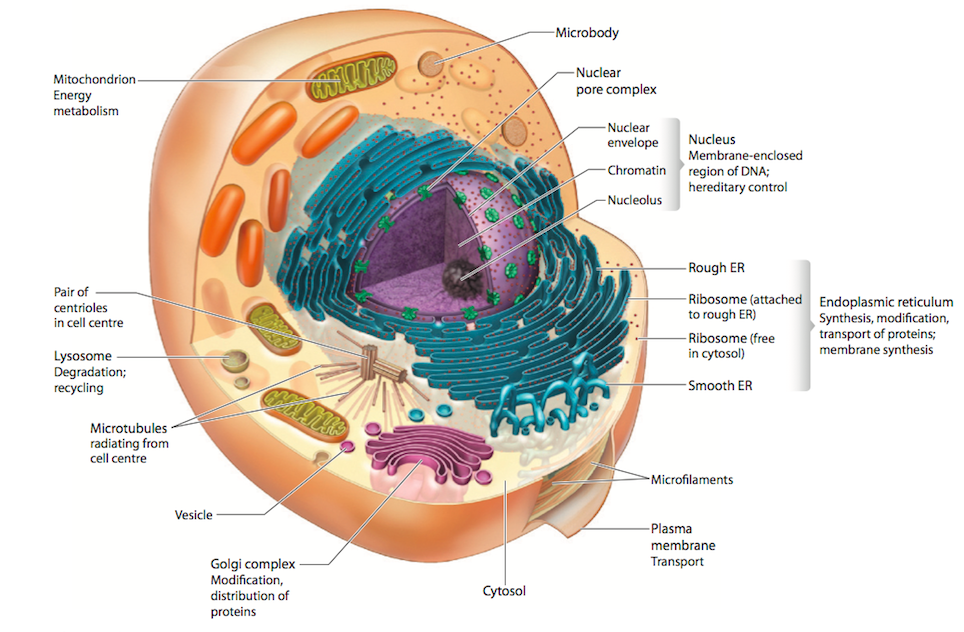
Theory of Endosymbiosis
States that the prokaryotic ancestors of modern mitochondria and chloroplasts were engulfed by larger prokaryotic cells, forming a mutually advantageous relationship called a symbiosis, and that slowly, over time, the host cell and the endosymbionts became inseparable parts of the same organism.
The rise in atmospheric O2 is thought to be a key factor in the occurrence of endosymbiosis. Mitochondria carry out aerobic respiration; thus, it is thought their ancestors were free-living aerobic prokaryotic cells. These cells would have been able to generate far more ATP from the same amount of food as a comparable anaerobic cell. Endosymbiosis of these small aerobic cells would give a larger anaerobic cell a distinct energy advantage compared with other anaerobic cells.
In the same way, the modern chloroplast is thought to be derived from endosymbiotic events involving cyanobacteria. Because cyanobacteria are photosynthetic, the host cell would be able to utilize sunlight as a source of energy. Additionally, because cyanobacteria carry out oxygenic photosynthesis, the host cell could easily supply the water needed to drive photosynthesis.
Whereas virtually all eukaryotic cells contain mitochondria, only plants and algae contain both mitochondria and chloroplasts. This fact indicates that endosymbiosis occurred in stages, with the event leading to the evolution of mitochondria occurring first. Once eukaryotic cells with the ability for aerobic respiration developed, some of these became photosynthetic after taking up cyanobacteria. This lineage developed into the plants and algae of today.
What evidence supports the theory of endosymbiosis?
- Morphology. The form or shape (morphology) of both mitochondria and chloroplasts is similar to that of a prokaryotic cell. Mitochondria resemble aerobic prokaryotes, and chloroplasts resemble cyanobacteria.
- Reproduction. A cell cannot make a mitochondrion or a chloroplast. Just like free-living prokaryotic cells, mitochondria or chloroplasts are derived only from preexisting mitochondria or chloroplasts. Both chloroplasts and mitochondria divide by binary fission, which is how prokaryotic cells divide.
- Genetic information. If the ancestors of mitochondria and chloroplasts were free-living cells, then one could predict that these organelles should contain their own DNA. This is indeed the case.
- Transcription and translation. Both chloroplasts and mitochondria contain a complete transcription and translational machinery, including a variety of enzymes and the ribosomes necessary to synthesize the proteins encoded by their DNA. The ribosomes of prokaryotic cells are distinctly different from those of eukaryotic cells. The ribosomes of mitochondria and chloroplasts are similar to the type found in prokaryotes.
- Electron transport. Similar to free-living prokaryotic cells, both mitochondria and chloroplasts can generate energy in the form of ATP through the presence of their own electron transport chains.
Binary Fission
Prokaryotic cell division—splitting or dividing into two parts.
Cytoskeleton
The interconnected system of protein fibres and tubes that extends throughout the cytoplasm of a eukaryotic cell maintaining its shape and internal organization as well as reinforcing the plasma membrane and functioning in movement, both of structures within the cell and of the cell as a whole.
Intermediate Filament
A cytoskeletal filament about 10 nm in diameter that provides mechanical strength to cells in tissues.
Microfilament
A cytoskeletal filament composed of actin.
Microtubule
A cytoskeletal component formed by the polymerization of tubulin into rigid, hollow rods about 25 nm in diameter.
Flagellum (plural, flagella)
A long, threadlike, cellular appendage responsible for movement; found in both prokaryotes and eukaryotes, but with different structures and modes of locomotion.






