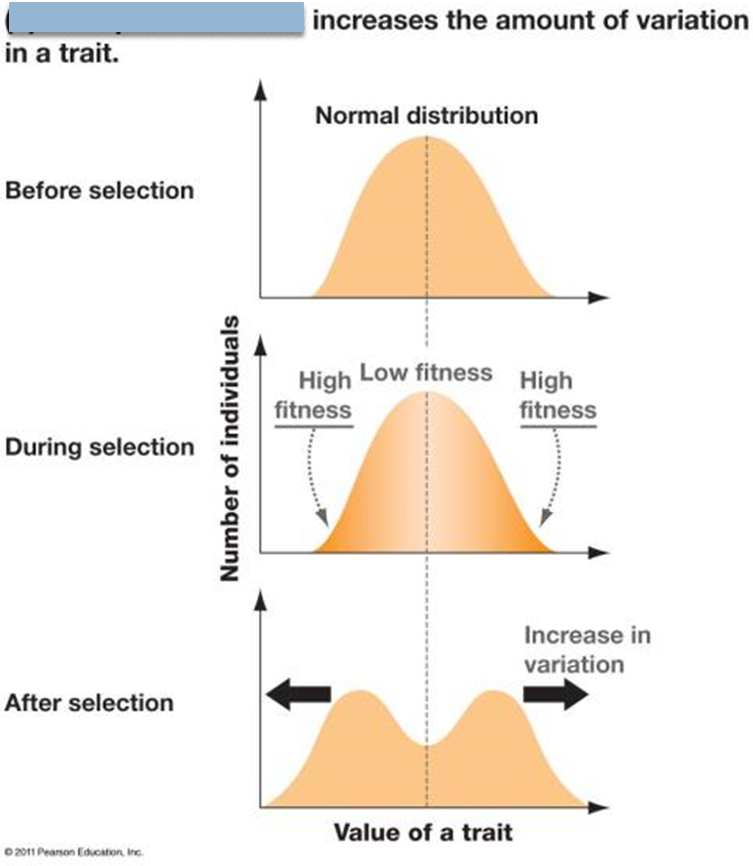
Evolution occurs because ..
traits vary among the individuals of a population and because individuals with certain traits produce more offspring than others
The main idea here is population
Population thinking
Focusing on the variation of individuals in a population
Not dismissing the genetic differences and looking at the whole
“descent with modification”
Species change over time
Species are related by a common ancestor
Extant
still alive
Radiometric dating
determine when and how long they have been decomposing
Determine age of bones by carbon dating
Evidence
Fossil record vs Extant species
Geological time scale
Radiometric dating with parent and daughter particles
Extinctions
Transitional features
Homology
Vestigial traits
Four postulates
Variation
Variation is heritable
Mortality due to differences in fitness
Survivors are not random
This leads to a new way of defining evolution as the “change in allele frequency in a population over time”
Misconceptions about Natural selection and adaptation
- Selection is on individuals, but evolution is on population
- During the process individuals do not change
- The pressure on individuals and the difference in reproduction causes the population to change
- The allele frequencies change, not the alleles themselves
- Acclimation is not adaptation
- Evolution is not goal directed
- Adaptations do not happen because the animals wanted or needed them
- Adaptation happened because they increased reproductive capabilities
- Evolution is not progressive
- Being more Highly evolved does not make you better
- Evolution can cause the loss in really complex traits
- No organism is higher or lower
- We are not a higher being
- We are adapted to our environment like every other organism
- Organisms do not act for the good of the species, but the good of the organism
- Reproduction
- Self sacrificing alleles vs. selfish alleles
Limitations of natural selection
- Non-adaptive traits
- Vestigial traits
- Silent mutations
- Genetic constraints
- Genetic correlation
- Variation
- Fitness tradeoffs: compromise of a variety of traits
- Historical constraints
Population
group of individuals in the same species and location that can breed
Evolution Mechanisms
natural selection
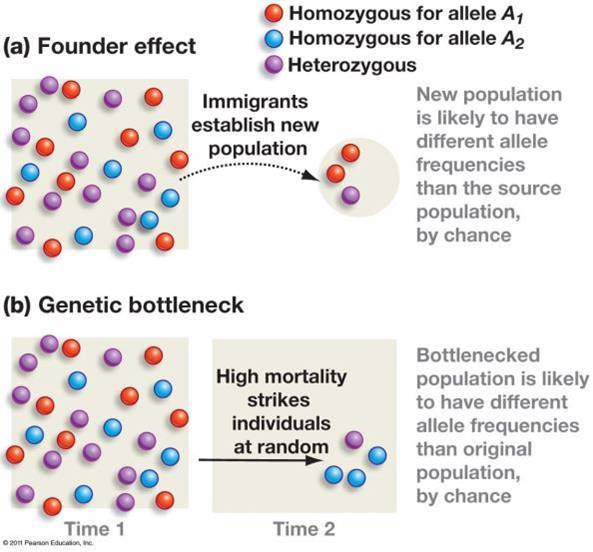
genetic drift
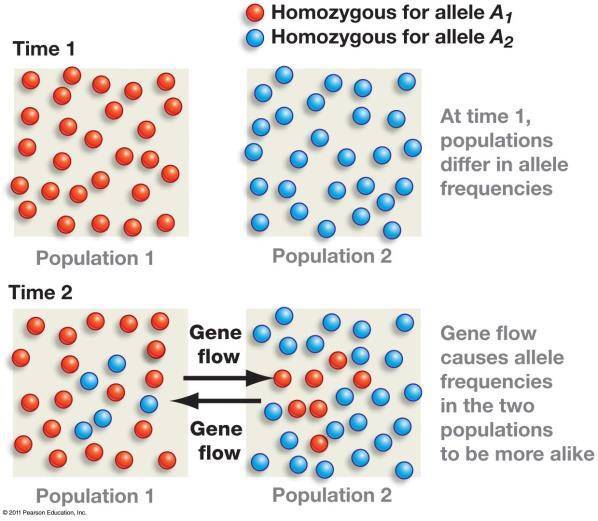
gene flow
mutation
natural selection
increases the frequency of certain alleles
Genetic drift
causes alleles to change randomly
Change in allele frequencies that is due to chance
Blind luck
A couple on an island with the genes AtAh and AtAh
They have five children
50:50 chance of each gene
Random
More pronounced in small populations
Can lead to the loss or fixation of alleles
Gene flow
individual movement causes a change in allele frequency
Typically causes equalization between the two populations
Mutation
produces new alleles
Most other mechanisms lead to loss of genetic diversity
Mutations do not
May not increase fitness
May be detrimental or beneficial or neutral
Not very significant for evolution
why?
Slow
Hardy Wienberg principle
1908 G.H. Hardy and Wilhelm Weinberg
Believed that variation only occurred from reproduction
a population viewpoint for the allele frequency
Gene pool
all of the gametes of a population
Exp: clams and sea urchins
Hardy Wienberg principle
finding geneotype
Two alleles of one gene
A1 and A2
p= frequency of allele A1
q = frequency of A2
Since the frequency must =1
p + q = 1
Three genotypes are possible:
A1A1, A1A2, A2A2
Hardy Wienberg principle
finding frequency
The frequency of:
A1A1 is p^2
A1A2 is 2pq
A2A2 is q^2
So the equation is p^2 + 2pq + q^2 = 1
To calculate the respective allele frequencies
p= ½(2pq) + p^2
Natural selection
3 types
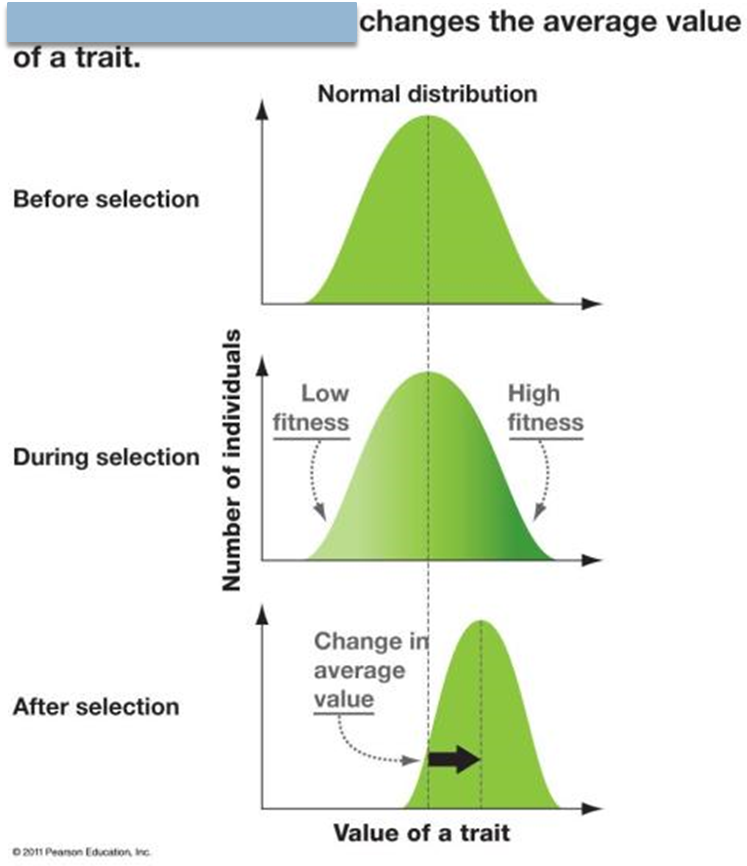
Directional
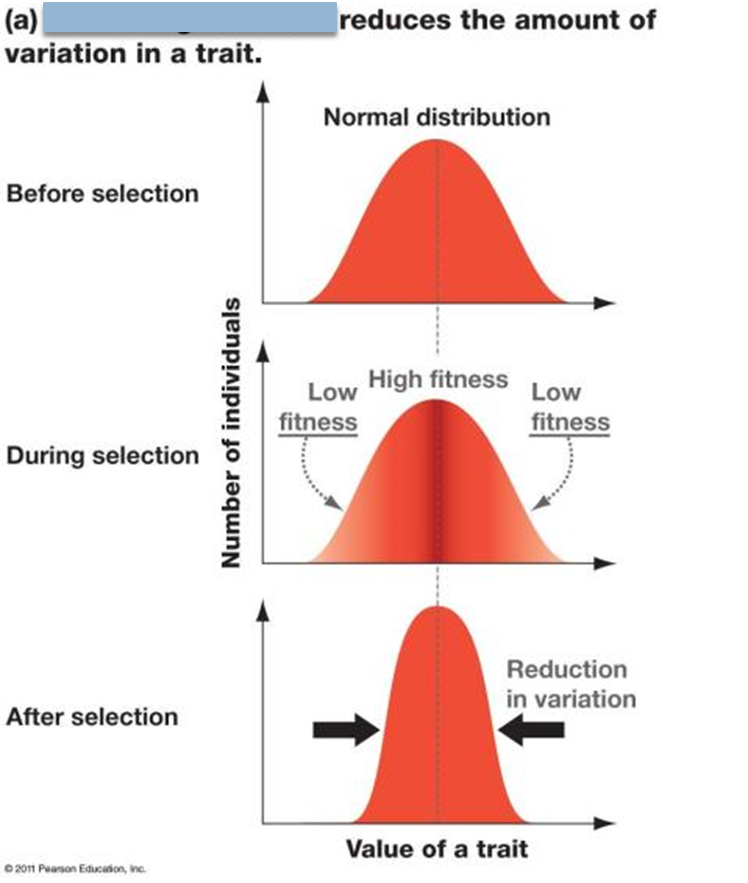
Stabilizing
Disruptive
Directional selection
Reduces genetic diversity
Purifying selection
Exp: freeze caused insect and bird die off
Fitness trade off for maneuverability
Stabilizing selection
No change in the average value of the trait
Genetic variation is reduced
Disruptive Selection
Black bellied seed crackers
Speciation
Could be a Heterozygote advantage
Balancing selection: no allele has an advantage