List some functions of the kidney
- Excrete metabolic waste products and foreign chemicals
- Regulate water and electrolyte balances
- Regulate body fluid somolality and electrolyte concentrations
- Regulation of arterial pressure
- Regulation of acid-base balance
- Regulation of erythrocyte production
- Secretion, metabolism and excretion of hormones
- Gluconeogenesis
What is the correct path of renal blood supply?
The correct path of renal blood supply:
Renal artery -> interlobar arteries -> arcuate arteries -> interlobular arteries -> afferent arterioles -> glomerular capillaries -> efferent arterioles -> peritubular capillaries -> interlobular vein -> arcuate veins -> interlobar arteries -> renal vein
List anatomy of the nephron, that fluid being filtered from the blood takes, ending with the collecting duct.
Out of glomeruar capillaries –> through Bowman’s capsule –> proximal tubule –> descencing loop of Henle –> thin ascending loop of Henle –> thick ascending loop of Henle –> Macula densa –> distal tubule –> connecting tubule –> cortical collecting tubules –> collecting duct
What, other than location, distinguishes the cortical and juxtamedullary nephron from each other?
A. The cortical nephron has a long loop of Henle, while the juxtamedullary nephron has a short.
B. The cortical nephron lacks a macula densa.
C. The vascular structure of the juxtamedullary nephron is specialized and called the vasa recta.
D. The juxtamedullary nephron has its glomerulus located just inside the medulla.
C. The vascular structure of the juxtamedullary nephron is specialized and called the vasa recta.
The cortical nephron is the shortest, with the glomeruli located in the outer cortex. The loop of Henle is short, penetrating just inside the outer zone of the medulla.
The juxtamedullary nephron has a long loop of Henle that can extend almost to the renal papillae. The glomerulus lies in the cortex, just adjacent to the medulla. The efferent arterioles dive down into the outer medulla and then divide into specialized peritubular capillaries called the vasa recta, extending into the medulla. The vasa recta return to the cortex and empty into the cortical veins.
Bladder innervation occurs how?
- Sensory and motor innervation through the pelvic nerves. The sensory path responds to stretching of the bladder. The motor pathway is responsible for the detrusor muscle reaction.
- The pudendal nerve controls the voluntary action of the external spincter.
Substances are excreted into the urine based on three renal processes. What are they?
- Glomerular filtration
- Reabsorption from tubule back into the blood
- Secretion from blood back into the tubule
Urinary excretion rate = Filtration rate - reabsorption rate + secretion rate
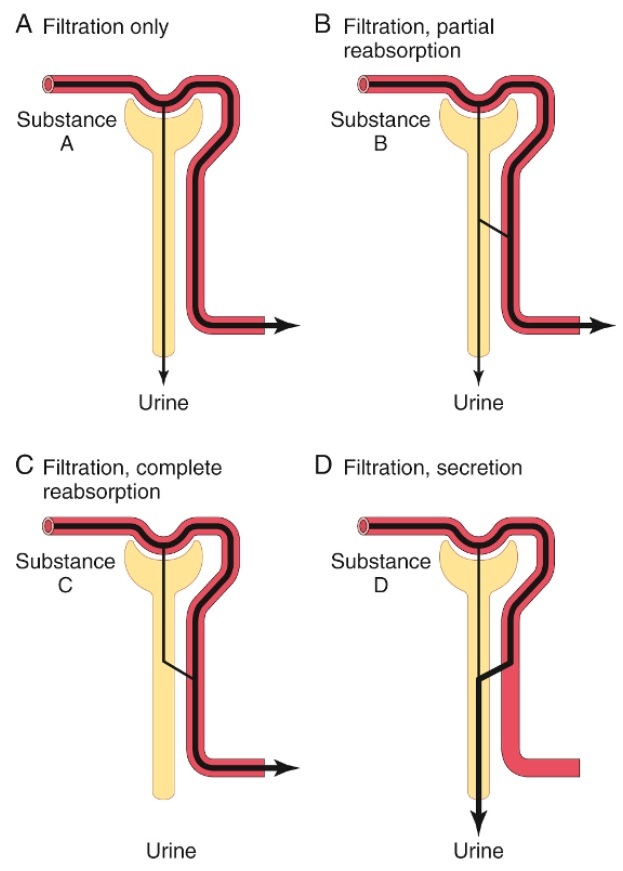
There are 4 hypothetical situations regarding what happens to substances as they are handled by the kidney. What are they?
A. Excretion rate = filtration rate; eg. waste material such as creatinine, urea, uric acids and urates need to ALLL LEAVE
B. Excretion rate < filtration rate; eg. electrolytes are resorbed back into blood
C. Total conservation; eg. amino acids and glucose, or other nutrients that need to be given back to the body
D. Excretion rate > filtration rate; eg. organic acids and bases that are filtered AND secreted from blood into tubules so large amounts are lost into the urine

-
Unit V (25-32) - The body fluids and kidneys64
-
Renal and Acid-Base Physiology - BRS & Guyton and Hall26
-
chapter 29 renal lecture 378
-
chapter 31 renal lecture 4 acid base75
-
chapter 32 diuretics, kidney diseases83
-
Chapter 26 Urinary System7
-
Chapter 27 GFR and RBF10
-
Chapter 28 Renal Tubular Reabsorption and Secretion14
-
Chapter 30 Renal Regulation of Electrolytes2



