Necrosis
- Cell death due to some type of acute injury such as trauma or lack of blood supply
- Cells swell, burst, and spill their guts
- Causes an inflammatory response at the site of injury and potentially a dangerous systemic response
Apoptosis
- Programmed cell death: activation of a specific biochemical pathway leading to cell death and removal by a macrophage or neighboring cell
- Apoptosis is inherent to all metazoan cells
- 300 million cells die in our bodies every minute (blood, intestinal, skin cells)
- Also occurs with genetically damaged cells
- These are exactly replaced by cell replication
When Apoptosis is a Good Thing
- Development/Regeneration
- body part sculpting during development
- death to neurons that don’t connect (about 50% of neurons)
- death to immune cells that are duds or recognize self
- turnover of intestinal, skin, and bone marrow cells
- Cancer prevention
- death to cells that have incurred heavy DNA damage, are not well fed, or have suffocated
When Apoptosis Is Not So Good
- Neurodegenerative diseases (Alzheimer’s disease; Parkinson’s disease; ataxias; etc.)
- AIDs
- Ischemic injury (myocardial infarction; stroke)
- Alcohol-induced liver disease
Symptoms of Apoptosis
- Cytoskeleton collapses; cells becomes more compact
- Nuclear envelope disassembles and chromatin condenses
- Nuclear DNA breaks up into nucleosomal-sized fragments**
- Mitochondrial function is lost
- Phosphatidylserine flips from the inside to the outside of the plasma membrane bilayer**
- Plasma membrane is altered (blebbing), allowing dying cell to be engulfed by macrophages via phagocytosis
TUNEL (Terminal deoxynucleoidyl transferase dUTP nick end labeling)
Assays add a fluorescent nucleotide to DNA ens. The DNA ends are extended with the template-independent DNA polymerase terminal deoxynucleotidyl transferase (TdT). TdT adds flluorescently labeled dUTPs to the ends of fragmented DNA. Large numbers of DNA fragments leads to bright fluorescent dots in apoptotic cells.
Caspases: The Mediators of Apoptosis (and Infllammation)
- Apoptosis is mediated by a cascade of highly specific proteolytic cleavages by a family of proteases known as caspases
- Caspases utilize an active site cysteine residue as the mechanism of hydrolysis
- Caspases cleave the peptide bond at a specific four amino acid sequence on the C-terminal side of an aspartate residue
- Some caspases (caspases 1, 4, and 5) are involved in inflammation rather than apoptosis
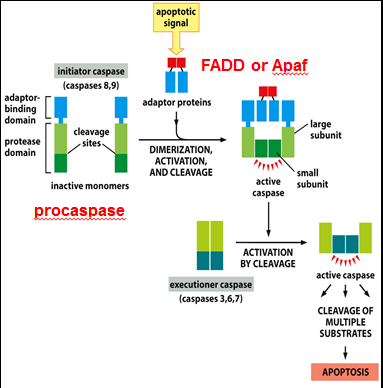
- Caspases are synthesized as inactive proenzymes that need to be activated by cleavage to remove an inhibitory pro-peptide segment.
Initiator Caspases
- Caspases 2, 8, 9, and 10
- Exist as inactive, soluble monomers in the cytosol before the apoptotic signal
- Function is to activate the executioner caspases
Executioner (Effector) Caspases (cut target proteins)
- Caspases 3, 6, and 7
- Exist as inactive dimers in the cytosol before the apoptotic signal
CAD (caspase-activated DNase)
- the enzyme responsible for DNA cleavage during apoptosis
- CAD is normally inhibited by an inhibitor (iCAD)
- Executioner caspases inactivate iCAD by cleaving it
- This releases an active CAD, which fragments DNA between nucleosomes
A Few Examples of Target Proteins Degraded by Executioner Caspases
- CAD
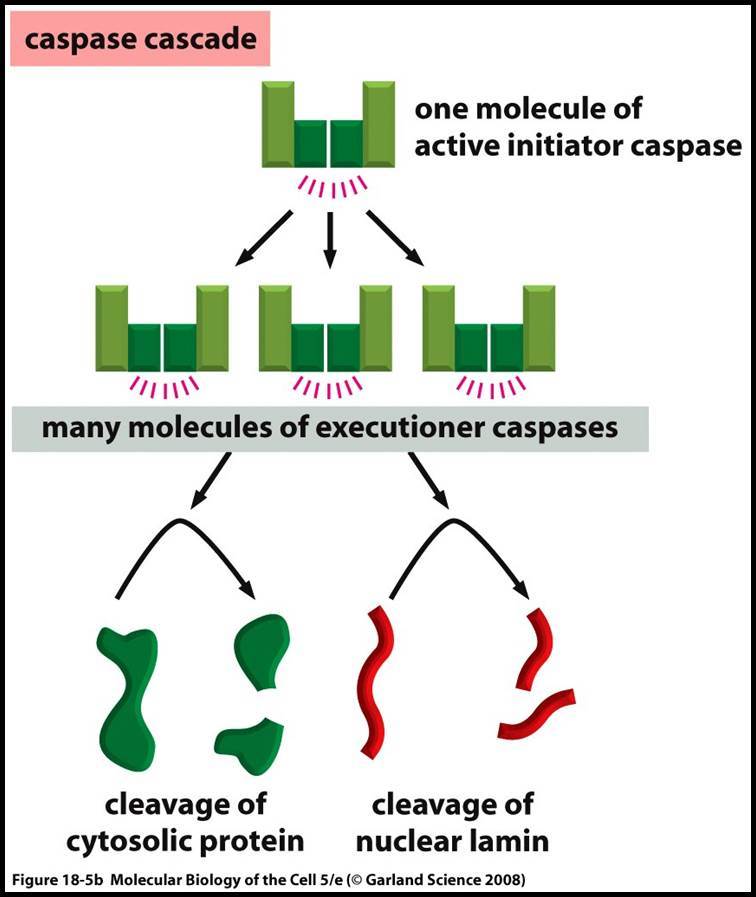
- Executioner caspases cleave nuclear lamins, the structural protein responsible for the nuclear envelope and nuclear integrity
- Executioner caspases degrade Mdm2, the E3 ubiquitin ligase that targets p53 for ubiquitination and thus proteasomal degradation. Thus, without Mdm2, p53 remains high and can signal cells to stop proliferating and to die.
Overview of Caspase Activation
Caspases are originally made in an inactive, procaspase form.
- Extrinsic or intrinsic signals trigger the assembly of adaptor proteins with the procaspases.
- Upon binding of the adaptor proteins (FADD or Apaf), the procaspases dimerize and are activated, cleaving the procaspase into a large and small subunit. (The prodomain is degraded.)
- The initiator caspases then clip the executioner caspase dimer, and the dimer rearranges and is active.
Caspases Function in Cascades that Can Greatly Amplify the Initial Signal
- Initiator caspases activate the executioner (effector) caspases by clipping off their prodomains.
- The catalytic activation creates an amplification step as one initiator caspase can activate many executioner caspases.
2 Pathways to Apoptosis
- All metazoan cells express procaspases and thus express the proteins necessary for their own destruction
- Initiation of apoptosis can occur in response to either external signals (extrinsic pathway) or internal signals (intrinsic pathway)
- In either case, protein:protein interactions mediated by specific modular interaction domains are particularly important to these signaling pathways
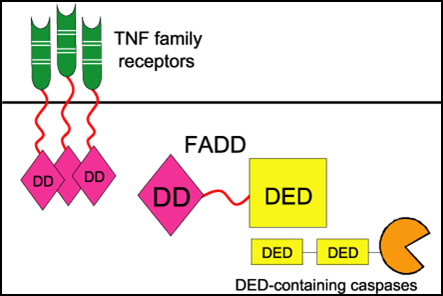
DD
Death domain
DED
Death effector domain
CARD
Caspase-associated recruitment domains
Extrinsic Apoptotic Pathway
- Activated by something outside the cell
- Death signals:
- TNFalpha
- Fas ligand (FasL)
- Both TNFα and Fas ligand are cell surface proteins and they bind to specific receptors on adjacent cells (contact-dependent signaling) that are members of the TNF receptor family (TNF, FAS, TRAIL), also known as the death receptors
TNFα (tumor necrosis factor α)
Secreted by macrophages and triggers cell death in chronic inflammatory diseases
Fas ligand (FasL)
Cell surface protein produced by activated natural killer cells and cytotoxic T lymphocytes to kill of viruses, foreign graft cells, some tumor cells, etc.
Death Receptors
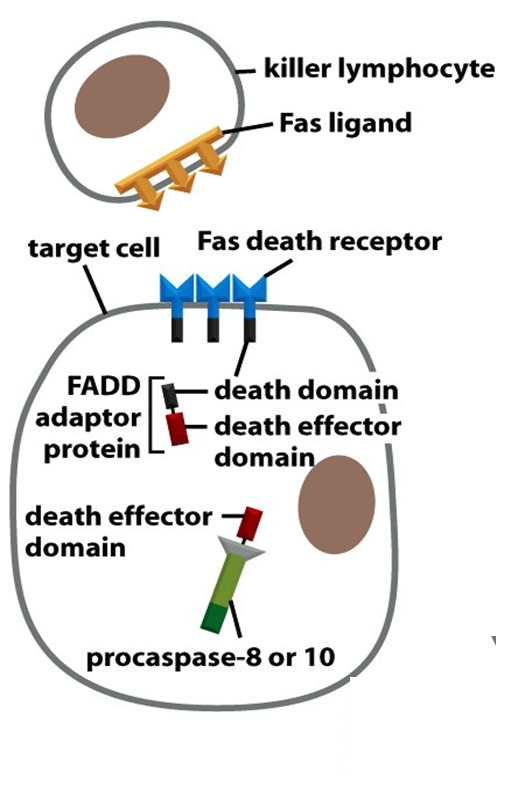
- Transmembrane proteins that have an extracellular ligand binding domain, a single transmembrane domain, and an internal death domain (DD)
- Receptors (and ligands) are homotrimers
- Liganded death receptros cluster and interact with the FADD (Fas-associated death domain) adaptor proteins
- FADD recruits an initiator caspase (caspase 8) with a death effector domain (DED)
Death by FasL Is the Best Characterized Extrinsic Pathway
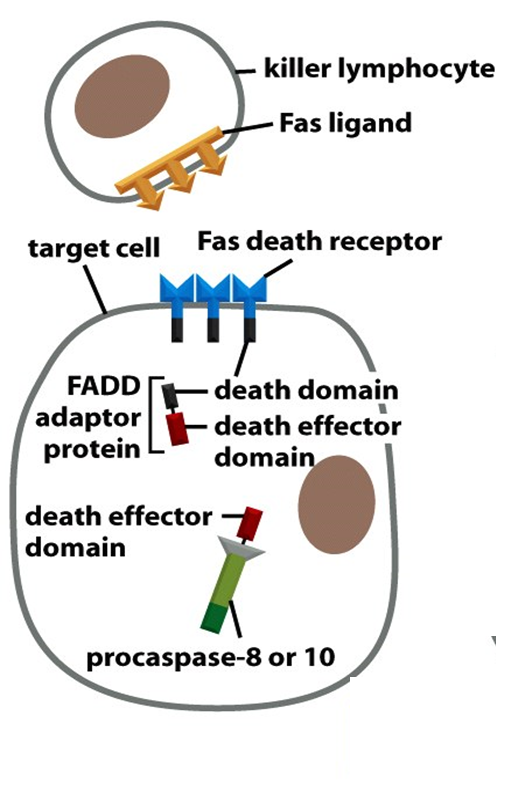
- The extrinsic pathway starts with a ligand trimer binding to a death receptor trimer such as Fas.
- The receptor has a DD that attracts an adaptor protein such as FAAD that has both a DD and a DED.
- The adaptor protein attracts a complex that contains several initiator caspases (typically caspases 8 and/or 10)
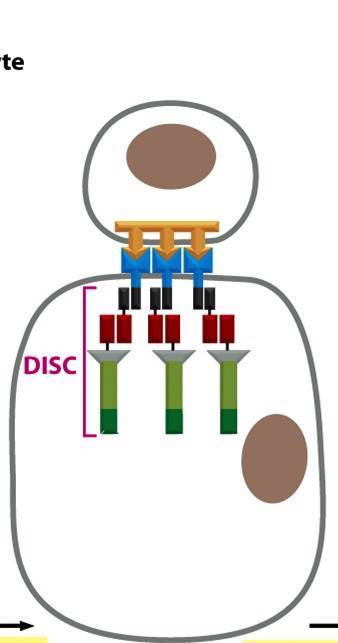
he Receptor/Adaptor Complex Recruits the Initiator Procaspase
- The aggregate of receptor, adaptor and procaspase is called DISC (death-inducing signaling complex).
- The aggregation of the procaspases causes them to cross-activate each other.
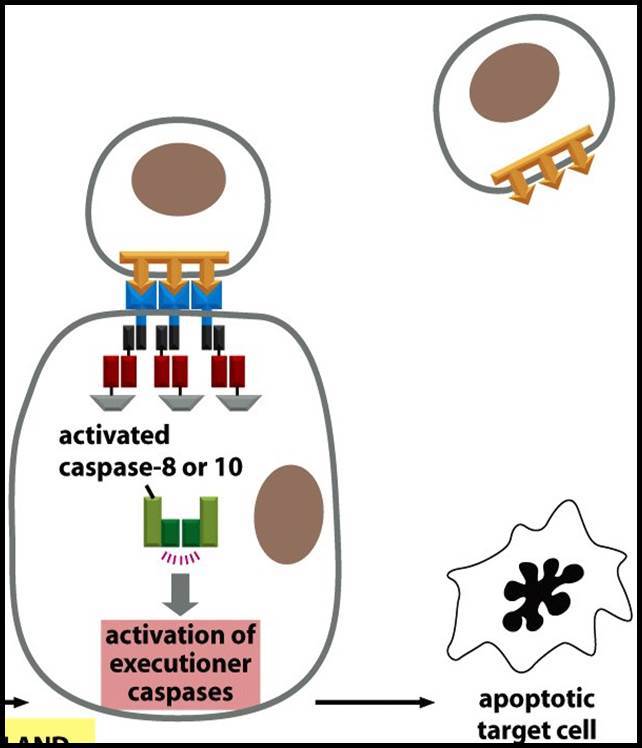
The Initiator Caspases Activate the Executioner Caspases, Notably Caspase-3
Once the procaspases are active, then two associate form an active dimer.
This dimer cleaves itself in the region by the DD, which frees up the initiator caspase dimer so it can move around the cytosol and activate executioner caspases.


-
Chapter 25: Enzyme-Coupled Receptors:Signaling Through Receptor Tyrosine Kinases37
-
Chapter 26:Insulin Receptor,the PI 3-Kinase Pathway, and the Cytokine Receptors32
-
Chapter 27 Signaling Through TGF-Beta Receptors, Guanylyl Cyclases, and Ion Channels51
-
Chapter 28: Intracellular Receptors and Regulated Proteolysis45
-
Chapter 29: Apoptosis36
-
Chapter 30: The Cell Cycle and Checkpoint Controls37
-
Chapter 31: Signaling and Cancer24



