Causes of anaemia (categorised by MCV)
Red blood cells:
- Microcytic (low MCV) = iron deficiency anaemia, thalassaemia, chronic disease. Rare: lead poisoning, sideroblastic anaemia.
- Normocytic (normal MCV) = anaemia of chronic disease, acute blood loss, combined haematinic disease, haemolytic anaemia, renal failure (chronic).
- Macrocytic (high MCV) = B12/folate deficiency (megaloblastic anaemia), excess alcohol, liver disease (including non-alcoholic causes), hypothyroidism, “M” haematological causes (myeloproliferative, myelodysplastic, multiple myeloma).
- B12 deficiency includes pernicious anaemia.
Myelodysplastic - immature blood cells do not mature. Often symptomless but later stages, sx depend on which cells are affected eg. SOB, tiredness, infections, bleeding, bruising
Neutropenia, anemia, and thrombocytopenia
Splenomegaly or rarely hepatomegaly
Can transform into AML
Causes of neutrophilia
Neutrophilia (high) :
- bacterial infection
- tissue damage (inflammation/infarct/malignancy)
- *steroids*.
Causes of Neutropenia
Neutropenia (low neutrophils)
- viral infection
- chemotherapy/radiotherapy (may become neutropenic in response to infection, neutropenic sepsis)
- If neutropenic sepsis, must give urgent IV broad-spectrum antibiotics (hospital-specific).
- clozapine (antipsychotic)
- carbimazole (antithyroid).
Causes of lymphocytosis
Lymphocytosis (high lymphocyts)
- viral infection
- lymphoma
- CLL.
Causes of Thrombocytopenia
Thrombocytopenia (low platelets)
- reduced production
- viral infection
- drugs especially penicillamine in RA
- myelodysplasia, myelofibrosis, myeloma
- increased destruction
- heparin
- hypersplenism
- DIC
- ITP
- HUS/TTP
Thrombotic thrombocytopenic purpura (TTP) and hemolytic uremic syndrome (HUS) are multisystemic disorders characterized by thrombocytopenia, microangiopathic hemolytic anemia, and organ ischemia due to platelet agglutination in the arterial microvasculature.
1
Until recently, the classification of these syndromes was based primarily on clinical findings, with neurologic dysfunction being more prominent in TTP and renal dysfunction predominating in HUS. However, overlap is substantial, and precise distinction of the 2 syndromes remains somewhat arbitrary and controversial.
2
3
Recent evidence suggests that deficiency of a specific plasma protease responsible for the physiologic degradation of von Willebrand factor (vWF) multimers has a causative role in a large proportion of familial and idiopathic cases of TTP.
Although most cases of TTP and HUS are idiopathic, several etiologies and associations are well recognized, including infection, drugs, malignancy, chemotherapy, bone marrow transplantation (BMT), and pregnancy.
Causes of thombocytosis
Thrombocytosis (high platelets)
- reactive
- bleeding
- tissue damage e.g. infection/inflammation/malignancy
- post-splenectomy
- primary
- myeloproliferative disorders
Causes of hyponatraemia
Na+ 135-145 mmol/L
Hyponatraemia: assess fluid status first.
- Hypovolaemic
- fluid loss (D&V)
- Addison’s
- any diuretic.
- Euvolaemic
- SIADH
- small cell lung tumours, _i_nfection, abscess, drugs (carbamazepine + antipsychotics), head injury.
- psychogenic polydipsia
- hypothyroidism.
- SIADH
- Hypervolaemic
- heart failure
- renal failure
- liver failure (hypoalbuminaemia)
- nutritional failure (hypoalbuminaemia)
- thyroid failure (hypothyroidism – can be euvolaemic too).
Causes of SIADH
SIADH
- small cell lung tumours
- infection
- abscess
- drugs (carbamazepine + antipsychotics)
- head injury.
Causes of Hypernatraemia
Hypernatraemia: Causes all begin with “D”…
- Dehydration.
- Drips i.e. too much IV saline.
- Drugs e.g. effervescent tablet preparations or IV preparations with high Na+ content.
- Diabetes insipidus – opposite of SIADH.
Causes of Hypokalaemia (3.5-5mmol/L)
Hypokalaemia: DIRE
- drugs (loop + thiazide diuretics)
- inadequate intake or intestinal loss (D&V)
- renal tubular acidosis
- endocrine (Cushing’s + Conn’s syndrome).
Causes of Hyperkalaemia (3.5-5mmol/L)
Hyperkalaemia: DREAD
- drugs (K+-sparing diuretics + ACE-i)
- renal failure
- endocrine (Addison’s disease)
- artefact (clotted sample)
- DKA (when insulin given to treat DKA, K+ drops so needs monitoring + replacement).
Link between urea and Hb
Hb broken down by gastric acid into Ur, then absorbed into blood
Ur rise = AKI or upper GI haemorrhage
GIH- you may find a low Hb, Ur rise.
nb isolated urea rise (without Creatinine rise) may be seen in pre-renal causes of renal failure e.g. DEHYDRATION
Causes of pre-renal AKI
Pre-renal = U rise > C rise (U x 10 > C).
- Dehydration (or if severe, shock) e.g. sepsis, blood loss.
- Renal artery stenosis (often triggered by drugs e.g. ACEi or NSAIDs; renal hypoperfusion)
Causes of renal AKI
Intrinsic = U rise < C rise, no bladder or hydronephrosis.
INTRINSIC
- ischaemic (prerenal AKI → ATN)
- nephrotoxic antibiotics
- gentamicin, vancomycin + tetracyclines
- tablets
- ACE-i, NSAIDs
- radiological contrast
- injury; rhabdomyolsis
- negatively birefringent crystals (gout)
- syndromes; glomerulonephritis
- inflammation; vasculitis
- cholesterol emboli.
Acute tubular necrosis is characterised by renal tubular cell damage and death and is usually caused by ischaemic or nephrotoxic insults. Deposition of cellular debris within the tubules results in oliguria.
Causes of post renal AKI
Post-renal = U rise < C rise, bladder or hydronephrosis.
- In lumen = stone or sloughed papilla.
- In wall = tumour (renal cell, transitional cell), fibrosis.
- External pressure = benign prostatic hyperplasia, prostate cancer, lymphadenopathy, aneurysm.
LFT:
- Markers of hepatocellular injury or cholestasis
- Synthetic function
- bilirubin, ALT, AST, ALP.
- Albumin, vit K dependent clotting factors (2,7,9,10) measure PT/INR
Causes of raised bilirubin (3 categories)
- Bilirubin rise only = pre-hepatic e.g.
- haemolysis
- Gilbert’s syndrome
- Crigler-Najjar syndrome
- Bilirubin + AST/ALT rise = hepatic e.g.
- fatty liver
- hepatitis
- cirrhosis
- Hepatitis + cirrhosis = alcohol, viruses (hepatitis A-E, CMV + EBV), drugs (paracetamol overdose).
- malignancy; 1⁰ or 2⁰
- metabolic; Wilson’s, haemochromatosis
- HF
- Bilirubin + ALP rise = post-hepatic i.e. obstruction…
- In lumen = gallstones, drugs (flucloxacillin, co-amoxiclav, nitrofurantoin, steroids + sulphonylureas).
- In wall = cholangiocarcinoma, PBC, PSC.
- External pressure = pancreatic or gastric cancer, lymph nodes.
Crigler-Najjar syndrome is a rare genetic disorder characterized by an inability to properly convert and clear bilirubin from the body. Bilirubin is an orange-yellow bile pigment that is mainly a byproduct of the natural breakdown (degeneration) of old or worn out red blood cells (hemolysis).
The disorder results in a form of nonhemolytic jaundice, which results in high levels of unconjugated bilirubin and often leads to brain damage in infants.
Causes of raised ALP
ALKPHOS
- any fracture
- liver damage (post-hepatic)
- k for kancer
- Paget’s + pregnancy
- hyperparathyroidism
- osteomalacia
- surgery.
Thyroid Fynction tests: and Changing levothyroxine!
Check TSH (0.5-5mIU/L), and change by smallest increment offered (unless grossly hypo/hyperthyroid).
- <0.5 = decrease dose
- 0.5-5 = nil action
- >5 = increase dose.
Abnormal TFTs: Hypothyroidism
Primary hypothyroidism = ↓T4 from thyroid so ↑TSH from pituitary = Hashimoto’s, drug-induced.
Secondary hypothyroidism = ↓TSH, so ↓T4 = pituitary tumour or damage.
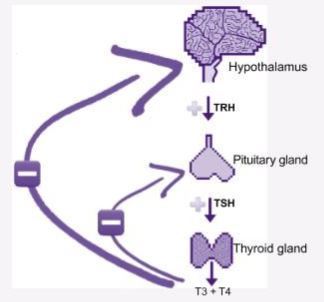
Abnormal TFTs: Hyperthyroidism
Primary hyperthyroidism = ↑T4, so ↓TSH = Grave’s, toxic nodular goitre, drug-induced.
Secondary hyperthyroidism = ↑TSH, so ↑T4 = pituitary tumour.
Quick review of CXR:
PIPRA + ABCDEFGH
PSA=?pneumonia/pulmonary oedema
PIPRA:
- Projection: PA (N, PA if no markings) or AP (can’t comment on heart) – should see from above clavicles to below diaphragm.
- Inspiration: 7th anterior (down-sloping) rib transects diaphragm.
- Penetration: vertebral bodies behind heart.
- Rotation: distance between spinous processes + clavicles equal.
- Artefact: if present.
ABCDEFGH:
- Airways: trachea central – if not, consider collapse (towards) or pneumothorax (away).
- Bone: rib fractures or lytic lesions.
- Cardiac: cardiothoracic ratio <50% on PA film.
- Diaphragm: air under diaphragm – bowel perforation or recent surgery; under L side is gastric bubble (N).
- Edges: costophrenic + cardiophrenic angles sharp or blunt (effusion).
- Fields: white area = effusion (unilateral + solid), pneumonia (unilateral + fluffy), oedema (bilateral + fluffy), fibrosis (bilateral + honeycomb).
- Oedema, ABCDE = alveolar oedema, kerley B lines, cardiomegaly, diversion of blood to upper lobes, effusions.
- Sail sign (triangle shape) behind heart = L lower lobe collapse.
- Gynaecomastia + other soft-tissues.
- Hila.
The hilum is visible as a triangular section at the inner midpoint of each lung. It is the space where vessels and nerves pass from your bronchus to your lungs. The hilum keeps your lungs anchored in place.
Quick review of ABG
- Check inspired oxygen concentration (FiO2):
- Calculate N PaO2 for patient on oxygen: subtract 10 from FiO2, and if PaO2 exceeds this number, then patient not hypoxic.
- E.g. On 60% oxygen with FiO2 of 30kPa actually hypoxic. Accurately done via arterial-alevolar gradient.
- Calculate N PaO2 for patient on oxygen: subtract 10 from FiO2, and if PaO2 exceeds this number, then patient not hypoxic.
- Check for respiratory failure: if PaO2 low or inappropriately N.
- Type 1 = low or N PaCO2 (fast breathing) → heart/lung damage causing SOB.
- Type 2 = high PaCO2 (slow breathing) → ‘blue-bloaters’ of COPD, NM failure or restrictive chest wall abnormalities.
- Check acid-base status:
- Low pH = acidosis; high pH = alkalosis.
- PaCO2 abnormal = respiratory. HCO3 abnormal = metabolic. Both = compensation (fully if pH normal, otherwise partial). Both abnormal in opposite directions = mixed.
Causes of the 4 acid base abnormalities
Respiratory alkalosis = rapid breathing – disease or anxiety.
Respiratory acidosis = same causes as T2RF. (COPD, blue bloaters, + neuromuscular failure + restrictive chest wall abn)
Metabolic alkalosis = vomiting, diuretics + Conn’s syndrome.
Metabolic acidosis = multiple causes e.g. lactic acidosis, DKA, renal failure, ethanol/methanol/ethylene glycol intoxication → narrow cause by using anion gap.
Aldosterone helps control blood pressure by holding onto salt and losing potassium from the blood. The increased salt increases the blood pressure.


-
Chapter 1: Basic principles of prescribing7
-
Chapter 2: Prescription Review16
-
Chapter 2 Qs20
-
Chapter 3: Data Interpretation38
-
Chapter 3 Qs9
-
Other1
-
Chapter 4: Planning Management45
-
Chapter 4 Qs4
-
Chapter 5 Qs: Communicating Information10
-
Chapter 6 Qs: Calculation Skills15
-
Chapter 7 Qs: Prescribing: doing it yourself11
-
Chapter 8 Qs: Drug Monitoring14
-
Chapter 9: Adverse Drug Reactions14
-
*Chapter 9 Qs10
-
deck_663327679



