Types of Budgets
- Master budget - a static hduget for the company as a whole/ This would summarize various individual budgets (Esp operating and financial budgets)
- operating budget - Projected/future/budgeted income statement
- financial budget - Projected/future/budgeted capital or cash budget, balance sheet, or Stmnt of CF. Usually for 1 year, but could be a rolling budget as well
- static budget - analyze specific conditions. Unchanged budgets unless recalculated
- Kaizen budgeting
- Flexible budget -
purchase budget
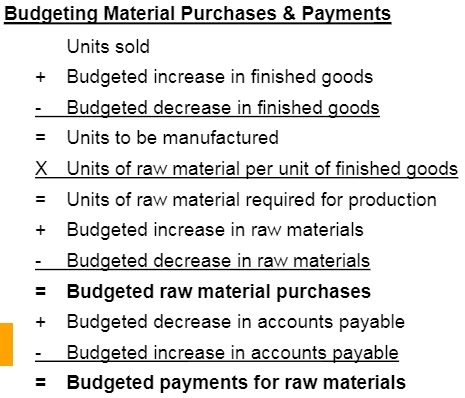
What would a production budget look like
Budgeted or Projected Sales
+ Desired ending inventory of finished goods
Total Needs
- Beginning Inventory of finished goods
of units to be prodcued
Flexible budget example:
the picture here is the budget. Sales were acutally 1500, so higher by 50%. To modify:
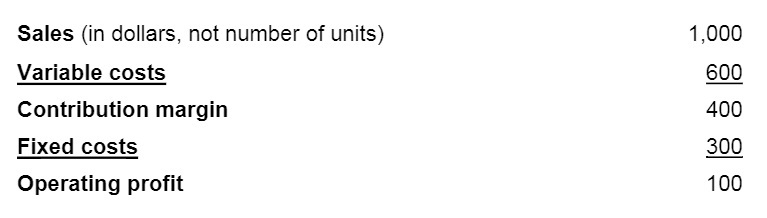
see picture attached to explain. Thus, the following formula we learned earlier will also work with this to find total cost.
Y = A + (b * X)
A is Fixed costs, b is variable costs, and X is the cost driver.
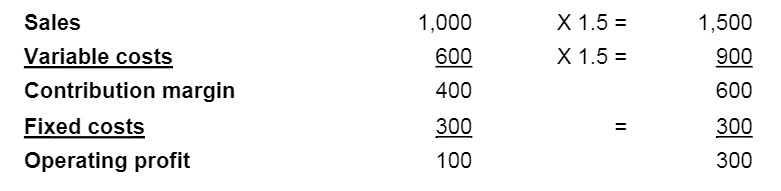
Given the picture, show the original formula we must have used for this flexible budget.
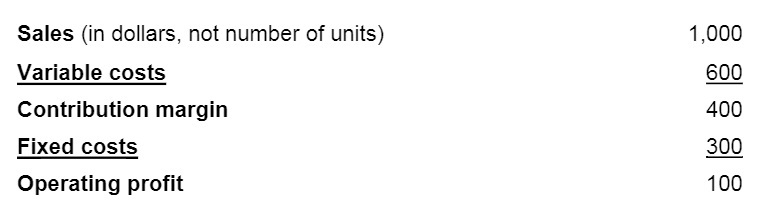
Well notice how that when sales were $1000, the variable costs were $600. Thus, there must be a variable cost of 60% of sales. So:
Y = A + (b * x)
Y = 300 FC + VC(0.6 * X)
Y equals total costs, A is fixed costs, the parentheses at the end represent the total variable costs.
What are total budget formula is Y = 300 FC + VC(0.6 * X)
If Sales were $1000, what were total costs (Y)?
Next - to illustrate how east it is to change flexible budgets - what if sales were actually 1500?
Put the sales figure into X
Y = 300 + (.6*1000) = 300 + 600 = 900
Next formula:
Y = 300 + (.6*1500) = 300 + 900 = 1200
Purpose of correlation analyiss
Remember that linear formula:
Y = FC + VC (b * X)
Sometimes companies try to identify which predictors would be the best to use as the X.
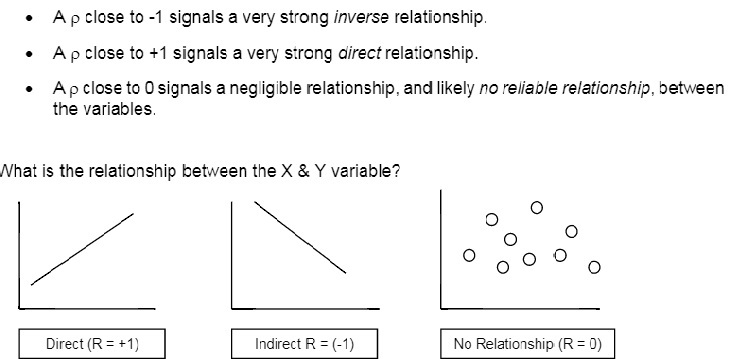
For instance - perhaps sales is the best indicator for total costs or direct labor hours would be best for manufacturing overhead. Whatever the case, to find the best relationship between two variables, correlation analysis is used
correlation analysis results
Purpose of responsibility accounting
To identify which parties within an organization are responsible for what and to seek standards to measure performance on them.
There are three sectors, and each lateer sector incldues responsibilites of the prior sector
- Cost Center - deals mainly with costs incurred by the center - tings like pruchasing, etc
- *2. Profit Center -** This would be the sales people, etc. respojnsible for revenue earned in the company but they are ALSO RESPONSIBLE for the cost center’s duties
3. Investment Center - does capital investments, and ALSO has responsibilies of the cost and profit center
Activity Based Costing
Try to group together costs affected by common factors and place them into a single cost driver.
Eg - Depreciation, maintencance, and repairs can be put together as a group and affected by machine hours.
or
Payroll taxes, wages, and benefits are grouped and affected by direct labor hours
Value-added vs non-value added
Value-adding costs:
- engineering costs
- Reseach and development
- modifying to customer’s specifications
- expenses that improve performance
- direct manufacturing costs
- operation of production machinery
Non-Value-adding costs:
- STORAGE OF RAW MATERIALS***
- moving
- handling
- factory utilities
- depreciation
Storage is often tested for some reason
Systematic vs Unsystematic Risk
unsystematic is risk that is unique, ie, pertains to a specific investment. It can possible be avoided through things like diversification, etc.
systematic risk is risk pertaining to market conditions. Tends to be unavoidable
Project management
- Project Initiation
- Project Planning
- Project Execution
- Minitoring
- Project Closure
Put vs Call contracts
Put - to SELL at an agreed price
Call - to BUY at an agreed price.
So say we expect to pay a British supplier in three moenths, the best hedge for us to enter is a British Pound Call Option. We’d BUY the option (incorrect answe’rs may say “sell the option”)
theory of constraints
identifying bottlenecks
DuPont ROI Analysis
ROI = Return on Sales X Asset Turnover
return on sales = net income/sales
asset turnover = sales/total assets
Residual Income
Operating Profit - Interest on Investment
***Interest = asset/investment balance x required rate of return. So say a company has profit of 400, a ROR of 10%, and 100 total assets.
Residual Income is
400 profit - 10 = 390
4 balanced scorecard measures
- Financial Perspectives -
- Customer Perspectives
- Internal business process cycles - measures internal variances/averages, finding defects, etc. A key component of innovation iwthin organizations
- Learning and growth perspectives - ensure that key drivers of organization’s long-term abilities to carry out mission of organization are not neglected for short-term obejctives. Include things like:
tracking employee satisfaction, and maintianing employee training and advancement
Budgets must be prepared in the following order
- Sales Budget
- Production Budget
- Direct/raw Materials purchases
- Cash Disbursements Budget
- Budgeted FIN. Statements: I/S, CF, B/S
what measures volatility of an investment?
Standard Deviation (GERT would be an incorrect answer. That refers to a project management technique)
Multiple regression vs simple regression
multiple allows more INdependent variables
Benchmarking
continuous process of comparing a company’s financial data to published ifnormation to see if optimal performance is being achieved
In using regression analysis, which measure indicates the extent to which a change in the independent variable explains a change in the dependent variable?
R squared

-
Chapter 1 - ECON58
-
LOOK AT THESE AT THE END18
-
Chapter 2 - Corporate Governance/InternalControl/ERM20
-
Chapter 3 - Financial Management+CapitalBudgeting56
-
Chapter 4 - Decision Making (Managerial Accounting)40
-
Chapter 5 - Cost Accounting and Performance Measurement WILL FINISH LATER9
-
Chapter 6 - Planning Control Analysis and Risk Management24
-
Chapter 7 - IT (Hard/Incorrect Questions Only)35
-
Chapter 6 - Hard Questions10
-
Chapter 3 Hard questions7
-
Chapter 1 Hard Questions5



