What kind of electrolyte disturbance will produce the following ECG?
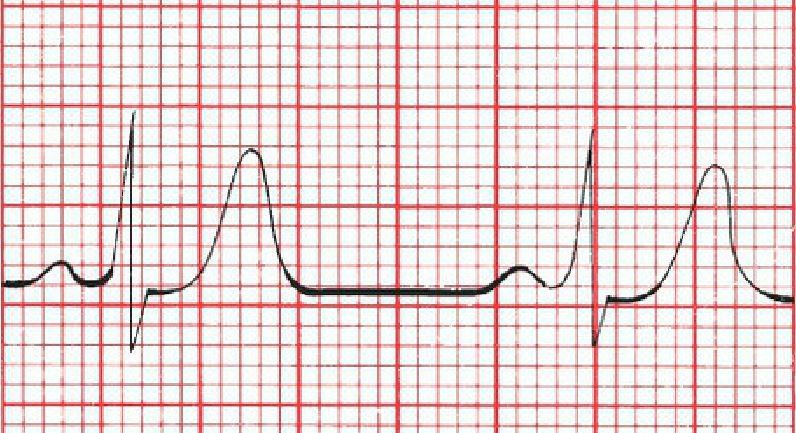
The peaked T waves of hyperkalemia.
What happens when serum K further increases?
As the potassium level rises, PR interval prolongs and P waves gradually flattens and then disappears. The T waves are even more peaked.
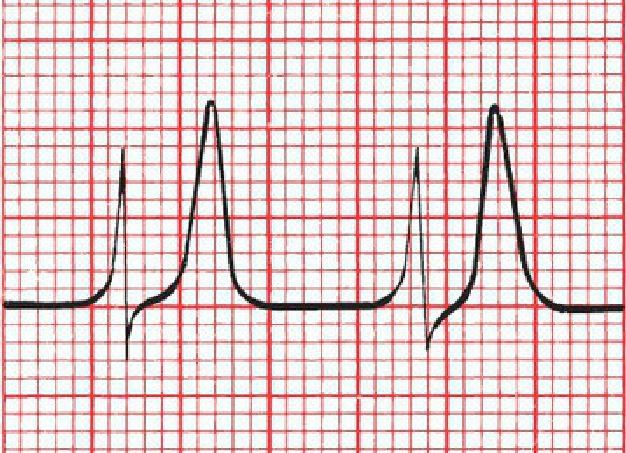
What happens eventually to the ECG with dangerously high serum K?
QRS widens until it merges w/ T, forming a sine wave. V fib may develop.
Progressive hyperkalemia leads to the classic sine wave pattern. The widened QRS complexes and peaked T waves are almost indistinguishable.
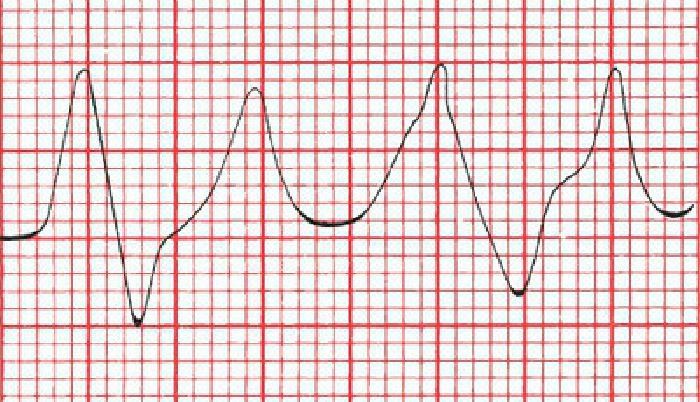
What kind of electrolyte disturbance produces this ECG?
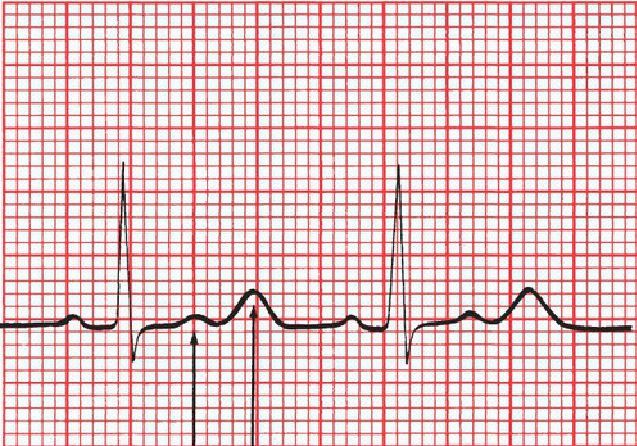
Hypokalemia. The U waves are even more prominent than the T waves.
How does serum Ca level affect ECG?
Hypocalcemia: prolong QT
Hypercalcemia: shorten QT
Why is Hypocalcemia dangerous?
Hypocalcemia prolongs the QT interval. A premature ventricular contraction can fall on the prolonged T wave and sets off a run of V tach or torsades de pointes.
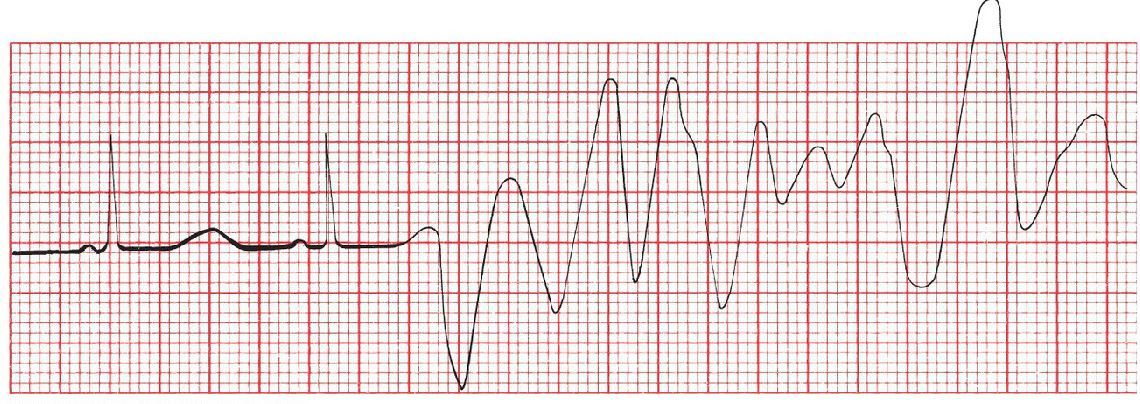
What happens to ECG when body temperature dips below 30C?
- Everything slows down. SB is common, all segments and intervals may become prolonged.
- J wave/Osborn wave may be seen.
- Various arrhythmias. Slow A Fib is most common.
- Muscle tremor artifact may be seen on the ECG tracing
What causes this ECG?
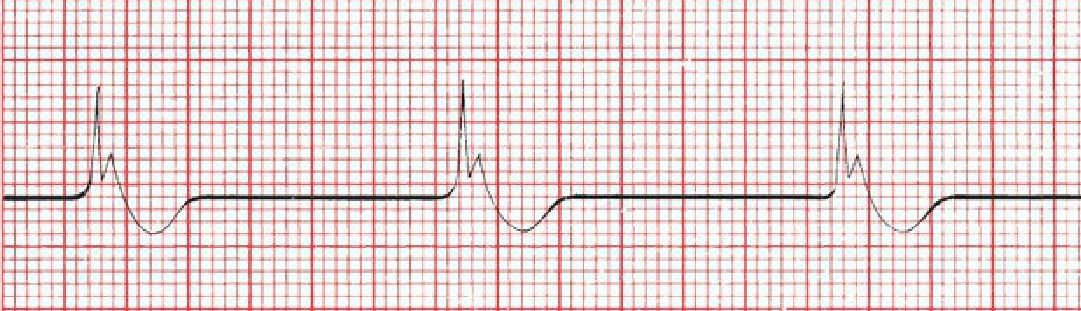
Hypothermia. The Osborn waves are very prominent.
Identify this ECG
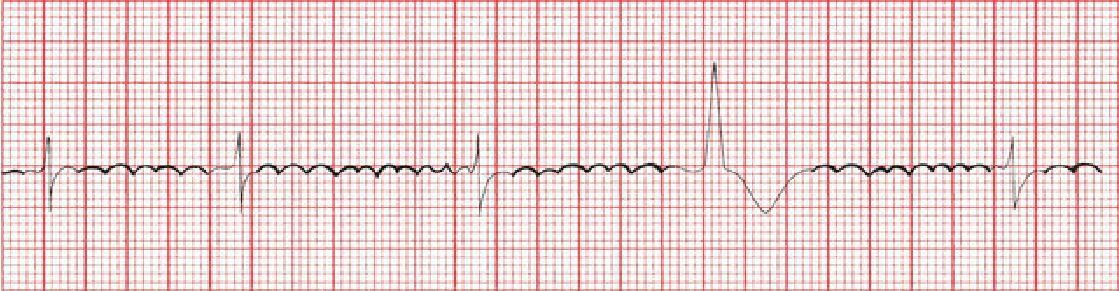
A muscle tremor artifact during hypothermia resembles atrial flutter. But A flutter is a regular rhythm, there’s a fixed block ratio between P and QRS, such as 3:1 or 5:1
What would you see on pt’s ECG if he’s taking digoxin?
The digitalis effect, with asymmetric ST segment depression.
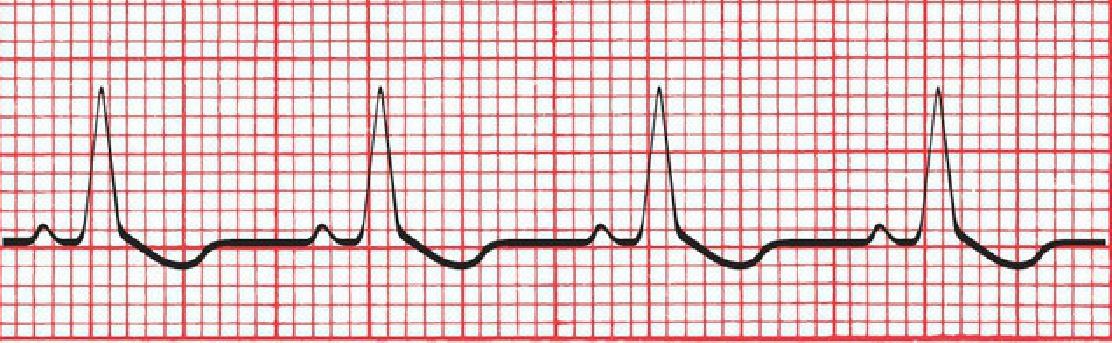
What happens on ECG when pt suffers digoxin(digitalis) intoxication?
- Sinus node suppression. Sinus exit block or complete sinus node suppression can occur.
- Conduction block. Digitalis slows AV conduction, thus can produce 1st, 2nd, and even 3rd degree AV block.
- Tachyarrhythmias. Digitalis enhances automaticity of all cardiac cells, causing them to all act like pacemakers, there is no tachyarrhythmias that digitalis cannot cause. PAT and PVC are most common, A flutter/fib are least common
- the combination of PAT with 2nd degree AV block is the most characteristic rhythm of digitalis intoxication.
Identify this ECG
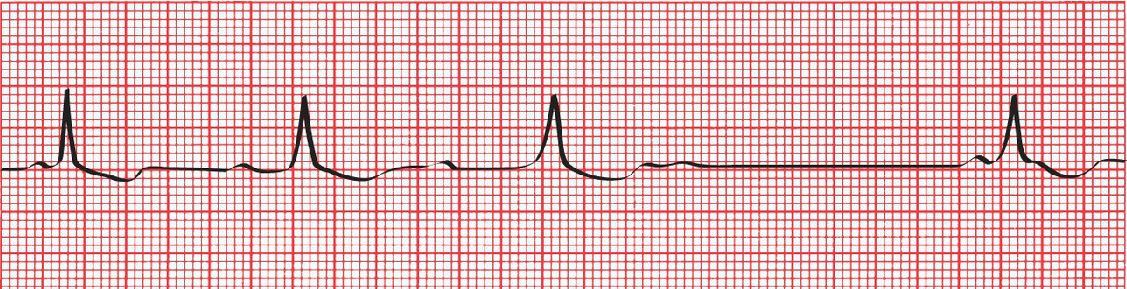
Wenckebach block caused by digitalis intoxication. The gentle downslope of ST depression is very characteristic for digitalis
How do you differentiate acute pericarditis from evolving infarction on ECG?
- The ST and T changes in pericarditis tend to involve far more leads than the localized effect of infarction.
- In pericarditis T wave inversion occurs only after ST has return to baseline; whereas in infarction, T wave inversion happens before normalization of ST segments
- Pericarditis doesn’t have Q wave formation
- PR interval is sometimes depressed in pericarditis
Identify the ECG
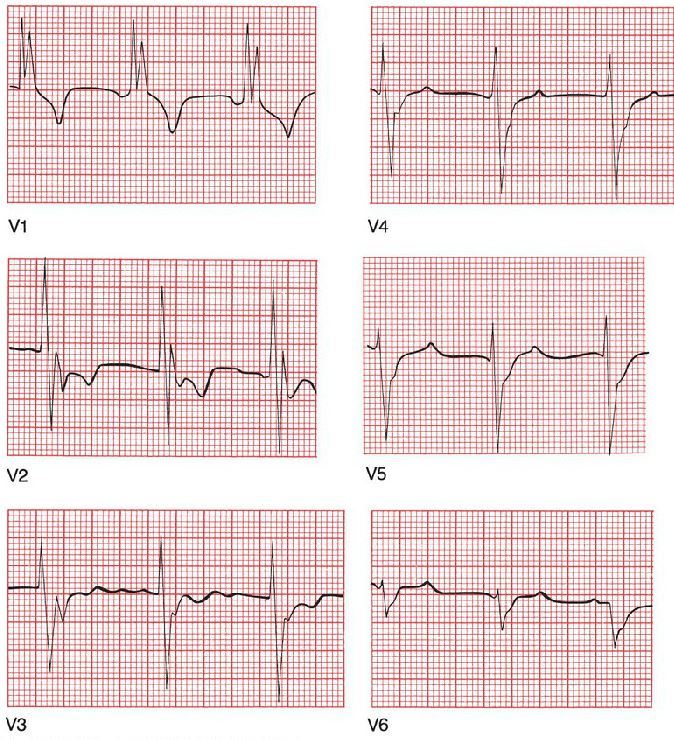
Right bundle branch block (in a patient caused by active myocarditis following a viral infection)
List some drugs that can prolong QT interval
sotalol
quinidine
procainamide
amiodarone
tricyclic antidepressants
pheothiazines
erythromycin
quinolone antibiotics
various antifungal meds
What would you see in the ECG of a pt with long-standing emphysema?
low voltage, right axis deviation, and poor R progression.
What kind of pulmonary disorder will cause the following ECG?
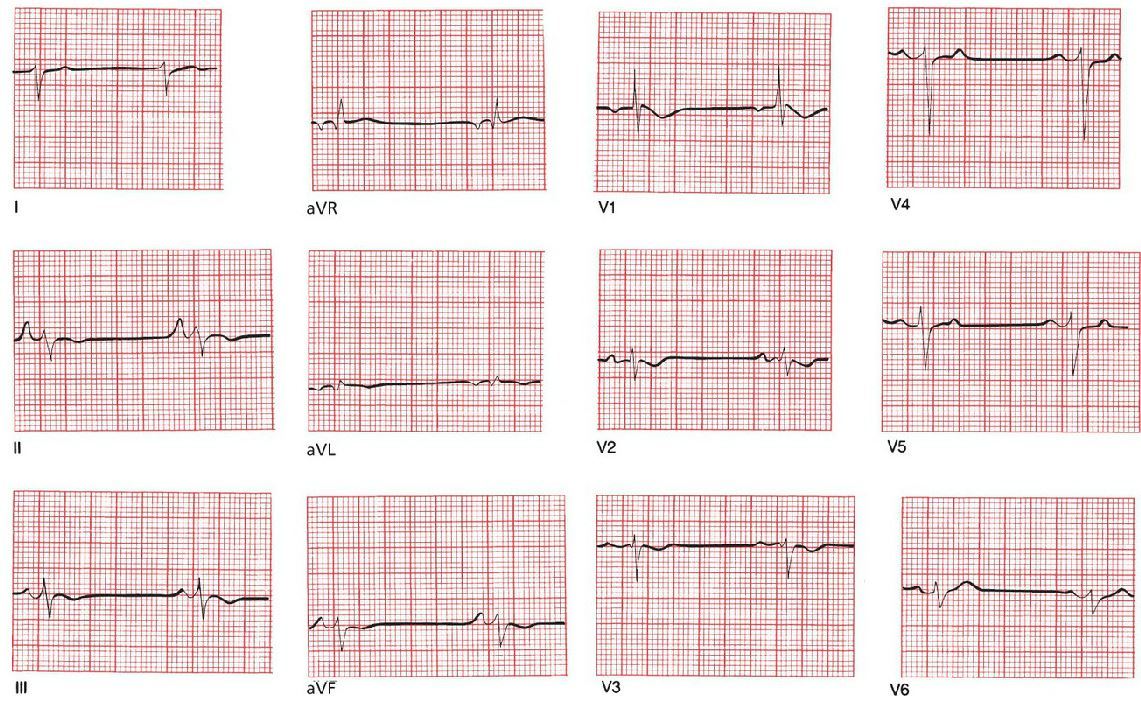
Chronic obstructive pulmonary disease. Note the low voltage, extreme right axis deviation, right atrial enlargement (in lead II), and precordial criteria for right ventricular hypertrophy.
What would you find on ECG when pt suffers a sudden massive pulmonary embolus?
- Acute right ventricular hypertrophy with repolarization changes
- Right bundle branch block
- A large S wave in lead I and a deep Q wave in lead III. The S1Q3 pattern. T may be inverted in lead III
- A number of arrhythmias, most commonly ST and A fib
What would you see on ECG of a pt suffering SAH or cerebral infarction?
very deep and wide and symmetrical T wave inversion, and sometimes prominent U waves
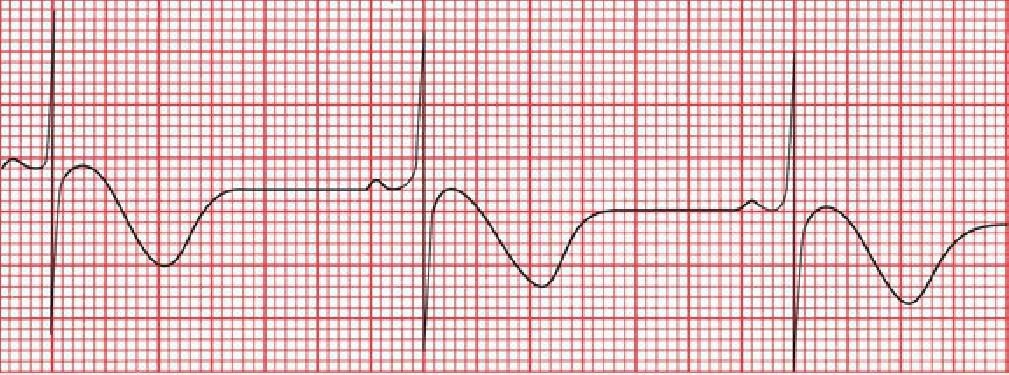
What would you see in “the athlete’s heart”?
SB, nonspecific ST and T changes, Left and Right ventricular hypertrophy, incomplete Right bundle branch block, 1st degree or Wenckbach AV block
Is this NSR? If not, what’s going on here?
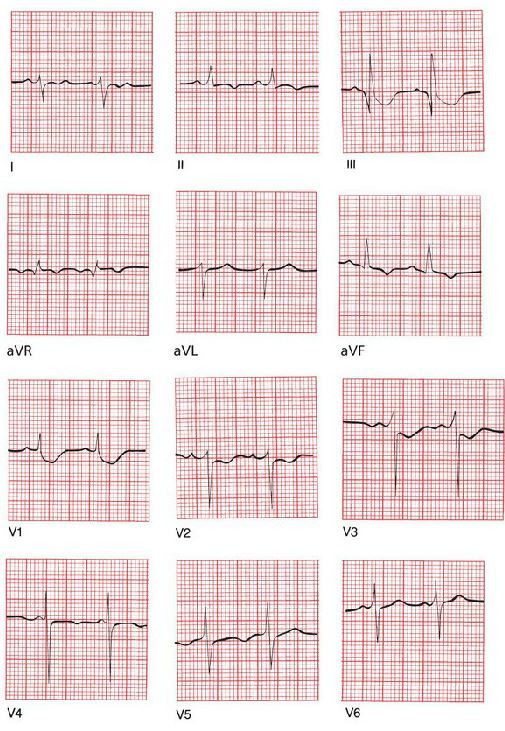
Borderline ST, Right ventricular hypertrophy w/ repolarization abnormalities, S1Q3 pattern suggesting acute pulmonary embolus
If your pt is on trimethoprim-sulfamethoxazole (an antibiotic) and lisinopril, and her ECG looks like following, does it alert you?
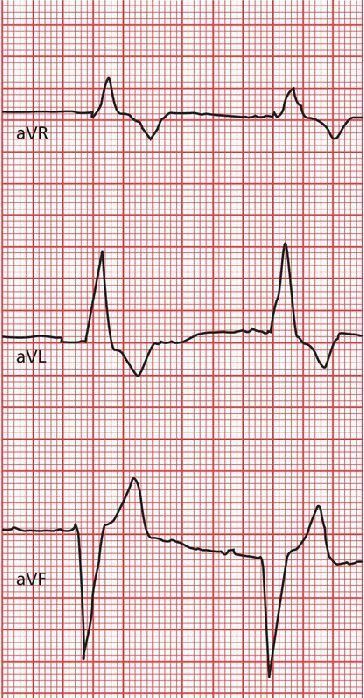
Yes, both the antibiotics and lisinopril will increase serum K, and the ECG clearly shows severe manifestations of hyperkalemia (loss of P, broad QRS that’s merging with T to form sine wave). Risk of V fib is in the setting, you should treat the pt aggressively for hyperkalemia




