Product and Services
Product: anything that can be offered to a market for attention, acquisition, use, or consumption that might satisfy a want or need (includes flights, BMO investments)
Services: an activity, benefit, or satisfaction offered for sale that is essentially intangible and does not result in the ownership of anything
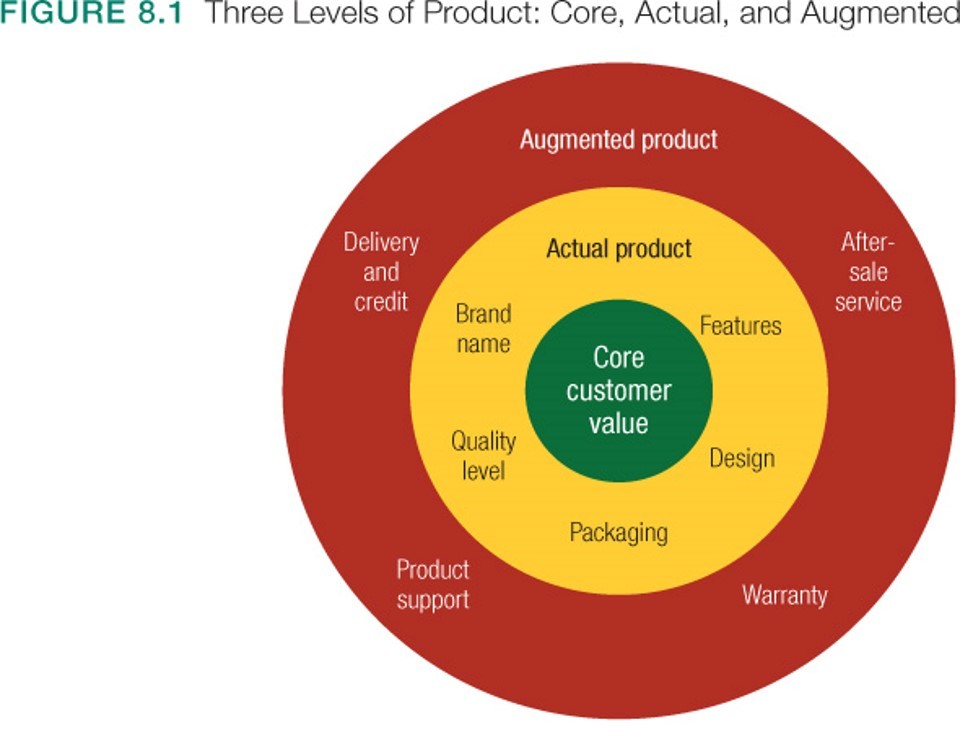
Levels of Products and Services
- *1.**
- *2.**
- *3.**
1. Core customer value: what is the customer really buying? So Smarphone , car ect
2. Actual Product: the physical device with all its
features and brand name +packaging
3. Augmented Product: the additional services and
benefits that go with it.
Example: the core product is a smartphone, the actual
product is the iPhone, and the augmented product is the
iPhone PLUS a calling and data plan
Product and Service Classifications
Products and services fall into two broad categories:
I.
II.
Product and Service Classifications
I. Consumer Products: products purchased by consumers for their personal use.
- Convenience product: a consumer product/ buy frequently, immediately, and with a minimum of comparison and buying effort
- Shopping product: less frequently purchased /compare carefully on suitability, quality, price, and style
- Specialty product: unique characteristics or brand identification/ a significant group of buyers is willing to make a special purchase effort
- Unsought product: consumer either does not know about or knows about but does not normally think of buying
II. Industrial Products: a product bought by individuals ad organizations for further processing or for use in conducting a business
New Product Development & Why New Products Fail
- *New Product Development**
(a) (b) (c) (d)
Why New Products Fail Lack of
New Product Development & Why New Products Fail
New Product Development
A new product is (a) an innovative product new to the world (b) product improvements (c) product developments (d) new brands coming up with a new product.
Why New Products Fail Lack of
- Lack of differentiation
- Poor match between features and customer desires
- Overestimation of market size
- Incorrect positioning
- Price too high or too low
- Inadequate distribution
- Poor promotion
- Inferior product
- Bad timing
Diffusion of Innovations Theory & Technology Adoption Life Cycle
Diffusion of Innovations Theory few early adopters of any new idea, product, or technology, most people wait until the idea is proven before they are willing to try it.
Technology Adoption Life Cycle: marketing a technology product, marketers must cross a big gap, between members of the early adopters’ segment and members of the early majority segment before a new product will become successful.
The New Product Development Process
The New Product Development Process
Idea Generation:
- internal/external sources such as customers, competitors, distributors& suppliers, and others
- crowdsourcing
Idea Screening: find good bad
Concept Development and Testing ;Description, drawing, prototype, NOT YET IN PRODUCTION
Marketing Strategy Development:how, when, where, and to whom the product will be introduced
Business Analysis: sales, costs, and profit projections for a new product to find it satisfies company’s objectives
Product Development: product concept into a physical product
Test Marketing: product and marketing program are tested in realistic market settings
Commercialization: the full-scale introduction of the new product into the market
The Product Life Cycle
…
Five stages:
The Product Life Cycle
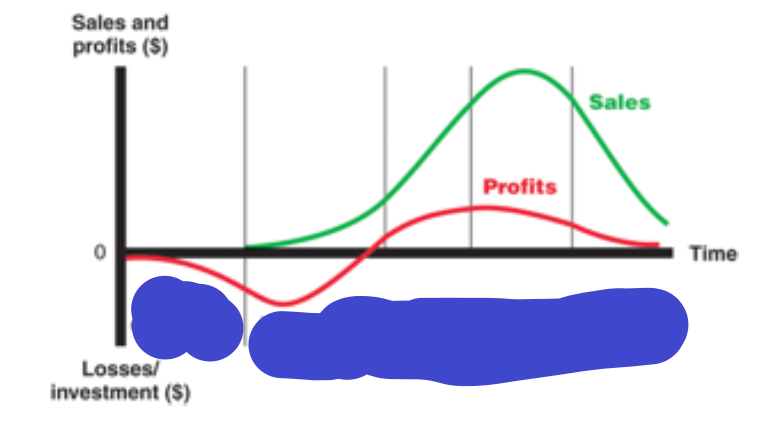
The course of a product’s sales and products over its lifetime. Five stages:
STAGE 1: Product Development
(see above, THE NEW PRODUCT DEVELOPMENT PROCESS)
STAGE 2: Introduction: made available for purchase.
- Many new products fail during this stage
STAGE 3: Growth
sales will start climbing quickly.
- Want to stay in this phase as long as possible
- Do so by adding new features/models or targeting new market segments
STAGE 4: Maturity
Sales growth slows down or levels off
- Keep products consistently profitable by modifying market, the product, or marketing mix
STAGE 5: Decline
Some mature products that continue to be useful (laundry detergent, shampoos) stay in the maturity stage indefinitely, but other products (computers, TVs, phones) will eventually decline, die, and be replaced by different new products.
- marketer’s may harvest (reduce various costs such as advertising, R&D, maintenance etc.)
Styles, Fashions and Fads
Styles, Fashions and Fads
Style: basic+ distinctive mode of expression
- Appears in homes , clothing , art
- Has cycle with several periods of renewed interest
Fashion: a currently accepted or popular style of design, colour, or theme
- Clothing, cars, furniture, music, sports
- They tend to grow slowly, remain popular for awhile, and the decline slowly
Fad: a temporary period of unusually high sales driven by consumer enthusiasm and immediate product popularity
- Not usually identified as fads until years later
Product and service decisions and Product Line Decisions
Product and service decisions
1. Individual Product and Service Decisions: includes decisions about product attributes, packaging, labelling, and product support services
- Product and Service Attributes
- Quality,features,Style and Design,Packaging, Labeling
2. Product Line Decisions: a group of products that are closely related because they function in a similar manner, are sold to the same customer groups, are marketed through the same types of outlets, or fall within given range prices.
- Product Line Length: the number of items in the product line.
- Expanding Product Line
- Line Filling/Stretching: adding more items within the present range of the line. New items must be different from existing ones
- Product Line Stretching: when a company lengthens its product line beyond its current range.
- Downward line stretch: lower-priced line, creates more competition between brands
- Upward line stretch: entering the high end of a market to add prestige.
3.Product Mix Decisions
- Product mix/portfolio: the set of all product lines and items that a company markets. It has 4 important dimensions. Growth and downsizing decisions
Services Marketing
What are services are
- Services are
- Intangibility: services cannot be seen, tasted, felt, heard, or smelled before they are bought. )
- Inseparability: produced and consumed at the same time and cannot be separated from their providers.
- Variability: their quality may vary greatly, depending on who provides them and when, where, and how.
- Perishability: service cannot be stored for later sale or use. The perishability of services is not a problem when demand is steady. Perishability can affect company performance as balancing supply and demand is very difficult.
Product Strategy
A.Product Mix Width (number of product lines)
B.Product Mix Depth (number of models or versions offered in product lines)
C.Consistency of the Product Mix: How closely related the product lines are from the consumers’ point of view, distribution channels, and production requirements.




