Motivation
The processis that cause an individual’s intensity, direction, and persistence of effort toward attaining a goal.
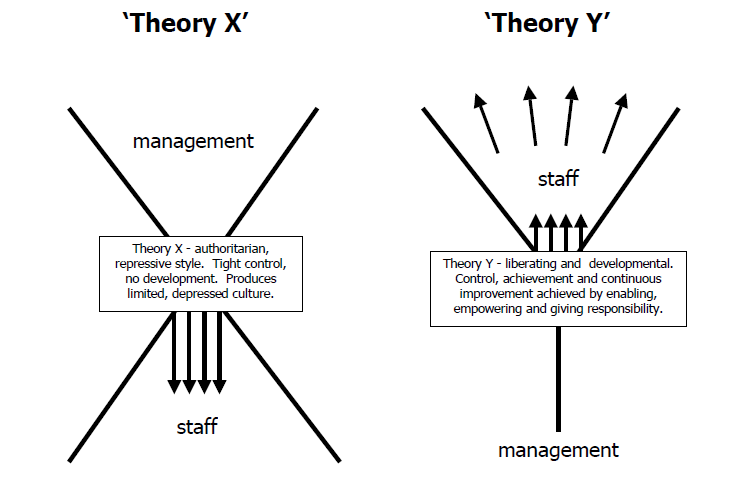
Theory X
Managers believe employees inherently dislike work and must therefore be directed or even coerced into performinig it.
Employees don’t like to work, as a result - motivate with punishments.
Theory Y
Managers assume employees can view work as being as natural as rest or play, and therefore the average person can learn to accept, and even seek, responsibility.
Generally, employees like to work - motivate iwth decision making, awarding etc.
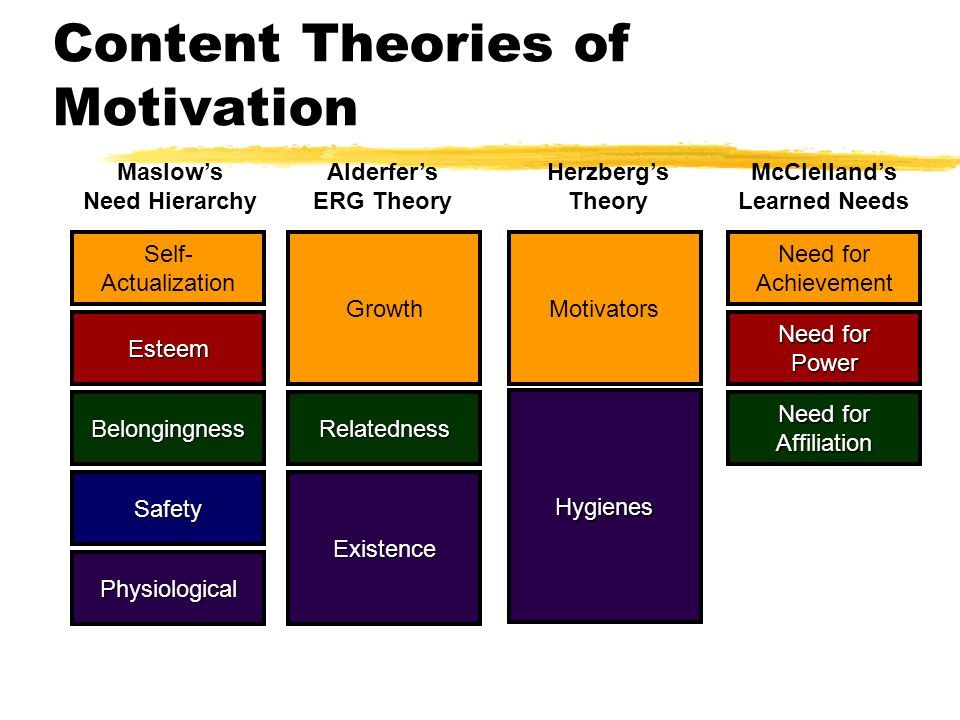
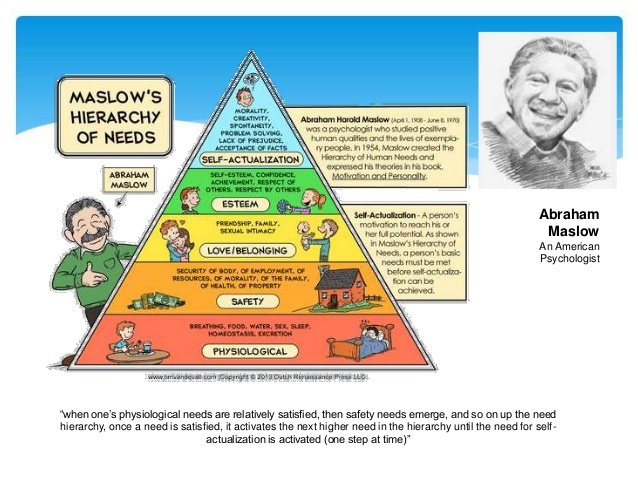
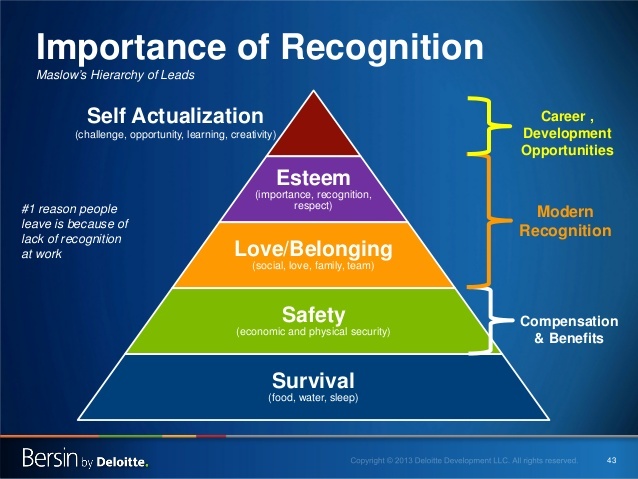
Maslow’s Hierarchy of Needs -
Hierarchy of Needs Theory
From Buttom Up:
1. Physiological - hunger, thirst, shleter, sex, and other bodily needs.
2. Safety - security and protection from physical and emotional harm.
3. Social - affection, belongingness, acceptance, and friendship.
4. Esteem
- internal factors - self-respect, autonomy, and achievemnt
- external factors - status, recognition, and attention.
5. Self-actualization - drive to become what we are capable of becoming: includes growth, achieving our potential, and self-fulfillment.
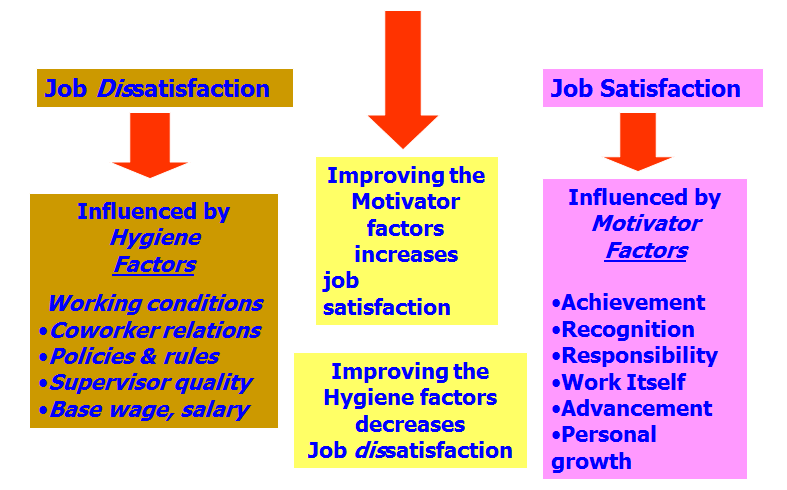
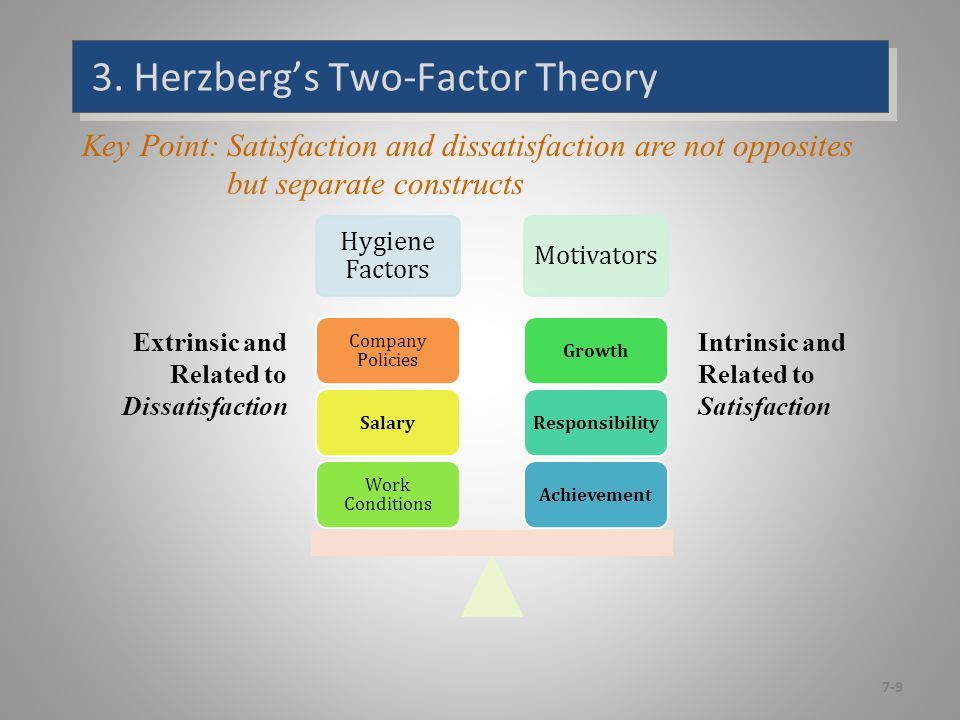
Herzberg’s Two-Factor Theory
(also called Motivation-hygiene theory)
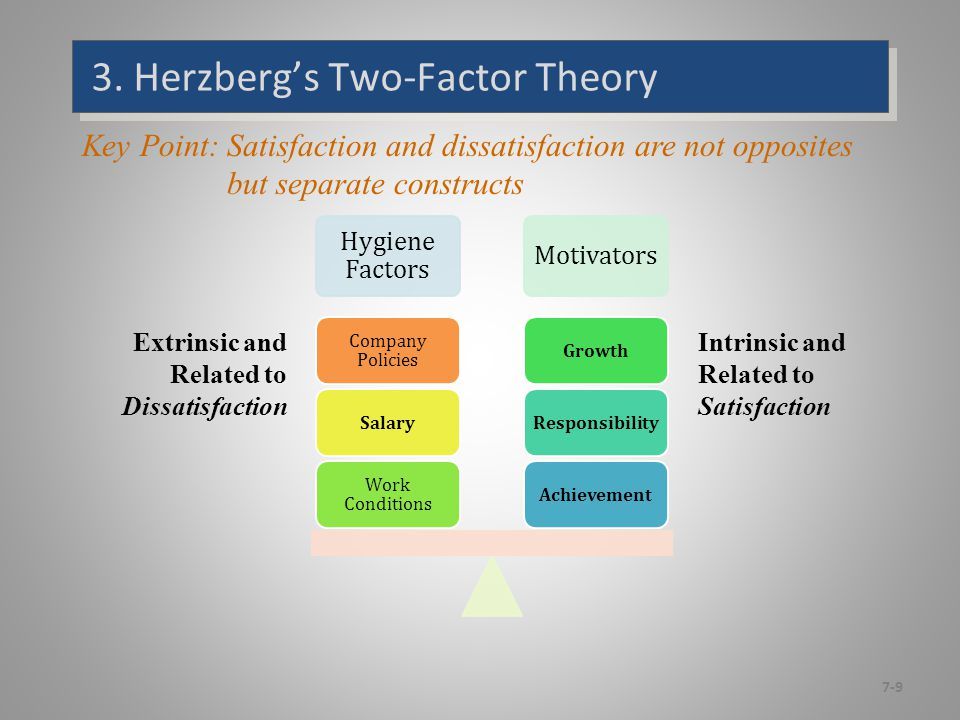
Hygiene factors (satisfy or dissatisfy, not nessesary motivated) - quality of supervision, pay, company policies, phisical working condition, relationship with coworkersm job security.
Motivational factors - promotional opportunities, recognition, responsibility, achievemnts
McClelland’s Theory of Needs
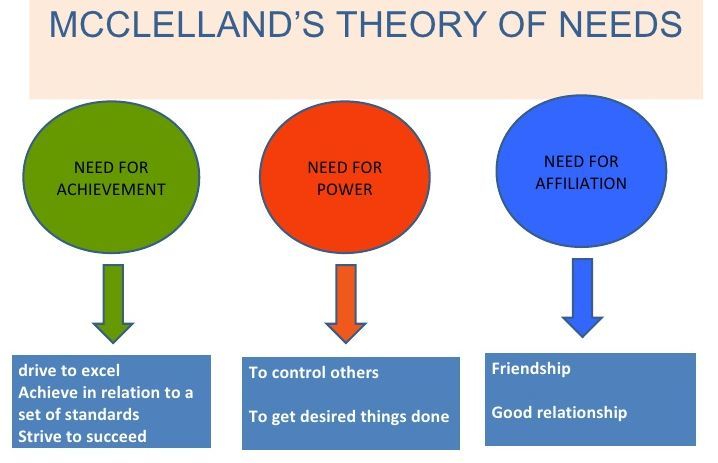
A theory that states
- achievement
- power
- affiliation
are 3 important needs that help explain motivation
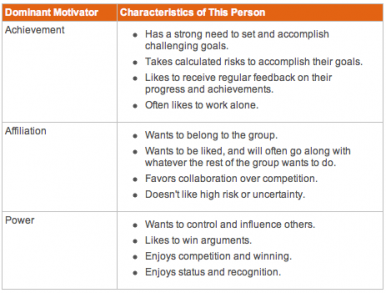
Need for Achievemnt - drive to excel, to achieve in relationship to a set of standards
Need for Power - is the need to make others begave in a way they would not have otherwise
Need for affiliation - desire for friendly and close interpersonal relationships
Critisism - best research support, but less practical than others. McClelland argued that needs are subconscious - easuring them is not easy, process is time consuming and expensive.
Self Determination Theory
(Contemporary Theories of Motivation)
Theory that is concerned with intristic motivation (motivation from within - by interests, curiosity, care or abiding values) and the harmful effect of extrinsic motivation (external factors - reward systems, grades, evaluations, opinions they fear others might have of them).
Example: Sales person would not be motivated to write everyday a porgram code, she would be less interested in the task and might reduce her effort.
Cognitive evaluation theory - something that had been previously intrinsically rewarding tend to decrease the overall level of motivation if the rewards are seen as controlling.
Job Engagement
(Contemporary Theories of Motivation)
The engagement of an employee’s physical, cognitive, and amotional energies into job performance.
Engagement resons:
- Degree to which an employee believes it is meaningful to engage in work (job characteristic and sufficient resources)
- A match between individual values and the organization’s.
- Inspiring leadership behavior.
Goal-Setting Theory
(Contemporary Theories of Motivation)
Specific and dificult goals, with feedback, lead to higher performance.
- Specific goals increase performance
- Dificult goals, when accepted, result in higher performance than do easy goals. Difficult goals get our attention and help us focus.
- Feedback leads to higher performance than does nonfeedback.
Management by Objectives (MBO)
A program that encompasses (surrounds) specific goals that are tengible, verifiable, and measurable, for an explicit time period, with feedback on goal progress.
Specific objectives of all levels - divisional, departmental, individual.
4 ingridients:
- goal specification
- participation in decision making (including the setting of goals or objectives)
- explicit time period
- performance feedback
Slef-Efficacy Theory
An individual’s belief that he or she is capable of performing a task.
Goal setting theory and self-efficacy theory do not compete, they complement each other.
If your boss sets higher goals for you than for others, you’d think that he thinks you are capable of performing better than other. It will help you to feel more confident and you set higher personal goals, performing better both inside and outside the workplace.
4 ways self-eficacy can be increased:
- Enactive mastery - gaining relevant experience with the task or job
- Vicarious modeling - becoming more confident because you see someone else doing the task. It’s more effective if you see yourself similar to the person you are observing.
- Verbal persiasion - someone convinces you that you have the skills necessary to be successful.
- Arousal - leads to energized state so the person gets “psyched up” and performs better. But if the task requires a steady, lower-key perspective, arousal may in fact hurt performance.
Equity Theory
Eequity Theory lies in principles of organizational justice. A theory that says that individuals compare thier job inputs and outcomes with others and resoind to eliminate any inequities.
Based on Equity Theory, employees who perceive inequity will make one of six choices:
- change inputs (less effort)
- change outcomes (higher quantity of units at lower quality)
- distort perceptions of self (I work a lot harder than everyone else)
- choose a different referent (i’m not making much, but I’m doing much better than my dad when he was my age)
- leave the field (quit the job)
Organizational Justice
Organizational Justice - an overall perception of what is fair in the workplace, composed of distributive, procedural, informational, and interpersonal justice. (Ex: I think this is a fair place to work.)
- Interactional Justcie - perceived degree to which one is treated with dignity and respect. (Ex: when telling me about my raise, my su[ervisor was very nice and complimentary)
- Distributive Justice - perceived fairness of the amount and allocation of rewards among individuals. (Ex: I got the pay raise I deserve)
- Procedural Justice - the perceived fairness of the process used to determine the distribtion of rewards/outcome. (Ex: I had input into the process used to give raises and was given a good explanation of why I received the raise I did.)
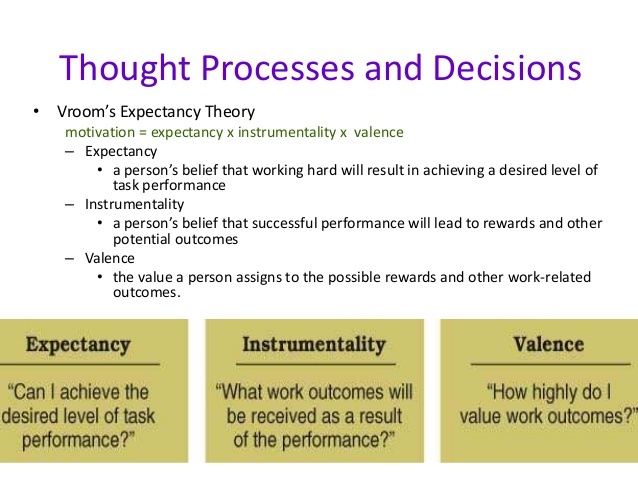
Expectancy Theory
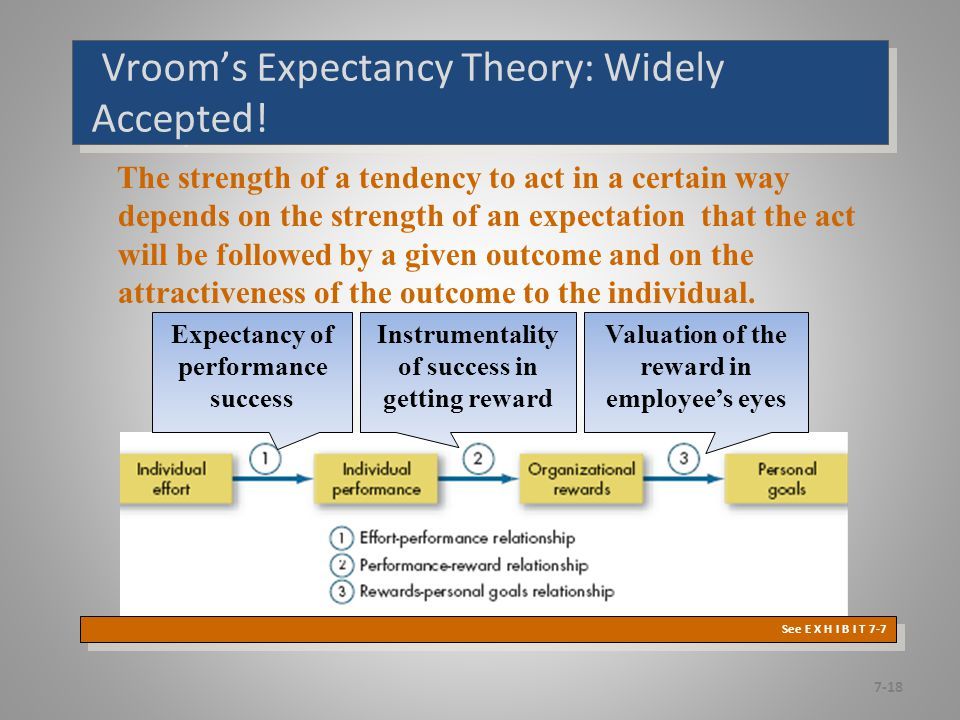
A theory that says that the strength of a tendency to act in a certain way depends on the strength of an expectation that the act will be followed by a given outcome and its attractiveness.
Reinforcement theory
(Operant Conditioning)
Rainforce a behavior that you want to or don’t want to be repeated.
Ex: reward someone who is never late
Social Learning Theory
Social-learning theory - we can learn through both observation and direct experience.
- Attention processes - people learn from a model, pay attention
- Retention processes - a model’s influence depends on how well the individual remembers the model’s action after the model is no longer available
- Motor reproduction processes - a person’s watching is converted into doing.
- Reinforcement processes - a person is more moivated to do well if rewards are provided.
Employee Involvement
(Y Theory, Two-Factor Theory)
Employee Involvement - A participative process that uses the input of employees and is intended to increase employee commitment to an organization’s success.
If we engage workers in decisions that affect them and increase their autonomy, they will become more motivated, more committed to the organization, more productive, and more satisfied with their jobs.
Two Major Forms of Employee Incolvement Programs
- Participation Management - joint decision making, in which subordinates share a decision-making power their their supervisors. For Participative Management to be effective, followers must have trust and confidence in their leaders.
- Representative Participation - most widely form of employee involvement around the world. Letting workers be reprented by a small group of employees who actually participate.
Variable Pay Programs!!!!!
Variable Pay Programs - a pay plan that bases a portion of an employee’s pay on some individual and/or organizational measure of performance.
- piece-rate plans - workers ar epaid a fixed sum for each unit of production completed
- merit-based pay - a pay based on performance appraisal ratings
- bonuses - a pay plan that reward recent performance (not historical like in merit-based)
- Skill-based pay - sets pau levels on the basis of how many skills employees have or how many jobs they can do
- profit sharing - distribute compensation based on some established formula designed around a company’s prfitability
- gainshaing - group incentive plan that uses improvements in group productivity from one period to another to determine the total amount of money allocated.
- employee stok ownership plans - employees acquire stock, often at below-market prices, as part of their benefits
Evaluation of Variable Pay - organization with profit-sharing plans have higher levels of profitability than those without them. Profit sharing plans have also been linked to higher levels of employee affective commitmnet, especially in small organizations.
Flexible Benefits
Flexible Benefits - a benefits plan that allows each employee to put together a benefits package individually tailored to his or her own needs and situation.
Employee Recognition Programs
(Intrisic Rewards)
Employee recognition programs range from a spontaneous and private than you to widely publicized formal programs in which specific types of begavior are encouraged and the procedures for ataining recognition are clearly identified. An obvious advantage of recognition jprograms is that they are inexpensive because praise is free!
Summary