what are fatty acids and triglycerides?
- fatty acids are long-chain carboxylic acids, and triglycerides are formed when 3 fatty acids form ester linkages to a 3C glycerol backbone
- the main function of fatty acids and triglycerides is to provide energy, although they also serve as precursors for the synthesis of other molecules
what are fatty acid/ triglyceride derivatives?
- a large category that includes phospholipids and sphingolipids. these molecules play structural and signaling roles
what is cholesterol and its derivatives?
- cholesterol has a characteristic 4 ring structure and plays a major role in stabilizing the structure of the plasma membrane, where it contributes to fluidity in low temperatures and reduces fluidity in high temperature conditions.
- steroid hormones are derived from cholesterol, and play a major role in the endocrine system
what are eicosanoids?
- these compounds are derived from arachidonic acid and have a characteristic structure involving a 5-C ring and 20 C overall.
- the most important eicosanoids are a large family of signaling molecules known as prostaglandins, which have a diverse range of effects, including the modulation of inflammation. additionally, thromboxanes are involved in clotting
fatty acids can be either?
- saturated, if their aliphatic tail contains only C-C single bonds “as many H’s as possible”
- unsaturated if at least one C=C is present
fatty acid nomencalture:
- IUPAC: C’s counted starting at the carbonyl C, Z =cis
- omega notation: counts from the non carbonyl C
- lipid numbering: the total number of C in a datty acid is given, along with an indication of how many double bonds are present ex. 18:3
- delta notation: the delta symbol is sometimes used to identify the position/orientation of double bonds (the idea is that the d stands for delta and double) so in this notation, carbons are counted from the carbonly C such that delta9 bond would be at the ninth C from the carbonyl end
naturally occuring unsaturated fatty acids generally have?
- cis bonds, which introduce a degree of bending into the chain
- in the context of the p.m., unsaturated fatty acids tend to make the membrane more fluid
- small amounts of trans fatty acids are produced in nature, but mostly present in the human diet
lipids are packaged into?
- chylomicrons in the small intestine and are then released into lacteals which drain into the lymphatic system
- ultimately they are released into the bloodstream via the thoracic duct
what are chlyomicrons made out of?
- triglycerides but ccontain apolipoprotiens, which allow the hydrophobic lipids to be transported through the aqeuous solution of blood
chylomicrons deliver some triglycerides to cells, and their remnants are processed in?
- the liver
the liver then produces very-low-density lipoprotein (VLDL) which is similar to chlyomicrons, as it also transports triglycerides to other tissues. the triglycerides in question are those left over after chlyomicrons are processed in the liver, as well as triglycerides that are produced de novo in the liver. after delivering triglycerides to the tissues, VLDL becomes?
- intermediate-density lipoprotien (IDL)
- these are either returned to the liver or become low-density-lipoprotein (LDL)
unlike chylomicrons and VLDL, which primarily transport triglycerides, LDL primarily transports?
- cholesterol
finally high-density lipoprotein (HDL) transports cholesterol as well as other lipids?
- away from the tissues to the liver for processing and excretion
- cholesterol returned to the liver may be processed into bile
in the body, fatty acids are primarily stores in?
- adipocytes
what triggers the hydrolysis of triglycerols?
- epinepherine and glucahon via an enzyme known as hormone-sensitive lipase
once triacylglycerols are hydrlyzed, the resulting free fatty acids enter the?
- bloodstream where they are transported by the serum protein albumin
fatty acids are broken down into?
- acetyl-CoA which can be fed into the TCA and the electron carriers NADH and FADH2 are generated, which produces energy in the ETC. this process is known as beta-oxidation because the beta carbon of each fatty acid is oxidized to a carbonyl group (C=O). it occurs in the mitochondria in eukaryotic cells
some preperatory steps have to take place before beta-oxidation can be initiated:
- essentially coA has to be attached to the head of the fatty acid and the resulting compound (known as acetyl-CoA) has to be moved to the mitochondria
- if the fatty acid has a short chain, the acetyl-coA compound can diffuse directly
- if it is a long-chain fatty acid, something knwon as the carnitine shuttle is needed for transport into the mitochondria
what are the 3 steps for carnitine shuttle?
- an enzyme recognizes the acetyl-CoA and swaps out CoA with carnitine resulting in an acyl-carnitine complex
- this complex is transported into the mitochondria
- another enzyme removes the carnitine and places a CoA back on, regenerating the original acyl-CoA compound
what are the steps of beta-oxidation:
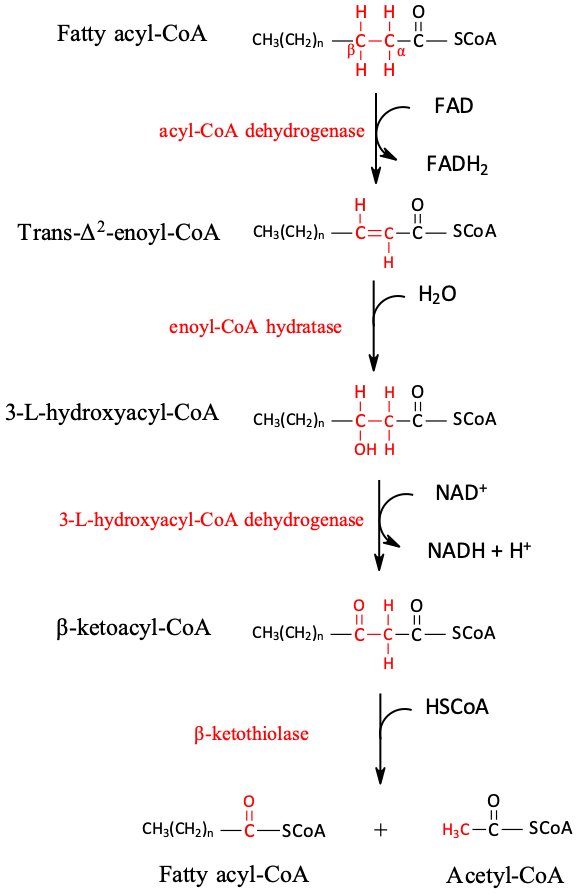
a saturated fatty acid chain with an even number of carbons. we start with an acyl-CoA molecule with n carbons and need to generate acetyl-CoA molecule with 2C and a new, shorter acyl-CoA molecule with n - 2 carbons. this happens in 4 steps:
- formation of a C=C double bond. this bond is formed between the alpha and beta carbons of the carbonyl group at the heard of the acyl-CoA molecule. the enzyme responsible for this is acyl-CoA dehydrogenase. this is a redox reaction in whcih the oxidation of a C-C single bond to a C=C double bond is coupled to the reduction of FAD to FADH2. the result of this process is known as a trans-delta2-enoyl-CoA
- add an -OH group to the beta carbon (C3). this is a hydration reaction and is stereospecific, and only the L isomer is formed. the end product is known as a L-beta-hydrxyacyl-CoA
- oxidize the C-OH bond on the beta carbon (C3) to C=O, a redox reaction in which the oxidation of the C-OH bond to a C=O bond is coupled to the reduction of NAD+ to NADH
- the molecule is broken up. the thiol group of another CoA group carries out a thiolysis reaction targeting the beta-carbon. this results in an acetyl-CoA group detaching from the fatty acid chain and the formation of a new, shorter acyl-CoA chain
what happens if there’s a double bond in the chain during beta-oxidation?
- odd-numbered double bonds are either CIS or TRANS conformation are dealt with by an enzyme known as enoyl-CoA isomerase, which has the job of flipping the delta3 bond at carbon 3 to form a delta2 bond at carbon 2. this corresponds to what is created in step 1 of beta-oxidation so beta-oxidation can simply continue on from step 2
- if its an even-numbered double bond, which can occur in polyunsaturated fatty acids, beta-oxidation proceeds until a 1,4-dienoyl-CoA ester is generated. a 2,4-dienoyl-CoA reductase catalyzes a reduction step, coupled to the oxidation of NADPH to NADP+, that produces a double bond at position 3. next enoyl-CoA isomerase moves the double bond up one carbon so that it’s located between the alpha and beta carbons. now we’re in the same situation as the one we just discussed
what happens if there’s an odd number of carbons in the fatty acid chain for beta oxidation?
- throughout most of the cycle, it doesn’t matter but the final cleavage of the chain is affected by this. instead of the final step resulting in 2 acetyl-CoA molecules, it results in an acetyl-CoA molecule and a 3-C substance knwon as propionyl-CoA which gets a C added to it by an enzyme known as propionyl-CoA carboxylase, and the resulting 4-C compound is further rearranged by various enzymes to form succinyl-CoA which then enters the TCA
how much energy is created by oxidizing a fatty acid?
- 14 in regular oxidation steps and 24 in final oxidations steps
- 7n ATP (n carbons)
additional acetyl-CoA can be used to generate?
- ketone bodies
- a way for hepatocytes to package acety-CoA in a portable structure that can be secreted into the bloodstream and sent to tissues that need energy
- upregulated under different conditions
- a way for hepatocytes to package acety-CoA in a portable structure that can be secreted into the bloodstream and sent to tissues that need energy