Anytime Wording is shown in BOLD it will be one of the following: WARNING, CAUTION, NOTE, Switch, Switch Position, Page, or Labeled Equipment.
Immediate Action Emergency Steps
WARNING
NOTE(S)
WARNING
In the event of a procedural difference between the written and displayed emergency procedure, the steps in this chapter take precedence.
NOTE(S)
- The urgency of certain emergencies requires immediate and instinctive action by the pilot. The most important single consideration is helicopter control. All procedures are subordinate to this requirement.
- When continued flight is in question, due to a loss of rotor RPM or reduction of available power (as a result of equipment malfunctions or environmental conditions), the immediate corrective action should be to adjust collective to maintain NR within limits and jettisoning of the aircraft wing stores. This should be done as the immediate means of reducing power requirement by approximately 1% torque per 200 lbs. of weight reduction.
- MSTR WARN and MSTR CAUT buttons should be reset after each malfunction to allow systems to respond to subsequent malfunctions. It is always possible that a caution light can unnecessarily illuminate. Whenever possible, check the caution or advisory message against the appropriate MPD page to verify that a malfunction has actually occurred. If time permits, during response to emergency situations, the crew must consider transmitting a Mayday call, selecting the XPNDR button on the emergency panel and locking shoulder harness.
Land Without Delay
The term LAND WITHOUT DELAY is defined as a landing in which the primary consideration is continued control of the aircraft and survival of the occupants. It is meant to be more urgent than Land As Soon As Possible. The situation may not permit the aircrew to continue to maneuver the aircraft to a suitable landing area (e.g., open field). If maneuvering to an open area is not practical, then the crew must make the decision to land in an area that will have the least amount of negative impact on crew survivability. (e.g. Over dense forest, select an area with the smallest trees, in a mountainous area, choose an area with the least amount of slope).
Land as Soon as Possible
The term LAND AS SOON AS POSSIBLE is defined as landing at the nearest suitable landing area (e.g., open field) without delay. The primary consideration is to ensure the survival of occupants.
Land As Soon As Practicable
The term LAND AS SOON AS PRACTICABLE is defined as landing at a suitable landing area. The primary consideration is the urgency of the emergency.
Autorotate
The term AUTOROTATE is defined as adjusting the flight controls as necessary to establish an autorotational descent and landing.
CAUTION
When Shutting Down Engines
CAUTION
- When shutting down an engine that has malfunctioned in flight, it is important to identify the malfunctioning engine to avoid shutting down the wrong engine.
- Monitor TGT after shutdown. If TGT rises above 540° C, or there is evidence of combustion as indicated by a rapid rise in TGT, place the ENG START switch in IGN ORIDE position and motor engine until TGT decreases below 540° C.
Emergency Engine Shutdown
POWER lever (affected engine) — OFF
Wing Stores Jettison
The term WING STORES JETTISON is defined as jettisoning any or all of the wing stores as appropriate using one of two methods: emergency and selective. The method to be used will be determined by the aircrew depending on the situation at the time of the emergency and the wing stores inventory.
After Emergency Action
After a malfunction of equipment has occurred, appropriate emergency actions have been taken and the helicopter is on the ground, an entry will be made in the Remarks Section of DA FORM 2408-13-1 describing the malfunction. Ground and flight operations will be discontinued until corrective action has been taken.
Emergency Exit and Entrance
WARNING
NOTE
WARNING
- Activation of the canopy removal system when combustible fuel/vapors are present in the cockpit can result in an explosion/ fire. An explosion/fire can also occur if the aircraft has rolled on its side and fuel vapors have gathered on the ground adjacent to the canopy side panels. The crewmembers survival knife may be used to fracture the canopy side panel as an alternate means of egress.
- Continuing to twist the canopy jettison handle while pushing can cause the actuator to jam and prevent operation of the canopy severance system. If the canopy jettison does not occur on the first attempt, ensure the handle is in the 90° position, and push again. A push force of 140 - 150lb may be required to overcome the jam and initiate canopy jettison.
- In the event that canopy jettison does not occur when the canopy removal system is actuated, the personal survival knife should be used to fracture the canopy panel and permit egress.
- In all cases of canopy jettison, remain clear of canopy side panels to avoid high-velocity canopy fragments.
- If emergency egress is required before the rotor blades have stopped, ensure MSTR IGN - BATT and cyclic remains centered to prevent rotors from striking personnel/fuselage/ground.
- To prevent eye injury, pilot and CPG helmet visors should be down prior to canopy jettison. Debris may be expelled 50 feet outward.
NOTE
Only the crew station arming the STORES JETTISON panel can disarm it. Once armed, either crew station can activate jettison.
Emergency Egress
- Helmet visors — Down.
- Area around helicopter — Clear of personnel.
- CANOPY JETTISON handle — Turn 90°, release, then push to jettison canopy.
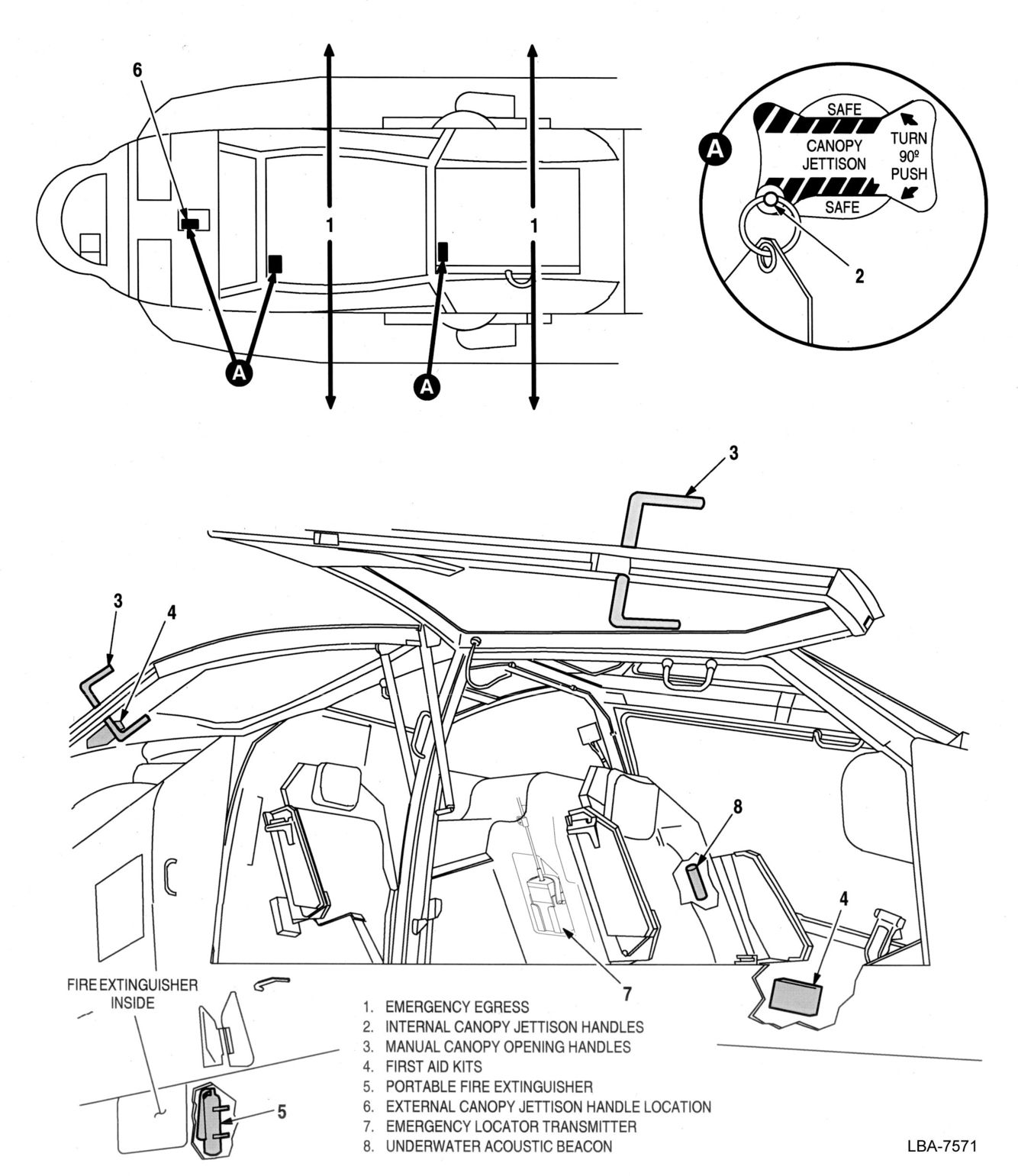
Emergency Equipment Consists of
- Canopy Jettison System
- Stores Jettison System
- Portable fire extinguisher
- Engine and APU Fire Detection/Extinguishing System
- Two first aid kits
- Master Zeroize Switch
- CBR Blower
- Emergency Locator Transmitter
- Underwater Acoustic Beacon
Dual Engine Failure- Low Altitude / Low Airspeed and Cruise
CAUTION
- AUTOROTATE
- CHOP button — Reset only if an engine chop warning message is present. Reset may be accomplished by either crewmember.
- Wing Stores Jettison — As appropriate.
CAUTION
With the POWER levers in FLY, resetting the CHOP button will cause an erroneous engine 1 out and engine 2 out warning to be activated.
Aborting Engine Start
CAUTION
CAUTION
Abort start for any of the following reasons:
- If it becomes apparent that TGT will exceed 851° C before NG idle speed (63% or more) is attained.
- If TGT does not increase within 45 seconds after moving POWER lever to IDLE.
- If no NP within 45 seconds after moving POWER lever to IDLE (unless rotor is locked).
- If positive oil pressure indication does not occur within 45 seconds after moving POWER lever to IDLE.
- If ENG1 or ENG2 START advisory is removed prior to attaining 52% NG.
ABORT START PROCEDURES are as follows:
- POWER lever — OFF.
- ENG START switch — IGN ORIDE for 30 seconds and TGT is below 540° C.
Single Engine Failure – Low Altitude/ Low Airspeed and Cruise
- Airspeed — Adjust as appropriate.
- Wing Stores Jettison — As appropriate.
- LAND AS SOON AS PRACTICABLE.
Engine 1 or 2 Overspeed – NP Failed
Collective — Adjust to maintain NR within
limits.
If condition persists:
(b) POWER lever (affected engine) — Retard
to equalize torque.
(c) LAND AS SOON AS PRACTICABLE.
High
- Collective — Adjust to maintain NR within limits.
If condition persists:
- POWER lever (affected engine) — Retard to equalize torque.
- LAND AS SOON AS PRACTICABLE.
Low RPM Rotor – NP Failed Low
NOTE
NOTE
- Advancing the POWER lever of the engine with low torque and TGT to LOCKOUT disables the automatic temperature limiting for that engine. The engine must be controlled manually to ensure that it does not exceed operating limits.
- LOCKOUT provides no increase in power if LOW ROTOR RPM warning occurs due to engine performance limiting on NG, NG/Mach or fuel flow.
A voice message will announce ROTOR RPM LOW. The EUFD will display LOW ROTOR RPM.
- Collective — Adjust to maintain NR within limits.
If condition persists:
- POWER lever (affected engine) — LOCKOUT and then retard to equalize torque output of both engines.
If manual control is not possible:
- POWER lever (affected engine) — IDLE.
- LAND AS SOON AS PRACTICABLE.
If continued flight is not possible, proceed as in Paragraph 9-10 f 4 SINGLE ENGINE FAILURE.
Engine Compressor Stall
- Collective — Reduce.
If condition persists:
- POWER lever (affected engine) — Retard.
If TGT decreases and there is no further evidence of a stall;
- POWER lever (affected engine) — FLY.
If stall condition recurs:
- POWER lever (affected engine) — IDLE.
- LAND AS SOON AS PRACTICABLE.
Loss of Tail Rotor Thrust in Cruise Flight - Continued Flight Possible
WARNING
WARNING
If airspeed is allowed to approach effective translational lift, the sideslip angle may become quite severe and helicopter control may be lost.
- EMERG HYD button — Press ON
- Airspeed — 100 KTAS minimum (until 10 to 20 ft above touchdown).
- Wing Stores Jettison — As appropriate.
- POWER levers — Retard as necessary (5 to 10 ft above touchdown).
Loss of Tail Rotor Thrust in Cruise Flight - Continued Flight Not Possible
and
Loss of Tail Rotor Thrust at Low Airspeed/Hover
- EMERG HYD button — Press ON
- Collective reduce (__compromise between rate of turn and rate of descent).
- Wing Stores Jettison — As appropriate.
- Minimize rate of descent (10 to 20 feet above touchdown).
- POWER levers — OFF (5 to 10 feet above touchdown).
Tail Rotor Fixed Pitch Malfunction - In-Ground Effect
A fixed pitch failure may be evidenced by slow, intermittent, or no response to pedal input or no pedal movement. A left or right yaw may be apparent.
- If a failure occurs during in ground- effect hover, reaction may vary from adjusting collective and POWER levers during a left rotation to activating the CHOP button to stop a right rotation. In any case, the primary concern should be to land the aircraft with as little yaw rate as possible.
- If the aircraft has an uncontrolled turn to the left, a reduction in the POWER levers coordinated with an increase in collective may slow or stop the rotation so that a controlled power on descent to landing can be accomplished.
- If the aircraft is not turning, a slight reduction in collective pitch will begin a descent. During the descent, a slight rotation to the left may be present; increasing collective just prior to touchdown should stop the rotation.
- If the aircraft has an uncontrolled turn to the right, reduce collective to begin descent. At approximately 5 to 10 ft AGL, perform a hovering autorotation by CHOP button - Press or POWER levers - OFF.
Tail Rotor Fixed Pitch Malfunction - Out-of-Ground Effect
- If little or no right rotation or if left rotation is experienced and control can be maintained, the aircraft should be accelerated into forward flight and perform approach and landing appropriate to power setting and condition of flight at time of failure.
- If the aircraft cannot be accelerated into forward flight, initiate a power-on descent. Collective should be adjusted so that an acceptable compromise between rate of turn and rate of descent is maintained. At approximately 5 to 10 ft above touchdown, perform a hovering autorotation by CHOP button - Press or POWER levers -OFF.
Main Transmission Input Drive Clutch Failure - In Flight
Associated Indications
CAUTION
An input drive clutch malfunction is most likely to occur during engine start or when an engine POWER lever is advanced. Indications may include:
- Erratic torque indication on affected engine.
- Complete loss of torque indication on affected engine.
- NP of affected engine exceeding NR.
CAUTION
- When a clutch fails to disengage, damage to the affected engine will result (due to lack of oil pressure) if both engines are not shutdown simultaneously.
- When a clutch fails to engage, do not shut down both engines simultaneously. Damage may result if there is sudden engagement.
- POWER lever (affected engine) — IDLE.
If NP (affected engine) is below NR (indicating the clutch is disengaged):
- EMERG ENG SHUTDOWN (affected engine).
- LAND AS SOON AS PRACTICABLE.
If NP (affected engine) does not drop below NR (indicating the clutch has failed to disengage):
- LAND AS SOON AS POSSIBLE.
- EMERG ENG(S) SHUTDOWN (both engines simultaneously).
Main Transmission Input Drive Clutch Failure - On Ground
On Ground. (with indications that a clutch has failed to engage):
- EMERG ENG SHUTDOWN (affected engine only).
- Check NG is less than 10% (affected engine).
- Normal engine shutdown — Perform.
On Ground. (with indications that a clutch has failed to disengage):
EMERG ENG(S) SHUTDOWN (both engines simultaneously).




