Broad classification of chest wall deformaties
- Pectus excavatum
- Pedtus carinatum
- Poland’s syndrome
- Sternal defects
- Miscellaneous syndromes (Jeune’s disease and Jarcho-Levin syndrome)
Most common congenital chest wall deformity
Pectus excavatum
sternal depression and flaring of costal margins
Characteristics of Pectus Excavatum
- Association with Marfan’s syndrome
- Excessive growth of lower costal cartilage
- manubrium and first/second ribs usually spared
- Frequently greater depression on Right
- Progressive
- potential for significant worsening with growth
Potential physiolgoic consequences of Pectus Excavatum
- Reduced VC
- Reduced exercise tolerance
- Depression of RV
- reduced cardiac performace
- MV prolapse due to sternal pressure on annulus
MC presentation of Pectus Excavatum
- Mostly asymptomatic
- Psychosocial factors and cosmetic conerns most common reason for presentaiton
- Pain at site of deformity
__ % of patients with Pectus Excavatum will have scoliosis
~ 25%
Diagnostic radiologic features to characterize severity of Pectus Excavatum
Haller Index
Ratio of lateral diameter : AP distance on CXR
Normal index 2.5
Pectus excavatum index > 2.5
Caridopulmonary evaluation for Pectus Excavatum
- EKG: abnormalities common
- Pulmonary function: does not correlate well with degree of exercise limitation
- Echocardiography: if MV prolapse suspected
Surgical options for Pectus Excavatum
Surgial correction (Standard of Care)
- Ravich repair (open repair)
- subperichondrial resection of costal segments
- wedge sternal osteotomy (allow sternal elevation)
- sternal fixation with retrosternal bar
- Nuss repair (minimally invasive repair)
- Thoracoscopic guided convex retrosternal bar placement
- behind sterum through anterior mediastinum
- rotated to push sternum and deformed cartilage forward
- Lateral fixation of bar to chest wall
- Bar placed before growth spurt
- Greater pain compared to Ravich
- Bar in place for 3 years
- Risk of recurrence (~ 7%)
- Thoracoscopic guided convex retrosternal bar placement
- Sternal eversion (free graft of sternum)
- rarely performed d/t potential for devestating complications
Accounts for ~ 10% of chest wall deformities
Pectus carinatum
More common in boys
Presents later in childhood
More likely to present with pain
May be related to history of trauma
Haller index for Pectus carinatum
Index < 2
Surgical approach to Pectus carinatum
- Subperichondrial excision of affected costal elements
- 1 or more osteotomies
Definition of Poland’s syndrome
Unilateral absence of pectoralis major and minor muscles + syndactyly
Proposed etiology of Poland’s sydnrome
in urtero vascular events that affect subclavian supply
Assocaited defects and characteristics of Poland’s syndrome
- Amastia
- Absence of axillary hair
- Rib aplasia (profound chest wall deformities)
Surgical correction of Poland’s syndrome
Rib grafts
Patch materials
Types of sternal defects
- Sternal cleft
- Ectopia cordis
- Thoracoabdominal extopia cordis/Cantrell’s pentology
Characteristics of sternal cleft
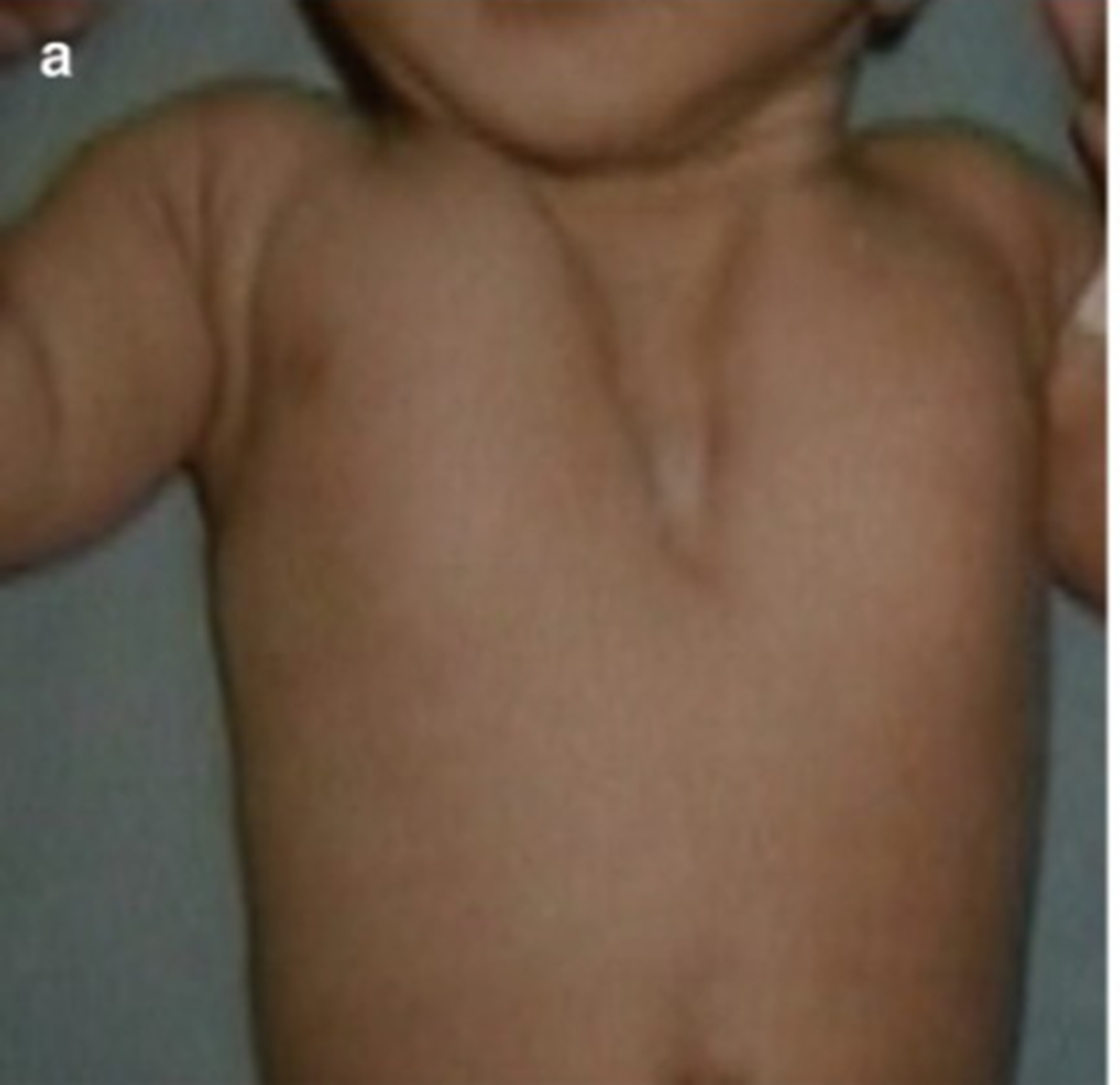
Defect of upper portion of sternum
Protrusion during infant crying
Heart, lungs, overlying skin normal
Repair indicated to protect mediastinal structures
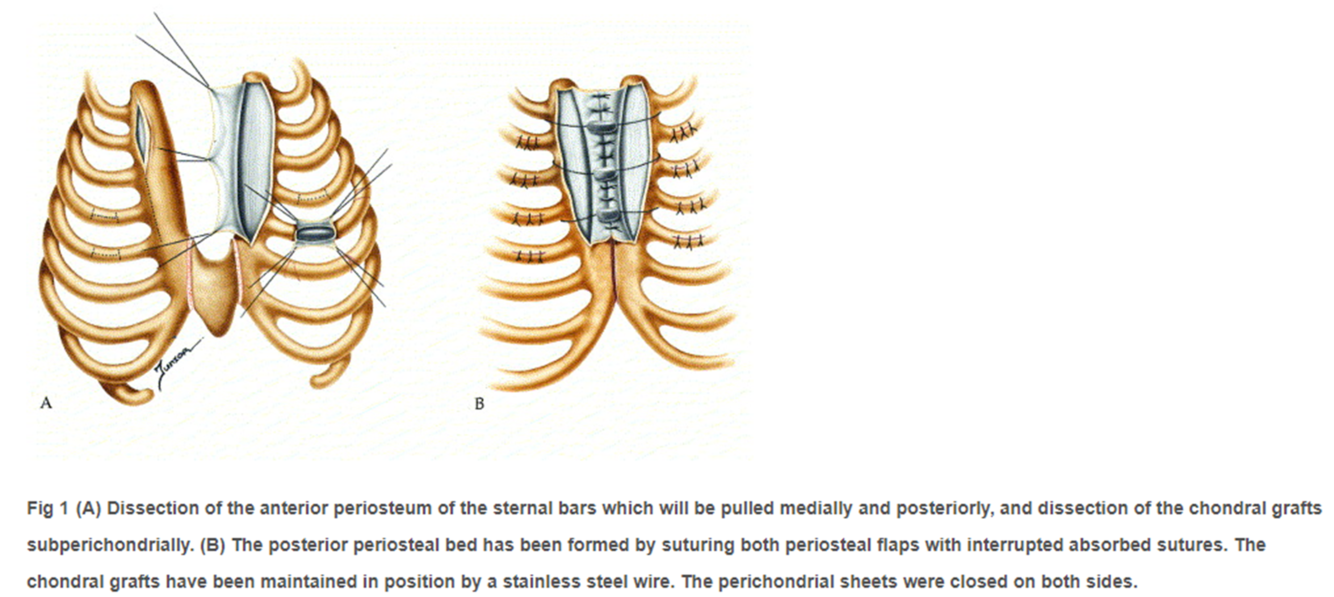
Definition and characteristics of ectopia cordis
- Complete fialure of midline covering of the heart (absence of skin, sternum, pericardium)
- Part or all of the heart may be positioned outside of the heart
- Heart usually rotated anteriorly
- Congenital cardiac defects in almost all cases
5 components of Cantrell’s pentology
(Thoracoabdominal ectopia cordis)
- Omphalocele
- Anterior diaphragmatic herina
- Sternal cleft
- Ectopia cordis
- Intracardiac defect (VSD or ventricular diverticulum)
Distinct finding of heart with thoracoabdominal ectopis cordis (Cantrell’s pentology)
Heart is covered by thin membrane and not rotated
(Different form ectopia cordis where heart is exposed and rotated anteriorly)
Intracardiac defects noted with thoracoabdominal ectopia cordis (Cantrell’s pentology)
VSD
LV diverticulum (unclear significance)
2 miscellaneous syndromes with chest wall deformities
Jeune’s syndrome
Jarcho-Levin synrome
Definition and characteristics of Jeune’s syndrome
(a.k.a. asphyxiating thoracic dystorphy)
- Narrow, bell shaped chest that is severely restrictive
- Ribs oriented horizontally and foreshortened
- Pulmonary development limited
- extremely poor respiratory mechanics
- frequent pulmonary complications

-
Lung Cancer Overview and Preop Eval51
-
Mediastinal staging for NSCLC24
-
Early Stage NSCLC42
-
Locally Advanced Lung Cancer41
-
Thoracic and Pulmonary Anatomy35
-
Pulmonary Physiology and Pulmonary Function Tests31
-
Paraneoplastic Syndromes13
-
Post-Pneumonectomy Complications39
-
Pulmonary Carcinoid Tumors and Other Primary Lung Tumors22
-
Pulmonary Metastatic Disease15
-
Congenital Lung Disease61
-
Surgery for Emphysema17
-
Benign Tumors of Lungs33
-
Interstitial Lung Disease55
-
Lung Transplantation30
-
Thoracic Infections and Hemoptysis78
-
Benign Pleural Disease22
-
Malignant Pleural Effusions and Malignant Pleural Mesothelioma50
-
Chylothorax25
-
Chest Wall Deformaties25
-
Chest Wall Tumors79
-
Thoracic Outlet Syndrome10
-
Diseases of Diaphragm35
-
Anatomy and Physiology of the Esophagus28
-
Esophageal Cancer64
-
Other Esophageal Tumors25
-
Congenital Disease of Esophagus27
-
Esophageal Reflux20
-
Esophageal Motility Disorders49
-
Esophageal Injury27
-
Esophageal Diverticula12
-
Paraesophageal Hernias25
-
Tracheal Stenosis and Postintubation Injury31
-
Tracheal Tumors31
-
Anatomy and Surgical Approaches to the Mediastinum28
-
Mediastinal Masses90
-
Thoracic Sympathectomy21
-
Small cell lung cancer0
-
NCCN Small Cell Lung Cancer13
-
SAGES Guidelines - Achalasia, Hiatal Hernia, GERD50
-
Osler Question Bank9
-
TSRA Clinical Scenarios - General Thoracic Surgery33
-
SESATS General Thoracic133
-
Thoracic Surgery235
-
Lung Cancer Overview and Preop Eval Short40
-
High Yield Mycobacterium: TB & Non-TB54
-
Mediastinoscopy6
-
Idiopathic Interstitial Pneumonia0



