What is the monomer of chitin?
Chitin (C8H13O5N)n is a long-‐chain polymer of a N-‐ acetylglucosamine, a derivative of glucose.
(Second most abundant polysaccharide after cellulose)
Where is chitin found?
Common structural polymer especially in crustacea, exoskeletons
How are the polymer chains of chitin and cellulose different?
Chitin has an additional acetyl group attached.
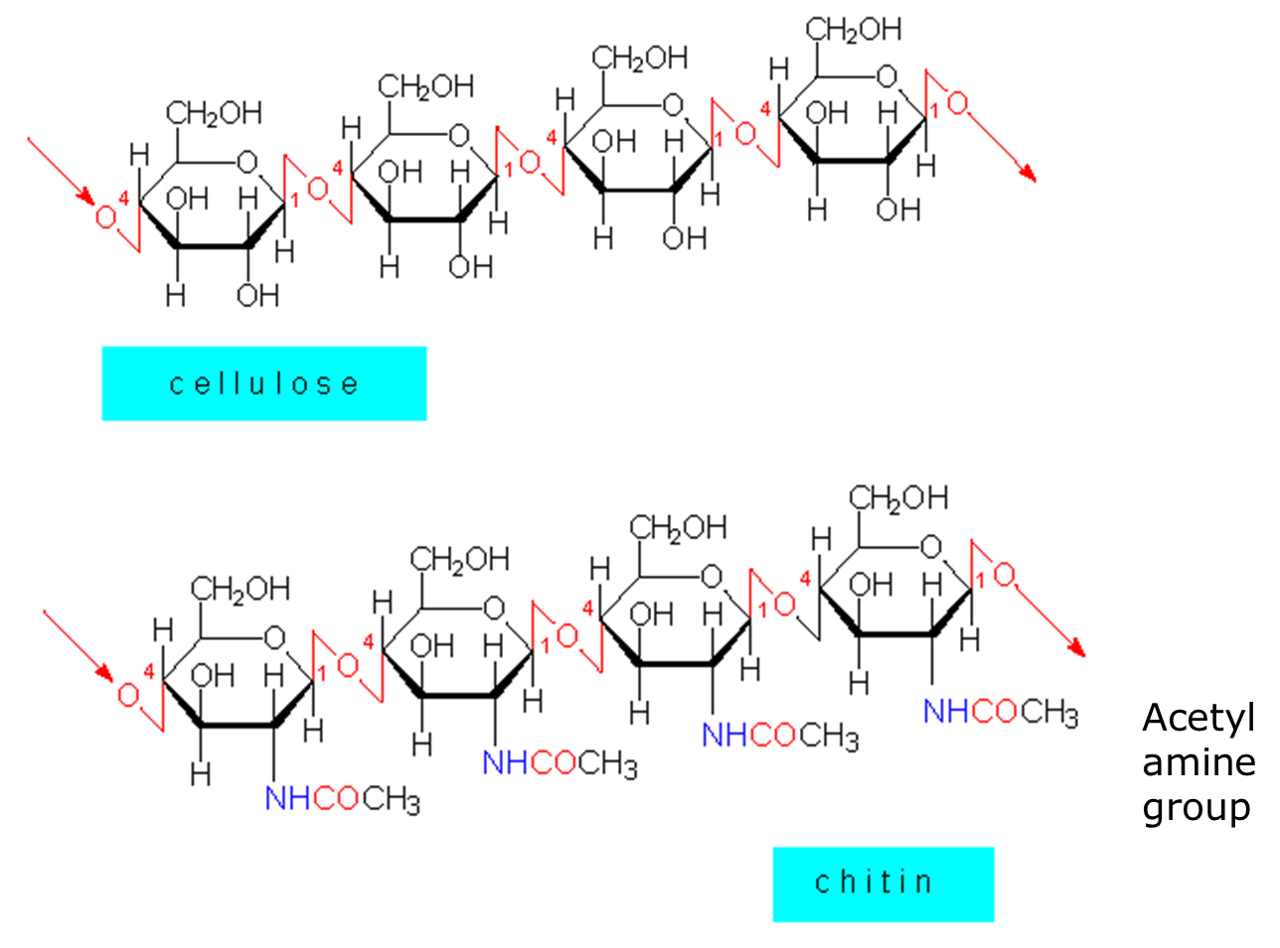
What is the benefit of chitin over cellulose?
Nitrogen essential for life and separates cellulose from chitin. Cellulose is an incomplete food source – whereas chitin can provide carbon & nitrogen.
Talk about the composite material formed with chitin in crustacea.
In crustacea – forms a composite material with calcium carbonate. (lobster shells are made of a composite material of chitin interlaced with chalk).
Chitin is interwoven like steel in construction.
Where and when was chitin discovered?
Discovered in 1811 by Braconnot in cell walls of mushrooms
1843 found in insects and plants
Give some of chitins useful properties.
- Biocompatible, biodegradable, bioabsorbable - possible use as a film in packaging.
- Antibacterial and wound healing properties
- Low immunogenicity (good for biomedical applications) - possibility of use in drug delivery.
How is chitin currently used in industry?
Thickener and stabiliser in food
Flexible and strong, use in a surgical thread (also biodegradable)
Paper manufacture
Stabiliser for pharmaceuticals
Component in dyes and adhesives
What is chitosan?
Chitosan is formed when chitin is solubilised in water
First produced in 1859
1940s -‐ many patents
Dumping of shellfish waste was banned in 1970s and processing of chitin expanded as a way of turning waste into products
Produced by the deacetylation of chitin
How is chitosan produced from chitin?
Chitosan – a product produced from chitin in a process called deacetylation.
Manufactured from waste crab and shrimp shell material
Water soluble bioadhesive
Improved seed protection in crop use
Wide use in agriculture
Also used to fight obesity and hypercholesterolemia
Binds to lipids and decreases their absorption
Where is chitin found in other organisms?
Chitin is found in the cell walls of bacteria and fungi
Sheaths of parasitic nematodes
Chitinases are produced as protection from chitin containing organisms (eg to damage their chitin containing coats) – part of innate immune response in mammals
Chitinases also control growth and moulting
Chitinase inhibitors have therefore also received attention as biopesticides against insects and fungi
Give an example of a business making money from chitosan.
Primex.is Icelandic marine
biotechnology company
Chitosan.no
Norwegian chitosan manufacturer
Many companies in India and China
What is the market size of chitosan?
Chitin and chitin derived products estimated to be worth £33 billion per year (sales) by 2015
For chitosan this figure is expected to be in the region of £10bn
New applications such as edible films for food preservation indicate the market will grow
Conclusions
Chitin is a widely available marine biopolymer
Its unique properties allow its use in a number of industrial as well as medical applications
Chitin is also an important part of the marine food chain and can be digested by a number of chitinase producing marine bacteria.
What happened in the study on wound dressing?
Study: Chitin membrane for wound dressing application – preparation, characterisation and toxiological evaluation.
(Singh et al, 2009)
- Chitin membranes were prepared as a wound dressing and were found to provide an effective barrier to microbial penetration and exerted a broad bacteriostatic action against gram + and – bacteria.
- Complete inhibition of a range of bacterial growth was observed in contact with the dressing
- Chitin has been shown to be useful as a wound dressing material, drug delivery vehicle and increasingly a candidate for tissue engineering – found to have an accelerating effect on the wound healing process, alongside properties of pain relief.
- In biomedical applications chitin is more favorable than chitinosan because the acetamide group present in chitin is similar to the amide linkage of a protein, making it more biocompatible than chitinosan.
Study: Chitin membrane for wound dressing application – preparation, characterisation and toxicological evaluation.
Method
Method:
- Agar plates were prepared with various methods to test the growth of bacteria though or on the membrane.
- Subcutaneous and scarification tests in guinea pigs showed no significant signs of inflammation, and successfully passes a test (Finkelstein’s) on rabbits)
Study: Chitin membrane for wound dressing application – preparation, characterisation and toxicological evaluation.
(Singh et al, 2009)
Results
Results
- The membrane were found to be impermeable to various bacilli and cocci strains but not others such as e.coli.
- The chitin dressings exhibited strong bacteriostatic effect on the eight bacterial strains tested and complete inhibition of bacterial growth was observed in contact with the dressing.
- No signs of inflammation were shown from the animal inflammation tests.
- Showed properties of being able to keep the wound wet, be permeable to air, stimulate damaged tissue, be removed without causing trauma – ideal properties for a dressing.
Study: Chitin membrane for wound dressing application – preparation, characterisation and toxicological evaluation.
Critical analysis
Critical analysis
- Comparison between the relatively low number of 8 strains of bacteria tested and the environment.
- How soya bean caesin agar plates compare to blood tissue. The real application may be on a much larger scale with more transport opportunities for the bacteria.
Study - prawn waste
Study: Utilization of prawn waste for chitinase production by the marine fungus Beauveria bassiana by solid state fermentation.
(Suresh and Chandrasekaran, 1998)
- Using a technique called solid state fermentation the bacterium Beauveria Bassiana breaks down prawn waste into chitin, with a yield of up to 248 units / g.
- This method replaces the conventional method of ocean dumping, incineration and land filling. This bioconversion of waste both the most cost-effective and environmentally friendly method. In India 60 – 80 thousand tonnes of chitinour waste are produced annually.
- Chitinase is used as antifungal agent in combination with antifungal drugs in therapy for various fungal infections.
Study: Utilization of prawn waste for chitinase production by the marine fungus Beauveria bassiana by solid-state fermentation.
findings
Findings:
(Suresh and Chandrasekara, 1998)
- Moisture is a critical factor effect the hydrolytic enzyme production with a 5:1 chitinous waste to seawater ratio being most effective.
- Enrichment with NaCl increases the chitinase yield, this also show these organisms have a high tolerance to salt. Other factors such as particle size and nitrogen and phosphate enrichment effected the yield.
- The ultimate limiting factor of fungal biomass production is sporulation, indicating low substrate conversion.
- The study shows that the process is industrially feasible but economic viability has meant that I don’t think chitinous waste has been processes in this way industrially yet.
wider reading another method of breaking down chiitin
Fines & Holt (2010)- discovered that cobia Rachycentron canadum are able to digest chitin due to the presence of chitinolytic enzymes. They have strong endogenous chitinolytic enzymes meaning they can break down crab and shrimp meal. This is advantageous as aquaculture facilities can be placed near crustacean processing facilities, and the cobia can feed off the waste of the crustacean. This is advantageous as it therefore reduces the cost of feed.
Chitin scaffold in tissue engineering
Jakahumar et al (2011)- Chitin Scaffolds in Tissue Engineering. – Scaffolds are used in medicine for the regeneration of new tissues using healthy stem cells, most commonly in situations where bone or cartilage is damaged. The scaffold must be the correct size, shape and porosity for the new tissue to properly develop, as these factors allow cell migration, proliferation and differentiation to take place. Chitin is used due to its properties: its non-toxic, biodegradable and biocompatible. It therefore succeeds as a tissue engineering biomaterial, as it can be manipulated into different shapes and is easily processed into gel, and can be used in numerous applications. It has also been proven to enhance recovery time and reduce the likelihood of any infections.
study - digest chitin
Fines & Holt (2010)- discovered that cobia Rachycentron canadum are able to digest chitin due to the presence of chitinolytic enzymes. They have strong endogenous chitinolytic enzymes meaning they can break down crab and shrimp meal. This is advantageous as aquaculture facilities can be placed near crustacean processing facilities, and the cobia can feed off the waste of the crustacean. This is advantageous as it therefore reduces the cost of feed.




