The Progression of Fifths
- Every chord has a very strong connection with the chord which is a fifth higher, that’s why V - I perfect cadence sounds nice. The V chord (G) contains the 5th of the I tonic chord, and also the leading note (B) of the tonic chord. This creates the strong pull of V to I.
- The progression of fifths shows the dominant-tonic relationship.
- A new chord is built upon the 5th of the previous chord:
- Tonic: 1 3 (5)
- Dominant: (5) 7 2 (or again 1 3 5 in the new key)
- This continues by building a new triad on each 5th note:
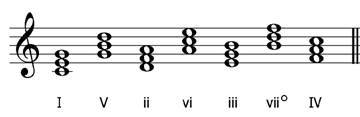
- I - V - ii - vi - iii - viidim - IV
- C - G - Dm - Am - Em - Bdim - F
- This progression includes every diatonic chord built from the scale.
- It’s easy to remember by writing 1 2 3 4 and then adding 5 6 7 between the gaps:
- 1 5 2 6 3 7 4.
- This order can also be reversed, making the progression of 4ths.
The Progression of Fourths
- The progression of Fourths is the progression of fifths backwards.
- It’s useful for showing how chords resolve to one another.
- An easy way to remember is is to write 1-4 backwards i.e. 4 3 2 1, then include 5-7 written backwards inbetween:
- 4 7 3 6 2 5 1
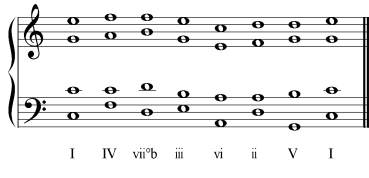
- This creates the progression of 4ths:
- IV - viidim - iii - vi - ii - V - I
- By analysing this progression we can see two chord progressions that sound nice, and are consequently frequently used:
- vi - ii - V
- ii - V - I
What are the diatonic minor chords?
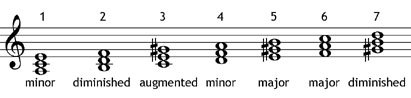
- The harmonic minor scale (#7) is usually the scale that chords are built upon in a minor key. We normally use the harmonic (not melodic) variety of the scale to work out triads in music theory. But in practice, triads from the melodic scale will also be common.
- Watch out! Chord 3 is an augmented triad (iii+) rarely used in practice. Because of this a major III chord is often used, which is the relative major of the key, e.g. in Am, a III chord is C.
- Notice how chord V is always major, even in a minor key.
What is special about the V-VI Progression in Minor Keys?
- The V-VI progression is very common in minor keys.
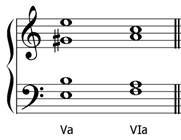
- It’s a bit special because you have to break a general guideline of harmony to use it: you have to double the third of the VI chord for the parts to flow smoothly. If you do not double the 3rd of the VI chord you’ll create consecutives between V and VI.
- Example in A minor:
- V = E major (E G# B)
- VI = F major (F A C).
What are the most important rules when writing chord progressions for SATB or two parts?
- Don’t write consecutive fifths or octaves.
- A “consecutive 5th” is when the interval between two parts is a perfect 5th (e.g. the bass and tenor have C & G) and the next interval is also a perfect fifth (e.g. the bass and tenor move to D & A)
- e.g. Check the interval made between the bass note and melody note. If it is a perfect fifth, you cannot follow it with another perfect fifth. The same goes for perfect octaves.
- Compound octaves are not allowed, so check for consecutive octaves in the bass/soprano movement.
- If two notes remain the same between chord progressions then parallel octaves or 5ths are allowed if the notes are not changing.
- A “consecutive 5th” is when the interval between two parts is a perfect 5th (e.g. the bass and tenor have C & G) and the next interval is also a perfect fifth (e.g. the bass and tenor move to D & A)
- Avoid doubling the major third in root position chords.
- For example, if your chord is C major in root position, you shouldn’t double the E. (The third can be doubled in first inversion chords, and minor root position chords).
- You can double all three notes, but the best notes to double are the root then the 5th.
- The exception is after chord V in a minor key piece (V-VI) where you have to double the 3rd to make it smooth.
- In a major or minor 1st inversion chord, you can double any of the notes, as long as it’s not a leading note.
- In a diminished chord, you have to double the bass note.
- The above it true of 2nd inversion (6-4) major or minor chords; you must double the bass note.
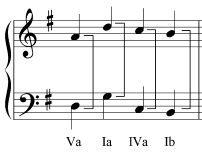
The attached image shows a poor choice of chords.
Name the primary chords
In both major and minor, the primary chords are:
I, IV, V
Tonic, Subdominant, Dominant
- Primary chords are essential for fixing the key of a piece.
- They contain all the notes of the scale.
- Chords I and V do this job together.
- Chord IV is not so important in this respect.
- For this reason, melodies should always begin and with I and V.
- It is possible (but not recommended) to harmonize every single note of the melody using only the primary chords. i.e. I: C E G; IV: F A C; V: G B D. As these are all the notes of the scale.
Name the secondary chords
In both major and minor, the secondary chords are:
II, III, VI
Supertonic, Medient, Submedient
- Chord VII is so similar to chord V that it is not normally considered to be a chord in its own right, but a “V substitute”. i.e. in C Major, chord V contains G B D. Chord VII contains B D F. The V7 chord contains all the notes of the VII chord (G B D F).
- Secondary chords are essential for creating an interesting harmony.
- Chord III is rarely used. It is possible (but not recommended) to use it in a major key (where it is a minor chord, e.g. E minor in the key of C major). It is NOT possible to use it in a minor key, because it is an augmented chord (e.g. C-E-G# in the key of A minor).
- What chords should you use when harmonising a melody?
Both Major and Minor. - What inversions are available to use?
- How should you handle cadences?
(This is for Grade 6 Theory)
Major keys: Ia/b – iia/b – IVa/b – Va/b* – via/b – vii°b
Minor keys: ia/b – ii°b – iva/b – Va/b* – VIa/b – vii°b
(The III chord is omitted as it’s tricky).
You should use a good mixture of root position and first inversion chords:
- Chords can be used freely in root position (root note in the bass).
- Chords can also be used freely in first inversion (third of the triad in the bass).
- *NOTE: Vb is only available if the leading note is not in the melody. You cannot double the leading note.
- Second inversion chords (fifth of the triad in the bass) can only be used in a passing 6-4 or cadential 6-4.
- Diminished chords (vii° in all keys and ii° in minor keys) can only be used in first inversion.
Cadences should be harmonized with root position chords. Mid-piece cadences are more flexible, but final cadences should always be root position.
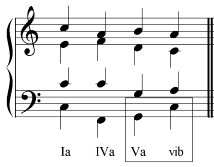
Never use Va-vib (or vib-Va). The bass notes of these two chords are the dominant and tonic. Our ears expect to hear chord I with the tonic bass note after/before V, so the vi chord sounds wrong.
What are the rules (not guidelines) of doulbing intervals?
- 6-4 (2nd inv) and 6-dim: always double the bass note.
- Never double the leading note.
- All other chords (all root position and 1st inversion major and minor chords):
- 1st choice: double the root
- 2nd choice: double the 5th
- Last resort: double the 3rd (unless minor key V-VI).
What chords should you not use when harmonising a melody?
- Avoid using the III chord (and III+ in a minor key).
- Never use Va - vib (or vib - Va). The bass notes of these two chords are the dominant and tonic. Our ears expect to hear chord I with the tonic bass note after/before V, so the vi chord sounds wrong. See attached image and audio. Here the Va has a G in the bass, the vib chord has a C in the bass, with a C in the bass we expect a tonic chord (C E G), but we get a C A E, and it doesn’t sound right.
When should/shouldn’t you repeat chords?
(From Grade 6 Theory)
- Change the chord with each new melody note, i.e. don’t use the same chord twice (or more) in a row.
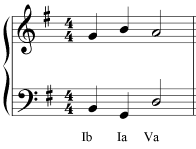
- HOWEVER, you can use the same chord again, provided it’s in a different inversion on the condition that one of the repeated chords is on a weak beat, e.g. in 4/4 weak beats are 2 and 4; in 3/4 time the weak beats are 2 and 3. See the attached correct example.
What is wrong with the following chord progression?
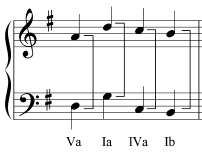
- The first two chords use consecutive 5ths.
- The final two chords use consecutive octaves.
Consecutive perfect fifths and octaves are forbidden.
Check the interval made between the bass note and melody note. If it is a perfect fifth, you cannot follow it with another perfect fifth. The same goes for perfect octaves.
When can you use augmented melodic intervals?
You can’t, augmented melodic intervals are forbidden.
- An augmented interval is one semitone (half-step) wider than a perfect or major interval.
- Your bass line is automatically created when you choose the inversions of your chords.
- Check the notes in the bass line and make sure there are no augmented intervals.
The attached image shows a poor chord choice. The bass line moves by an augmented 4th.
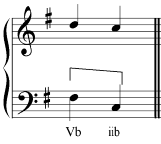
What are the most common chord progressions in a major key?
Aim to use the most likely chords in every case. The most typical progressions in a major key are (examples given in C Major):
- VI – II – V
- C Maj: A - D - G
- II – V – I
- C Maj: D - G - C
- Ic – Va – Ia (the cadential 6-4)
- C Maj: C/G - G - C
- V – vi
- C Maj: G - Am
- IV – I
- C Maj: F - C
What are the most common chord progressions in a minor key?
Aim to use the most likely chords in every case. The most typical progressions in a minor key are (examples given in A Minor):
- VI – ii° – V
- A minor: F - B° - E
- II° – V – i
- A minor: B° - E - Am
- ic – Va – ia (the cadential 6-4)
- A minor: Am/E - E - Am
- V – VI
- A minor: E - F
- iv – I
- A Minor: Dm - A (ends on the major chord)
What are good chords to move to?
(From Grade 6 Theory)
- Think of the progression of 4ths/5ths: Move the fundamental bass by 4ths or 5ths. The fundamental bass is not necessarily the root of the chord.
- You are not restricted to root movement of fourths and fifths, but this kind of movement creates the strongest, most stable bass line.
- You can also move the root by step (V-VI is an example, or IV-V).
- Root movement by a third is weak, because the two adjacent chords share two common notes.
- e.g. if F major moves to A minor, both chords share the notes C and A.
- You can use root movement by a third, but use it very sparingly.
- Chord I can be followed by any other chord.
How should you aim for the melody/bassline to move?
(Grade 6 Theory)
In contrary motion (in opposite directions).
e.g. if the melody moves up, aim to move the bassline down.
Note that it won’t always be possible, but it should be your first choice.
What are the best steps to follow when asked to harmonize a melody?
- Work out the key (is it major or minor?)
- List your available chords. Highlight the diminished chords, so that you remember to use them in first inversion.
- Harmonize cadences: Find the cadences. Complete these first with root position chords. Use a Ic-Va-Ia progression if you can.
- Harmonize the start: Harmonize the first two (or possibly three) chords with I and V, to establish the key.
- Harmonize the rest of the melody, using a good mix of primary and secondary chords and mixed inversions.
- Use common progressions where possible.
- Write in the bass line as you go along, and with each note you write, make the following checks with the previous chord:
- No consecutive perfect 5ths or octaves
- No augmented melodic intervals
- Chords are not repeated exactly
- Repeated chords with different inversions fall on strong-weak beats.
When you are working out your answer, it is essential that you write in the notes of the bass line, as you go along. i.e. C - G - F etc. This is the only safe way to make sure that your harmony is “grammatically correct”.
Write in the Roman numerals only when you have decided on your chords, then erase the bass line notes.
In SATB, what arrangement of notes/parts makes for good voice leading?
- Soprano: Melody line, it needs to be tuneful; lots of small movements.
- Most of the notes will move by step (2nds) or by 3rds, avoid repetition.
- Alto & Tenor: Fill out the harmony, and not as tuneful as the soprano line.
- Hardly moves. They will move by small intervals (2nds & 3rds) and are often repeated - both notes and patterns.
- If you can’t repeat a note, move to the nearest one.
- Bass: The notes can jump up and down a lot more than the other parts.
- Leaps of 5ths, steps and 3rds are common.
- There can sometimes be a leap of an octave.
Make sure the parts don’t crossover, even though Bach did cross parts (he was an expert afterall…).
Make sure the leading note is always followed by the tonic in the same part, apart from only a few exceptions.
Avoid augmented and diminished melodic intervals. Diminished harmonic intervals are used, but should not be used melodically. Augmented intervals are always avoided. Check to make sure there are no rises to Augmented 4ths, and no falls to diminished 5ths.
How should the leading note be handled in voice leading?
The leading note is always followed by the tonic in the same part, apart from only a few exceptions.
- The leading note (7th) is very important when writing in four part harmony.
- Keep an eye on it and always keep in the back of your mind which note it is.
- In 1st inversion chords, you can double any note (root, 3rd, or 5th) except if it’s a leading note. Never double the leading note in any chord.
How can you avoid consecutives?
- Use contrary motion (motion in opposite directions), i.e. when one of the lines moves up, the other line moves down.
- Use oblique motion (motion of one melodic line while the other remains at the same pitch).
Consecutives can still sneak in using these motions, so do still check them.
NOTE: diminished 5ths to perfects 5ths are fine, as they’re not the same interval size.
What are the four main types of motion?
- Parallel motion (motion in the same direction), i.e keeping the same interval between them, e.g. all intervals move by sixths.
- Similar motion (motion in the same direction, but changing the interval between them). In other words, both lines move up, or both lines move down, but the interval between them is different in the first chord and the second chord
- Contrary motion (motion in opposite directions), i.e. when one of the lines moves up, the other line moves down.
- Oblique motion (motion of one melodic line while the other remains at the same pitch).
What are suitable ranges between SATB parts?
- Between S-A: max of an 8ve.
- Between A-T: max of an 8ve.
- Between T-B: Fine to be more than an 8ve.
- You should aim to have your biggest gap between the Tenor and the Bass.
- Have the other parts (SAT) close together.
- When starting your first chord, choose the note of your soprano carefully. Aim to have a good amount of space to move up or down.
Omissions in SATB writing; what note of the chord could you leave out?
Guideline: don’t omit anything, unless you have to.
- Never leave out the root; it’s the most important note.
- Do not leave out the 3rd; it’s the note that give the chord its quality (major or minor).
- You are allowed to leave out the 5th.
This works best for minor chords where it’s okay to double the 3rd, and also first inversion chords where it’s okay to double the 3rd, so long as the 3rd is not the leading note.
For major chords, it’s probably best to just have three roots and have one 3rd.
You should, in any chord, never triple the 3rd.
- *Never** double the leading note
- *No omissions** are allowed in 2nd inversion chords.



-
Key Signatures30
-
Compound Time Signatures2
-
Music Theory Knowledge7
-
Composition31
-
Harmony50
-
Terms Grade 129
-
Terms Grade 238
-
Terms Grade 345
-
Terms Grade 4 (French)26
-
Terms Grade 4 (Italian)28
-
Terms Grade 5 (Italian and German)52
-
Modes7
-
Instruments2
-
Scales4
-
Cadences8
-
"The Rudiments of Music"0
-
Chord Progressions33
-
Chords26
-
Figured Bass17



