What are the characteristics of acute inflammation?
- Rapid, stereotyped response of living tissue to any injury.
- Macroscopic: redness, swelling, heat, pain and loss of function
- Microscopic: Vascular dilatation, exudate leaks into tissues, neutrophils emigrate.
- Changes controlled by many short-lived chemical mediators
- Neutrophils: Fast acting. short-lived phagocytes, engulf and degrate bacteria, dead tossue ect..
- Phagocytosis enhanced by opsonisation
- Bacterial killing largely oxygen dependant
- Defects in the system lead to severe susceptibility to infection.
What is chronic inflammation?
A chronic response to injury with associated fibrosis.
Less is known when compared to acute inflammation, and it overlaps with host immunity.
How does chronic inflammation arise?
- May ‘take over’ from acute inflammation
if damage is too severe to be resolved within a few days.
- My arise de novo This occurs in:
- autoimmune conditions (RA)
- Some chromic infections (viral hepatitis)
- Chronic low-level irritation. - May develop alongside acute inflammation
in severe persistent or repeated irritation.
What does chronic inflammation look like?
- Characterised by the microscopic appearances which are much more variable thank acute inflammation.
- Most important characteristic is the types of cell present. Inc. Macrophages, Lymphocytes Plasma cells, Eosinophils, Fibroblasts / myofibroblasts and Giant cells.
WHat are macrophages derived from?
Macrophages are derived form blood monocytes. They are called monocytes when circulating and macrophages in tissues.
What are the functions of macrophages?
They are important in acute and chronic inflammation.
They’re have various levels of activation.
Functions:
- Phagocytosis and destruction of debris and bacteria.
- Processing and presenting antigens to the immune system.
- Synthesis of not only cytokines but also complement proteins, blood clotting factors and proteases.
- Control of other cells by cytokine release.
What are lymphocytes often called?
Chronic inflammations cells (but this isnt an acurate name as they are a nrmal component of many tissues)
What are the functions of lymphocytes?
- Complex and mainly immunological
- B lymphocytes differentiate to produce antibodies.
- T lymphocytes involved in control and some cytotoxic functions.
What other cells (not macrophages and lymphocytes) are involved in chronic inflammation? What are their roles?
Plasma cells - differentiated antibody-producing B lymphocytes. Usually implies considerable chronicity.
Eosinophils - Allergic reactions, parasite infestations, some tumours. (sunburnt face with shades on)
Fibroblasts / Myofibroblasts - recruited by macrophages; make collagen.
What are giant cells?
They are multinucleate cells made by the fusion of macrophages.
Frustrated phagocytosis (all combine together to undergo phagocytosis.)
Several types recognised:
Langhans - TB
Foreign body type - foreign material
Touton - Fat necrosis
How do the proportions of each cell change in chronic inflammation of different diseases? RA? Chronic Gastritis? Leishmaniasis?
Rheumatoid Arthritis: Mainly Plasma cells.
Chronis gastrits: Mainly lymphocytes
Leishmaniasis (a protozoal infection): mainly macrophages
Giant cell type may be a help to diagnosis
What are the effects of chronic inflammation?
Fibrosis (scarring) eg gall bladder (chronic cholecystitis), chronic peptic ulcers, cirrhosis.
Impaired function eg chronic inflamatiory bowel disease
- rarely increased fuction eg mucus secretion.
Atrophy - gastric mucosa, adrenal glands
Stimulation of an immune response - macrophage - lymphocyte interactions.
What is chronic cholecystitis?
Gall stones getting stuck or eroding the mucosa. It leads to a thick, fibrotic wall. This is repeated attacks of acute inflamation usually initiated by gall stones h=which leads to chronic inflamation.
What is inflammatory bowel diesease?
Inflammatory Bowel Disease is a family of idiopathic diseases affecting the large bowel.
Patients present with diarrhoea, rectal bleeding and other symptoms.
Ulcerative colitis (superficial- diarrhoea and bleeding) and Crohn’s disease (transmural (through thickness of bowel wall) - strictures (narrowing) and fistulae (normal connection between two epithelium-lined organs)).
What are the causes of cirrhosis?
Alcohol,
Infection (HBV, HVC)
Immunological,
Fatty liver disease,
Drugs and toxins.
What leads to cirrhosis?
Chronic inflammation with fibrosis (disorganisation of architecture, attempted regeneration) leads to cirrhosis which is irreversible.
Graves?
Autoimmune disease caused by antibodies which are produced by plasma cells and bind to the TSH receptor. This stimutaes the release of T3 and T4.
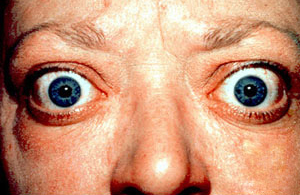
What is gastric mucosa atrophy?
Atrophic gastritisis a process of chronic inflammation of the stomach mucosa, leading to loss of gastric glandular cells and their eventual replacement by intestinal and fibrous tissues. As a result, the stomach’s secretion of essential substances such as hydrochloric acid, pepsin, and intrinsic factor is impaired, leading to digestive problems. It is an autoimmune condition.
What is the link between chronic inflammation and immune response?
Chronic inflammation and immune responses overlap.
- Immune diseases cause pathology by chronic inflammation.
- Chronic inflammatory processes can stimulate an immune response.
What is granullomous inflammation?
Chronic inflammation with granulomas!
What is a granuloma?
Macrophages that stick together like epithelium. Also with lymphocytes.
“a granuloma is an organized collection of macrophages.”
How do granulomas arise?
Persistent, low grade antigenic stimulation.
Hypersensitivity. (Immune reactions that result in damage to the body).
What are the main causes of granulomatous inflammation?
Mildly irritant ‘foreign’ material.
Infections
- Mycobacteria: TB, leprosy
- Other infections eg some fungi
Unknown causes (Idiopathic)
- Sarcoidosis (common)
- Wagner’s granulomatosis (rare)
- Crohn’s disease
What is TB?
Caused by mycobacteria
-especillly M. Tuberculosis.
Difficult and slow to culture.
Nature of organism: see microbiologists
-n.b. wall lipids (mycosides)
Toxins or lyric enzymes
-Causes disease by persistence and induction of cell mediated immunity.
Cough up blood (inflammation in lungs) and scarring - it is the bodies reaction to the organism that causes the symptoms.




