What is adult polycystic kidney disease?
- An autosomal dominant condition that occurs in roughly 1 in 1000 births.
- The mutation occurs in either the PKD 1 gene (85%) or PKD 2 gene.
- Cysts grow with age and generally present in aduithood.
- Prognosis depends in rate of increase in kidney size and age.
How do you diagnose APCKD?
- Ultrasound - can’t exclude if under 30.
- Genetic testing isn’t wide spread - only donw in specfic senarios e.g. if donating a kidney.
What secondary complications can occur because of APCKD?
- Pain
- Bleeding into cyst
- Infection
- Renal stone
What other diseases occur alongside APCKD?
- Hypertension (very common)
- Aneurysms
- Heart valve abnormalities
How do you manage APCKD?
- Treat hypertension - block RAAS
- Diet
- Lots of fluids
- Low salt
- Normal but not excessive protein
- Tolvaptan - block ADH
What is normal GFR?
90-120ml/min
Define CKD
The irreversible and sometimes progressive loss of renal function over a period of months to years.
Renal injury causes renal tissue to be replaced by extracellular matrix in response to tissue damage.
Why does CKD matter?
In some patients CDX inexorably worsens with progressive loss of renal function.
It is also accociated with substntial crdiovascular morbidity and mortality even with mild CKD.
How do you stage CKD?
Look at GFR and at the amount of protein in urine.
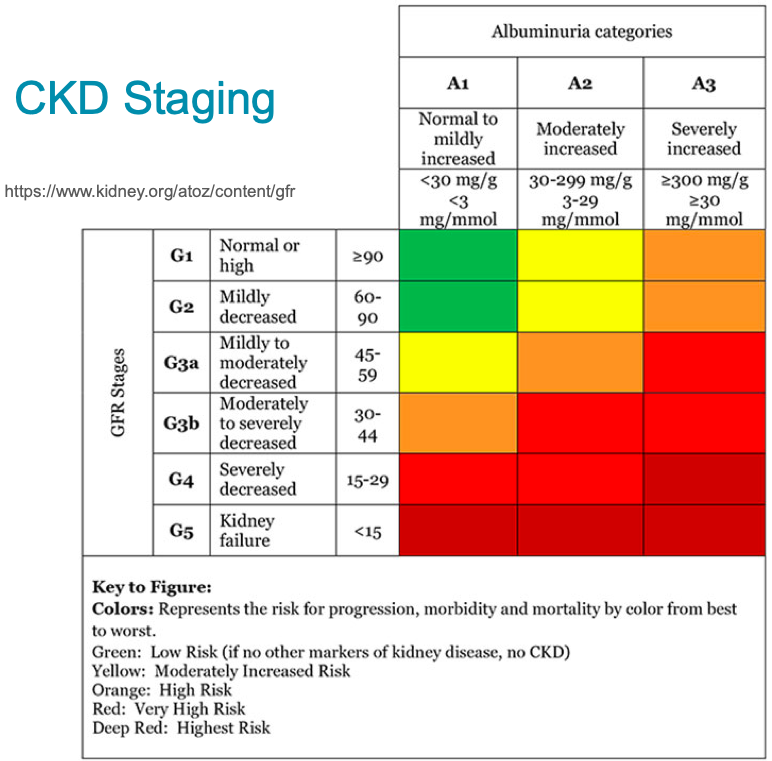
In who is CKD more common?
- Elderly
- Ethnic minorities
- Multi-morbid
- Social deprivation
What are the causes of end stage renal disease?
- Diabetes (common)
- Hypertension (common)
- Immunilogical - Glomerulonephritis
- Infection - Pyelonephritis
- Genetic - APCKD / Alports
- Obstruction and reflux nephropathy (OU)
- ATN
- Vascular
- Systemic disease - myeloma
- Unknown
How do you investigate CKD?
- Define degree of renal impairment
- Define cause of renal impariment
- Provide patient with diagnosis and porgnosis
- Identify complications of CKD
- Plan long term treatment (delay long term progression and plan for dialysis and transplantation)
What do we need to measure in CKD?
- BP
- Urine Dipstick
- Creatinine
In who is eGFR accurate and when is a corretion needed?
- Only accurate in adults
- Correction of blacks (not asians)
- Not useful in AKI
What general blood tested need to be done when assessing CKD?
- U&E
- Bone biochemistry
- LFTs (Albumin)
- FBC
- CRP
- Iron (ferritin, iron, reticulocyte, haemoglobin)
- PTH
What specific blood tests can be done to determine the cause of CKD?
If there is clinical suspision of the following:
- Auto-antibody screen (autoimune diseases)
- Complement levels (autoimmune diseases)
- Anti-neutrophil cytoplasmic antibody - ANCA (vasculitis)
- Serumimmunoglobulin screen (myeloma)
- Protein electrophoresis and serum free light chain measurement (myeloma)
What other investigations can be done when investigating CKD?
- USS
- Kidney size,
- Obstruction (hydronephrosis).
- Kidney biopsy
- Unknown,
- Haematuria,
- Proteinuria.
- Other:
- CT,
- MRI,
- MR angiogram.
How do you prevent / slow progression of CKD?
- Modifiable risk factors:
- Lifestyle
- Smoking
- Obesity
- Lack of exercise
- Uncontrolled diabetes
- Hypertension
- Proteinuria (ACE-inhibitors, ARBs)
- Lipids (Statin)
What does the kidney do?
- Regulation of:
- BP
- Blood volume
- pH
- Electrolytes
- Osmolality
- Excretion of waste products
- Metabolism of drugs
- Endocrine - 1-alpha cacidol, renin, erythropoitin
Ho do you control water and salt?
- Anti-hypertensive
- Diuretics
- Fluid restrict
80-85% od CKD patients are hypertensive
What is the effect of CKD on water / salt handling by kidney?
Reduced GFR
Loose ability to maximally dilute and concentrate urine - much lower range.
Small glomerular filtrate but same solute load causes osmotic diuresis (reduces maximum concentraing ability and response to ADH) .. nocturia.
Low volume of filtrate reduced maximum ability to excrete urine therefore maximum urine volume is much smaller.
When during CKD could hyperkalaemia occur?
Can occur once eGFR < 20 mls/min
Less likely when good urine output is maintained.
How do you treat hyperkalaemia?
- Stop ACE-inhibitor / ARB
- Avoidance of other drugs that can increase K+ (amiloride, spironolactone, trimethoprim)
- Altering diet to avoid foods with high potassium (e.g. McDonalds or bananas)
What are the symptoms of acidosis?
- Central
- Headache
- Sleepiness
- Confusion
- Loss of consciousness
- Coma
- Muscular
- Seizures
- Weakeness
- Intestinal
- Diarrhoea
- Resporatory
- Shortness of breath
- Coughing
- Heart
- Arrhythmia
- Increased heart arte
- Gastric
- Nausea
- Vomitting
Treat with oral NaHCO3 tablets.

-
Introduction21
-
Control Of Plasma Osmolarity26
-
Low Sodium...4
-
Control Of Potassium33
-
Urinary Incontinence17
-
Glomerular Pathology20
-
Glomerular Diseases33
-
UTIs26
-
AKI21
-
Urinary Tract Obstruction21
-
Prostate Cancer12
-
Cancers - RCC And TCC23
-
CKD44
-
Embryology20
-
Radiology13
-
GFR and renal blood flow20
-
Measurement of Kidney function29
-
Control of Volume31
-
Blood Pressure and the Kidney14
-
Diuretics33



