The general structure of amino acids are shown in this figure. What functional groups are highlighted in salmon and yellow, respectively?
- Amino and carbonyl
- Hydroxyl and carbony
l 3. Amino and carboxyl
- Methyl and carboxyl
- Methyl and hydroxy
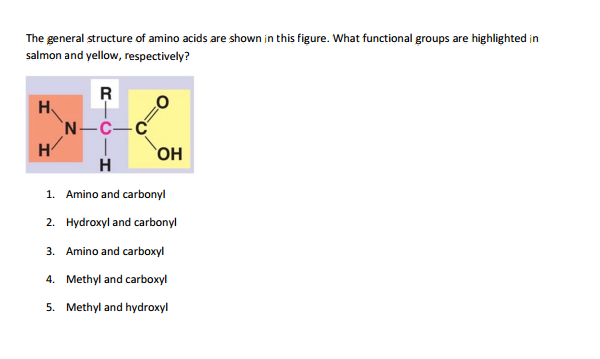
l 3. Amino and carboxyl
Water is a polar molecule because of the presence of ___________ bonds. 1. ionic
- covalent
- polar covalent
- hydrogen
- More than one of the above options is correct
- polar covalent
Water has an unusually high specific heat. This is directly related to which one of the following?
- At its boiling point, water changes from liquid to vapor.
- More heat is required to raise the temperature of water.
- Ice floats in liquid water.
- Salt water freezes at a lower temperature than pure water.
- Floating ice can insulate bodies of water.
- More heat is required to raise the temperature of water.
How many molecules of water are needed to completely hydrolyze a polymer that is 11 monomers long?
- 12
- 11
- 10
- 9
- 8
- 10
All lipids
- are made from glycerol and fatty acids.
- contain nitrogen.
- have low energy content.
- are acidic when mixed with water.
- do not dissolve well in water.
- do not dissolve well in water.
Compared to tropical fish, arctic fish oils have
- more unsaturated fatty acids.
- more cholesterol.
- fewer unsaturated fatty acids.
- more trans‐unsaturated fatty acids.
- more hydrogenated fatty acids.
- more unsaturated fatty acids.
What would happen to DNA molecules treated with enzymes that break hydrogen bonds?
- The two strands of the double helix would separate
- The phosphodiester linkages of the polynucleotide backbone would be broken
- The purines would be separated from the deoxyribose sugars
- All bases would be separated from the deoxyribose sugars
- The two strands of the double helix would separate
Which group of large biological molecules is not synthesized via dehydration reactions?
- polysaccharides
- lipids
- proteins
- nucleic acids
- lipids
Approximately 32 different monomeric carbohydrate subunits are found in various natural polysaccharides. Proteins are composed of 20 different amino acids. DNA and RNA are each synthesized from four nucleotides. Among these biological polymers, which has the least structural variety?
- polysaccharides
- RNA
- proteins
- DNA
DNA
If cells are grown in a medium containing radioactive 32P‐labeled phosphate, which of these molecules will be labeled? 1. proteins 2. both phospholipids and nucleic acids 3. phospholipids 4. amylose 5. nucleic acids
- both phospholipids and nucleic acids
What is the most likely pathway taken by a newly synthesized protein that will be secreted by the cell? 1. ER > Golgi > nucleus
- Golgi > ER > lysosome
- Nucleus > ER > Golgi
- ER > Golgi > vesicles that will fuse with plasma membrane
- ER > lysosome > vesicles that will fuse with the plasma membrane
- ER > Golgi > vesicles that will fuse with plasma membrane
Most plant cells contain 1. Mitochondria only
- Chloroplasts only
- Neither organelle
- Both organelles
- Both organelles
Which of the following is present in a prokaryotic cell?
- Mitochondrion
- Ribosome
- Nuclear envelope
- Chloroplast
- ER
- Ribosome
Which structure‐function pair is mismatched? 1. nucleolus; production of ribosomal subunits
- Lysosome; intracellular digestion
- Ribosome; protein synthesis
- Golgi; protein trafficking
- Microtubule; muscle contraction
- Microtubule; muscle contraction
ECM proteins are made by ribosomes in which part of a eukaryotic cell?
- cytoplasm
- rough ER
- nuclear envelope
- mitochondria
- Golgi apparatus
- rough ER
If you tear a muscle, what type of cell junction are you most likely rupturing? 1. Plasmodesmata 2. Gap Junctions 3. Desomosomes 4. Tight Junctions
Desomosomes
Which of the following is true of integral membrane proteins? 1. They are usually transmembrane proteins. 2. They are loosely bound to the surface of the bilayer. 3. They serve only a structural role in membranes. 4. They lack tertiary structure. 5. They are not mobile within the bilayer.
- They are usually transmembrane proteins.
In order for a protein to be embedded in the cell membrane it would have to be 1. Hydrophobic 2. Hydrophilic 3. Both hydrophobic and hydrophilic 4. Covered in phospholipids
Both hydrophobic and hydrophilic
An animal cell lacking oligosaccharides on the external surface of its plasma membrane would likely be impaired in which function? 1. transporting ions against an electrochemical gradient 2. cell‐cell recognition 3. maintaining fluidity of the phospholipid bilayer 4. attaching to the cytoskeleton 5. establishing the diffusion barrier to charged molecules
- cell‐cell recognition
Which of the following would likely move through the lipid bilayer of a plasma membrane most rapidly? 1. CO2 2. K+ 3. starch 4. glucose 5. an amino acid
CO2
Five dialysis bags constructed of membrane which is permeable to water and impermeable to sucrose, were filled with various concentrations of sucrose and then placed in separate beakers containing an initial concentration of 0.6 M sucrose solution. At 10‐minute intervals, the bags were massed (weighed) and the percent change in mass of each bag was graphed. Which line in the graph represents the bag that contained a solution isotonic to the 0.6 M solution at the beginning of the experiment?
- A 2. B 3. C 4. D 5. E
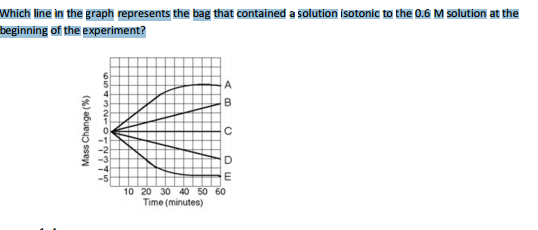
C
The solutions in the arms of a U‐tube are separated at the bottom of the tube by a selectively permeable membrane. The membrane is permeable to sodium chloride but not to glucose. Side A is filled with a solution of 0.4 M glucose and 0.5 M sodium chloride (NaCl), and side B is filled with a solution containing 0.8 M glucose and 0.4 M sodium chloride. Initially, the volume in both arms is the same. Refer to the figure to answer the following question.
At the beginning of the experiment, 1. side A is hypotonic to side B. 2. side A is hypertonic to side B. 3. side A is hypertonic to side B with respect to glucose. 4. side A is isotonic to side B. 5. side A is hypotonic to side B with respect to sodium chloride
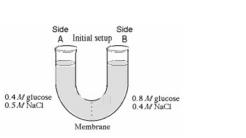
- side A is hypotonic to side B.
Human immunodeficiency virus (HIV) infects cells that have both CD4 and CCR5 cell surface molecules. The viral nucleic acid molecules are enclosed in a protein capsid, and the protein capsid is itself contained inside an envelope consisting of a lipid bilayer membrane and viral glycoproteins. One hypothesis for viral entry into cells is that binding of HIV membrane glycoproteins to CD4 and CCR5 initiates fusion of the HIV membrane with the plasma membrane, releasing the viral capsid into the cytoplasm. An alternative hypothesis is that HIV gains entry into the cell via receptor‐mediated endocytosis, and membrane fusion occurs in the endocytotic vesicle. To test these alternative hypotheses for HIV entry, researchers labeled the lipids on the HIV membrane with a red fluorescent dye. What would be observed by live‐cell fluorescence microscopy immediately after HIV entry if HIV is endocytosed first, and then later fuses with the endocytotic vesicle membrane?
- A spot of red fluorescence will be visible on the infected cell’s plasma membrane, marking the site of membrane fusion and HIV entry.
- A spot of red fluorescence will remain outside the cell after delivering the viral capsid.
- Fluorescence microscopy does not have enough resolution to visualize fluorescently labeled HIV virus particles.
- A spot of red fluorescence will diffuse in the infected cell’s cytoplasm.
- The red fluorescent dye‐labeled lipids will appear in the infected cell’s interior.
- The red fluorescent dye‐labeled lipids will appear in the infected cell’s interior.
A mutant form of a G protein lacks the ability to function as a GTPase. What effect do you think this would have? 1. No effect, other proteins can perform the same function 2. The G protein will remain inactive 3. The G protein will be constitutively active 4. GDP will accumulate in the cell
- The G protein will be constitutively active





