Principles of vaccination?
- Stimulate immunity: need to activate appropriate immune response that will induce protection
- Active immunity (alive or dead virus Þ active response) or passive immunity (antibodies from another person Þ limited life)
- Whole virus or part of the virus
- The toxin produced by the virus
- Conjugated/multiple vaccines
- Stimulate memory: only effective if vaccinee is protected upon subsequent exposures
- Herd Immunity: for vulnerable population
Who do we vaccine?
- Those at risk:
- Children under the age of 1 and elderly are particularly vulnerable
- Adults facing chemotherapy or transplant also vulnerable
- Patients with immunodeficiencies
- Travelers
- Family contacts
- Health professionals
Benefits of vaccination?
- Herd immunity
- Costs (prevention)
- Contributes to general population health
- Prevents morbidity and mortality
Side effects of vaccination?
- Side effects: fever, irritability, rash, pain, headache
- NO EFFECT on autism, sudden death, and brain damage
Criteria for febrile neutropenia?
- Fever: 38oC for more than 1 hour or Þ 38.5 (>100.4oF)
- Neutropenia: <500 neutrophils/μL
Pathogenesis of febrile neutropenia?
- Breeches in host defense related to underlying malignancy and treatment:
- MUCOSITIS: effect of chemo on mucosal barriers (causes MAJORITY of febrile neutropenia)
- Tumor itself
- Surgery
- Immune defect –> can’t react optimally
Criteria to be a high risk neutropenic febrile patient?
- Patient-related predictors
- Age ≥65yrs
- Poor nutritional status
- Poor performance based on active comorbidities
- Disease-related predictors
- Advanced stage of cancer
- Bone marrow failure due to marrow involvement
- Anti-cancer treatment-related predictors
- High dose chemo
- Absence of growth factor support with high dose chemo
General rules in management of neutropenic fever?
- Most do not have documentable infection but MUST be promptly evaluated and receive empiric broad spectrum antibiotics
- Infection can progress rapidly to death; hard to distinguish
- Initiate antibiotics after blood cultures, before other investigations: <60 min
- Attenuated signs and symptoms due to lack of inflammatory reaction: fever may be ONLY sign
- Immediately evaluate for evidence of sepsis syndromes
Steps in management of neutropenic fever?
- HIstory: if chemotherapy in the last 6 weeks Þ SUSPECT NEUTROPENIA
- Physical exam
- Vitals but NO rectal exam
- Culture: blood, urine, stool, sputum, skin, CSF, ascites, pleural fluid
- Imaging: CXR for all patients, CT sinuses, abdomen prn
- Admitted patients: daily ROS, CBC, examination, blood cultures
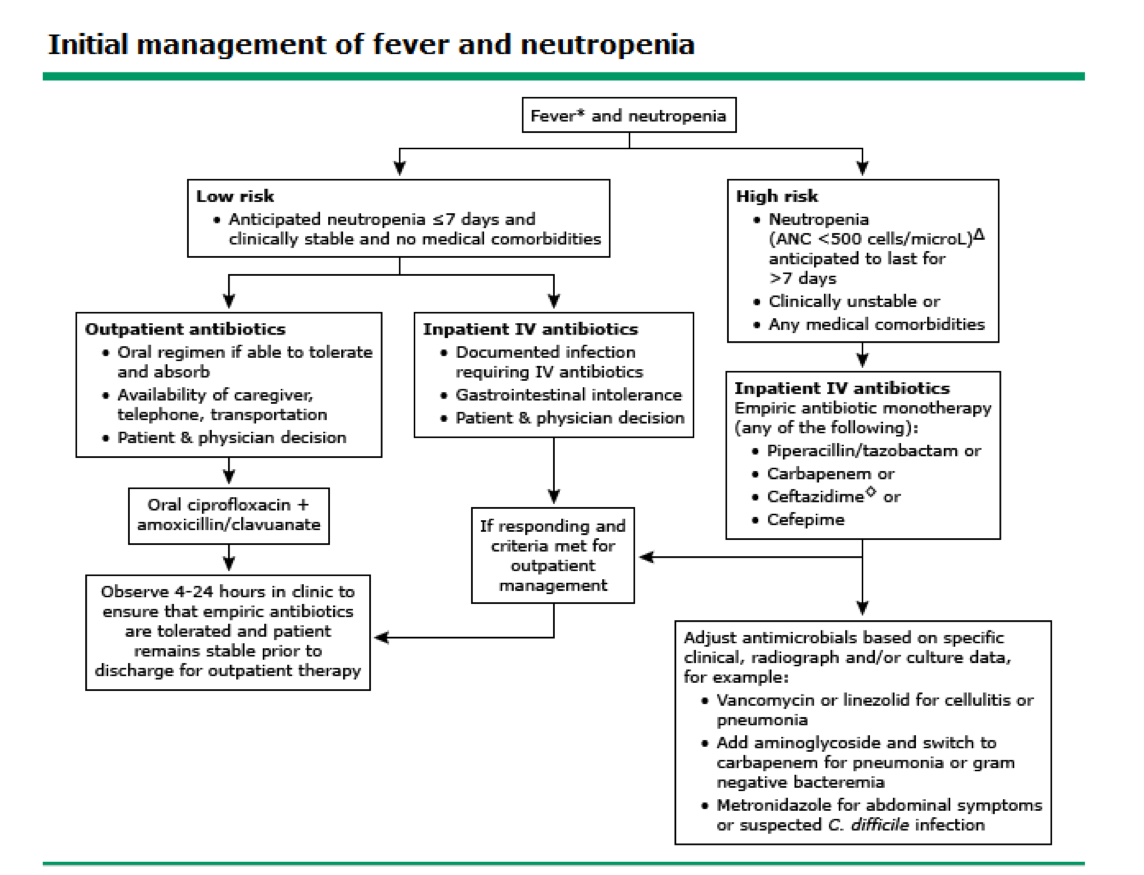
Algorith of management of febrile neutropenia?
- Determine the risk (IDSA)
- Empiric antibiotics (< 1 hour)
- HIGH RISK: hospital admission and IV antibiotics, INITIATE MONOTHERAPY WITH ANTI-PSEUDOMONAL β-LACTAM ANTIBIOTICS, include G+ and anaerobic coverage if signs of it
- LOW-RISK: usually outpatient with oral antibiotics Þ Fluoroquinolone + β-Lactam
Criterias to stop febrile neutropenia treatment?
- Neutrophils to > 500 cells/μL and rising
- Afebrile 48 hrs
What are the 3 effectors of inflammatory allergic reaction?
- mast cells
- basophils
- eosinophils
What are the 2 components that explain the increase of allergic diseases?
- GENETIC: there is some genetic predisposition to allergic reactions
- ENVRIVONMENT: increasing prevalence of allergic diseases in economically advanced regions of the world
- -> “Hygiene hypothesis”: infections that evoke a TH1 response early in life might reduce the likelihood of TH2 response later in life and vice versa + Infections might protect against devlpm atopy by driving the production of TReg cytokines
- -> Other possibilities that explain the increase in atopic disease include climate, ovesity, western diet and housing
What are the 4 types of hypersensitivity reactions?
A-B-C-D
Type 1 hypersensitivity - IgE - Allergic Anaphylaxis Atopy
Type 2 hypersensitivity - mediated cytotoxicity (ADCC) antiBody
Type 3 hypersensitivity - Immune Complex mediated (IgM, IgG)
Type 4 hypersensitivity – T cell Delayed
Pathophysiology of type 1 hypersensitivity?
- An allergic reaction induced by specific antigen (allergen)
- Provoked by re-exposure to the same antigen
- Mediated by specific IgE antibodies (Antibody-mediated): IgE is tightly bound to FceRI at the surface of mast cells and basophils –> will release inflammatory mediators such as Histamine, platelet-activating factor, leukotreins, bradykinins, prostaglandins, and cytokines that contribute to inflammation when bound to an antigen
Diseases associated with type 1 hypersensitivity?
The most common type (20% of the population)
- Asthma
- Rhino-conjunctivitis
- Dermatitis
- Food allergy
- Urticaria
- Drug allergy
- Other chronic diseases
Pathophysiology of type 2 hypersensitivity?
Antibody-dependent cell mediated cytotoxicity (ADCC) (IgG, IgM) made against intrinsic Ag (normal self-antigens)
- Failure in immune tolerance
- Cross reactivity foreign antigen with self molecule on the surface of host cells
- Opsonization of the host cells (phagocytosis)
- Complement activation (MAC lysis of the host cells)
- NK cell activation: destruction of host cells by the release of pergorins and grazymes
- Activation or blockage of important cell receptors
Diseases associated with type 2 hypersensitivity?
- Penicillin allergy: the RBCs absorbs the drug and express it at its surface Þ it creates MAC complex (membrane attack complex) Þ the body attacks RBCs
- AB and Rh blood group incompatibilities (Transfusion reactions)
- Autoimmune diseases: Myastenia gravis, Idiopathic Thrombocytopenic Purpura, Goodpasture’s, Graves’
- Some drugs
Pathophysiology of type 3 hypersensitivity?
Caused when soluble antigen-antibody (IgG or IgM) complexes, which are normally removed by macrophages in the spleen and liver, form in large amounts and overwhelm the body These small complexes lodge in the capillaries, pass between the endothelial cells of blood vessels - especially those in the skin, joints, and kidneys - and become trapped on the surrounding basement membrane beneath these cells The antigen/antibody complexes then activate the classical complement pathway This may cause:
- Massive inflammation: due to complement protein C5a
- Influx of neutrophils: due to complement protein C5a, resulting in neutrophils discharging their lysosomes and causing tissue destruction and furthers inflammation c. MAC lysis of surrounding tissue cells, due to the membrane attack complex, C5b6789n; and
- Aggregation of platelets: resulting in more inflammation and the formation of microthrombi that block capillaries
- MAC lysis
Diseases associated with type 3 hypersensitivity?
- Serum Sickness (ex: Ceclor)
- Immune Complex Glomerulonephritis
- Extrinsic Allergic Alveolitis (Farmer’s lung)
Pathophysiology of type 4 hypersensitivity?
- Mediated by TH1 cells by a series of phases that each take several hours: exposure to antigen –> presentation through APC –> activation of TH2 –> production of IgE (in the tissues)
Diseases associated with type 4 hypersensitivity?
- Immunized TB: Purified Proteine Derivative (PPD) test
- Poison ivy
- Contact dermatitis (cosmetics, solvents…)
Treatement of allergic reaction?
Epinephrine IM
Alpha 1 adrenergic receptor
- Increase peripheral vascular resistance by promoting vasoconstriction = decreases ski perfusion
- Reduces angioedema
- Improves coronary perfusion
10 Warning Signs of Imm-Def?
- 8 or more new ear infections within a year
- 2 or more serious sinus infection within a year
- 2 or more months of antibiotics with little effect
- 2 or more pneumonias within a year
- Failure of infant to gain weight or grow normally
- Recurrent skin or organ abscess
- Persistent thrush in mouth or elsewhere on skin, after age 1
- Need for IV antibiotics to clear infections
- 2 or more deep seated infections
- Family history of primary immunodeficiency



