How is sensory input used to control body movement?
- Higher centres of the brain generate motor commands and transmit them through the brainstem to the spinal cord
- sensory signals from sensory afferent neurons mediate spinal reflexes and ascend to the brainstem, cerebellum and cerebral cortex where they provide feedback of the evolving movement
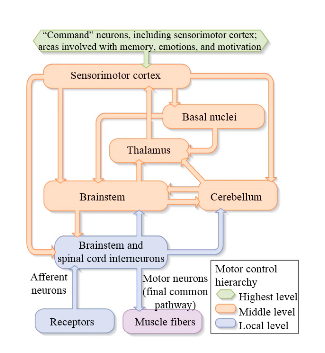
Signals from the sensorimotor cortex descend to the ____ and to the ______ _______ ______ which innervate muscle fibres
Signals from the sensorimotor cortex descend to the brainstem and to the spinal cord motor neurons which innervate muscle fibres
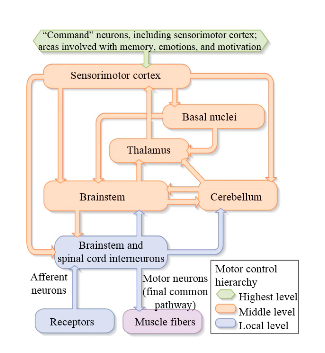
Information from sensory receptors travels to the spinal cord via _______ axons. Sensory pathways ascend to the _____, the _____ and the _______ which transmits sensory information to the _________ cortex where sensory input is combined with input from other parts of the brain (integrated) to form output commands to the _____, ________ and the ______
Information from sensory receptors travels to the spinal cord via afferent axons. Sensory pathways ascend to the brainstem, the cerebellum and the thalamus which transmits sensory information to the sensorimotor cortex where sensory input is combined with input from other parts of the brain (integrated) to form output commands to the brainstem, basal ganglia (basal nuclei) and the cerebellum
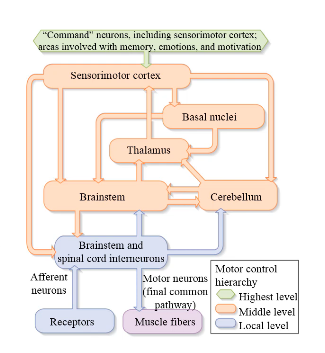
The basal ganglia and the cerebellum send their outputs to the ______ and the ______
The basal ganglia and the cerebellum send their outputs to the thalamus and the brainstem
What are the supraspinal centres involved in controlling motion?
Supraspinal = above spinal cord
Include:
- sensorimotor cortex
- brainstem
- cerebellum
- cerebral cortex
- thalamus
- basal ganglia
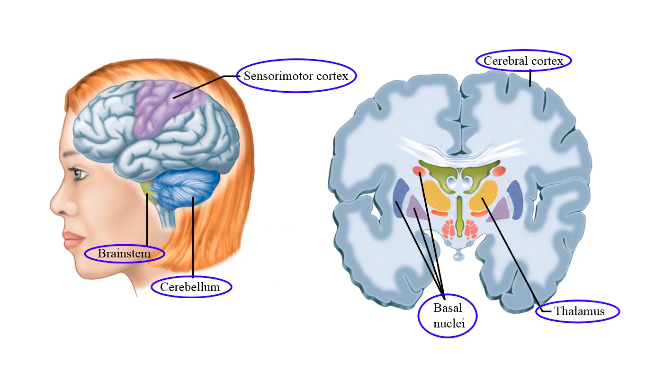
the sensorimotor cortex, the cerebellum and the basal ganglia issue motor commands via the _____ and ______
Describe feedback control of the image:
- the motor command is a desired limb position
- spinal cord transmits the command to the muscles via ______ _____ ____ ______ where it stimulates ______ ______
- receptors in the _____, ______ and _____ signal the position of the limb to the _______ via _______
- What happens in the spinal cord?
- What happens if a load is added?
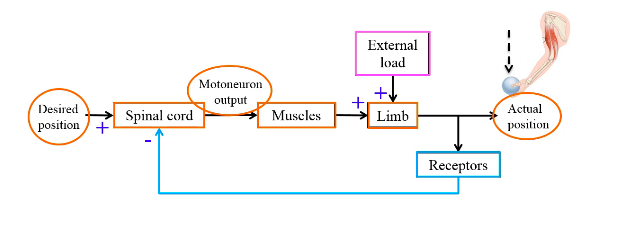
the sensorimotor cortex, the cerebellum and the basal ganglia issue motor commands via the brainstem and spinal cord
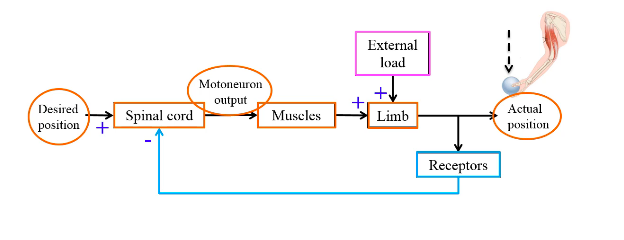
Describe feedback control of the image:
- the motor command is a desired limb position
- spinal cord transmits the command to the muscles via alpha motor neuronal axons where it stimulates muscle contraction
- receptors in the muscles, joints and skin signal the position of the limb to the spinal cord via afferent axons
- What happens in the spinal cord?
- the actual position is subtracted from the desired position and the difference causes motor neurons to contract in order to minimize the difference
- limb moves from actual position to desired position
- greater the difference = stronger the muscle activation
- What happens if a load is added?
- Limb is moved away from desired position
- this movement is detected by receptors
- operation of feedback loop acts to minimize difference corrected for external load
What is necessary for feedback control?
Sensory information and a mechanism for comparing desired to actual state
What two types of muscle receptors provide the most relevant information to the control of muscle?
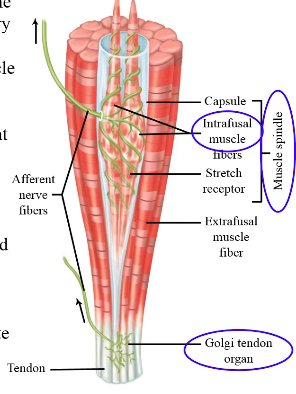
- Muscle spindle - respond to changes in muscle length
- Golgi Tendon Organs (tendon organs - signal changes in muscle force
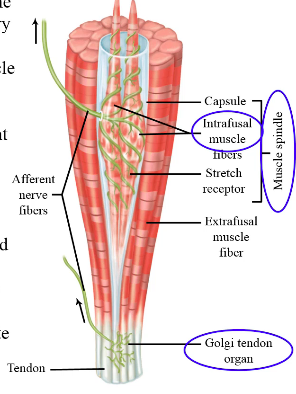
Muscle spindles respond to changes in _________
Muscle spindles respond to changes in muscle length
Muscle spindles are located in parallel with the ________ so their sensory endings, which give rise to group ____ and ____ sensory afferents respond to changes in muscle length.
Muscle spindles are located in parallel with the force-producing muscle fibres so their sensory endings, which give rise to group Ia and Group II sensory afferents, respond to changes in muscle length.
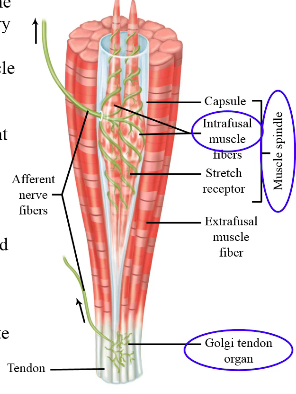
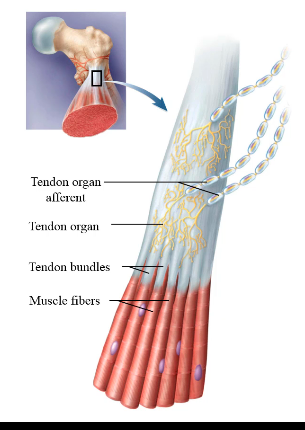
Tendon organs are in the ______ ______ at the ends of the muscle fibres.
Their muscle endings (Group ___) respond to muscle _____
Tendon organs are in the tendinous fascicles at the ends of the muscle fibres.
Their muscle endings (Group Ib) respond to muscle Force
In addition to responding to muscle stretch, muscle spindle group Ia afferents also respond to _________
What is the clinical significance of this?
In addition to responding to muscle stretch, muscle spindle group Ia afferents also respond to Muscle or tendon vibration
- Prolonged vibration used in physiotherapy to alleviate spasticity (overactive stretch reflexes) - possibly because Ia afferents activate interneurons that inhibit transmission in the stretch reflex pathway
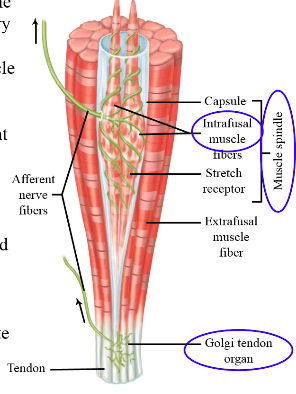
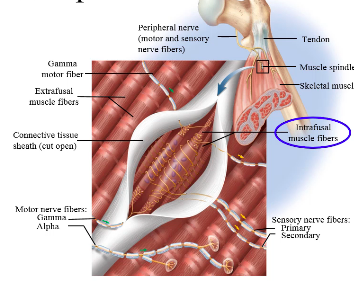
The sensory endings of muscle spindles are spiralled around specialized muscle fibers called ________
The sensory endings of muscle spindles are spiralled around specialized muscle fibers called intrafusal muscle fibres (which are inside the muscle spindle)
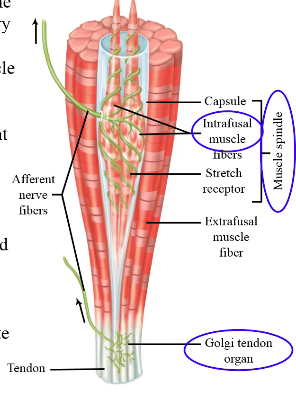
What are the components making up the muscle spindle?
- Connective tissue capsule
- intrafusal muscle fibres
- stretch receptors
What does the term spasticity refer to?
Overactive stretch reflexes
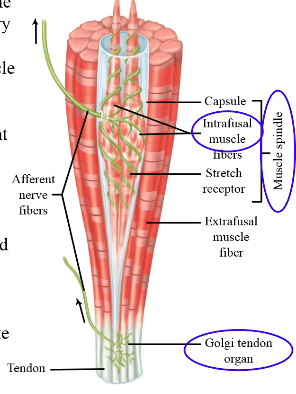
______ (within muscle spindles) generate only tiny amounts of force
intrafusal muscle fibres (within muscle spindles) generate only tiny amounts of force
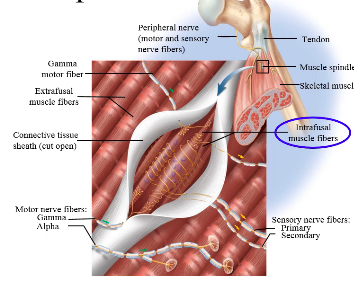
The main muscle fibres found outside the muscle spindle that produce all of the measurable force are called:
Extrafusal muscle fibres
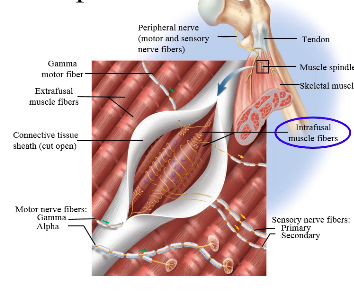
What are the two types of motor neurons innervating a muscle?
- alpha motor neurons
- gamma motor neurons
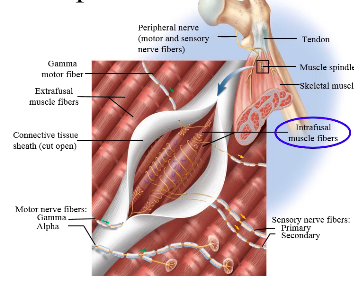
What do alpha motorneurons (often just called ‘motor neurons’) activate?
What is their conduction velocity?
Motor neurons activate the main (extrafusal) muscle fibres to contract
- conduction velocities similar to those of muscle spindle 1A afferents and tendon organ 1B afferents
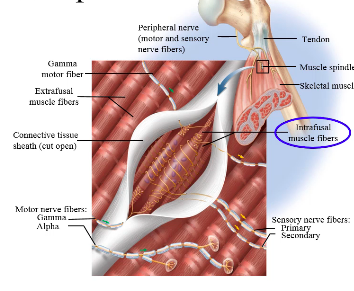
What muscle fibres are activated by Gamma motor neurons?
What is their conduction velocity?
Gamma motor neurons activate intrafusal muscle fibres at each end of the muscle spindle (middle is non-contractile)
- conduction velocity between 25-40 m/s
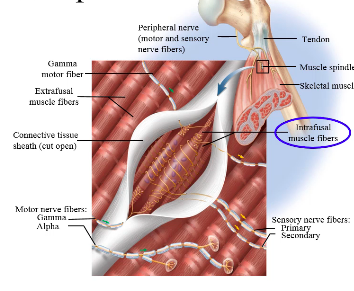
Muscle spindle afferents (1A and 2) signal changes in ______
muscle length
What happens when the intrafusal muscle fibres are activated?
stretches the elastic non-contractile middle part where the sensory endings are located =
- causes sensory afferents to fire more rapidly and become more sensitive to changes in length of muscle as a whole
What afferents signal muscle force?
What group do these afferents belong to?
Golgi tendon organ afferents (group 1B) signal muscle force
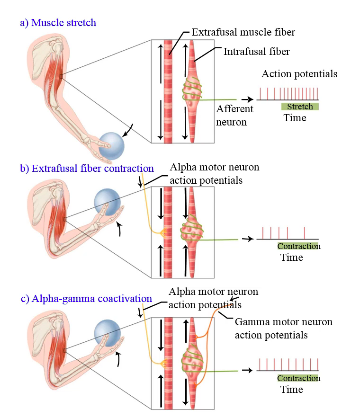
What is alpha-gamma coactivation?
What does this theory suggest about the simultaneous activation of intrafusal muscle fibres and alpha motorneurons
Theory that suggested gamma motor neurons are coactivated with alpha motorneurons to keep the muscle spindle afferents firing during muscle shortening
- if intrafusal muscle fibres are activated at the same time as alpha motorneurons, this will keep the muscle spindle taut as the muscle shortens
- the elastic non-contractile region remains approx the same length instead of going slack
- intrafusal contraction compensates for extrafusal muscle shortening, tightening the spindle so the afferents maintain (or increase) their firing



-
Chapter 3.1-3.2 Cell Membranes48
-
Chapter 3.3 - Cell organelles40
-
Chapter 3 section B: Protein Synthesis, Degradation, and Secretion40
-
4.1 Diffusion9
-
Lecture 2 Cell Physiology Video 8 Movement of molecules across membranes1
-
Chapter 5 Cell Signalling in Physiology45
-
Chapter 18.1 Cells and secretions mediating Immune response34
-
Chapter 18.2 Innate Immune Responses36
-
Chapter 18.3 Adaptive Immune Response33
-
Nerve, Muscle, Synapse Lecture 222
-
Nerve, Muscle, Synapse Lecture 321
-
Nerve Muscle Synapse Lecture 428
-
Nerve, Muscle, Synapse Lecture 539
-
Nerve Muscle Synapse Lecture 731
-
CNS Lecture 1A42
-
CNS Lecture 1B38
-
CNS Lecture 228
-
CNS Lecture 339
-
CNS Lecture 463
-
CNS Lecture 563
-
ANS Lectures 1&2104
-
Special Senses Lecture 116
-
Cardiovascular physiology Lecture 147
-
Cardiovascular Physiology Lecture 251
-
Cardiovascular Physiology Lecture 336
-
Cardiovascular Physiology Lecture 495
-
Endocrine Physiology0
-
Gastrointestinal Physiology241
-
Renal Physiology279
-
Respiratory Physiology222
-
Reproductive Physiology193



