Macroclimate
The prevailing weather conditions of a region throughout the year and averaged over a number of years. Characterized by general descriptions such as cool, temperate, hot-arid and hot-humid.
Microclimate
The modification of the prevailing weather conditions by site specific features such as bodies of water, hills, trees, paved areas and buildings. A thorough understanding of this modification can have a profound impact on site developments. For example, the architect could locate a new building near a grove of trees in order to take advantage of the wind break or shading effects.
Climate is quantitatively described by:
- Temperature range and distribution.
- Hours of daylight.
- Wind direction and velocity.
- Amount of relative humidity and precipitation.
A zoning ordinance would probably include restrictions on which of the following? I. Parking Requirements II. Sound Ratings III. Lot Sizes IV. Occupancy Separations (A) I only (B) IV only (C) I and III only (D) II and IV only
(C) I and III only Zoning ordinances, originally intended for the protection of property rights, are concerned primarily with land use issues such as the minimum number of parking spaces required or the minimum lot size for a particular use. Sound Ratings and Occupancy Separations are primarily building code issues with are intended for the protection of public health and safety.
Barrier Free
A term applied to spaces, buildings, and facilities that are all fully accessible to anyone including those who are physically handicapped. (see ANSI and ADA Standards)
P.U.D
Planned Unit Development A zoning designation in which parcels of land are developed with a combination of commercial, residential, recreational and civic uses. Disorganized development lead to the implementation of zoning ordinances that, while separating the use districts, crated a monotonous and homogeneous environment. The goal of the P.U.D. is to integrate mixed use development and promote a vital and diverse community.
A setback is addressed by which of the following? (A) An easement (B) F.A.R. (C) A deed (D) Zoning codes
(D) Zoning codes These codes refer to the partitioning of a city into districts, the regulation of land use, and restrictions on building volume and location within those districts.
Regarding building codes, what is IBC?
Through the joint efforts of various model code organizations, the International Code Council (ICC) was established in 1994. The developed a single comprehensive and coordinated set of model codes with the intention of unifying the existing national codes. These codes include: Building, Fire, Electrical, Mechanical, Zoning, Energy Conservation, etc. Their model building code is called the International building Code (IBC) and it contains no regional limitations.
Define the following: 1. Conditional Use 2. Variance
- Granted by a zoning board to achieve a purpose deemed by the board to be in the public Interest. A school or hospital located in a residentally zoned area, for example, may have been granted this type of permission. 2. Special permission to deviate from the standard zoning regulations. It is sought by presenting the desired deviation before a local administrative authority (generally a board of zoning appeals or a board of adjustment). While both a variance and conditional use allow one to build outside the standard zoning regulations, the primary difference is that a variance is granted for the benefit of an individual owner, while conditional use is granted for the general public welfare.
How do natural lighting conditions affect one’s choice of orientation for a building?
While many theories of building/sun orientation exist, most agree that principal facades ideally face south (in the northern hemisphere) for optimal living conditions (warmth in winter and coolness in summer). The quality of light is also a concern. Southern light tends to be direct, bright, and intense while northern light is more evenly diffused. Most importantly, all of these generalities must give way to regional and local conditions. The location of a 2nd building or other micro-climate conditions may trump any general rule of orientation.
Fire Zone
A zoning classification utilized by some jurisdictions to designate geographical areas of high hazard, moderate hazard, and low hazard. The classifications are based on the following criteria: population density, street access and traffic flow, building height, and the equipment and capabilities of the local fire department. High hazard areas may require the use of certain non-combustible construction materials and may impose restrictions or building use.
Name several methods used to control erosion due to runoff or wind, during construction.
In the interest of site sustainability, these methods have been implemented to reduce the negative impact of construction on water and air quality, and minimize the loss of topsoil and native vegetation. 1. Silt fence: Filter fabric usually fixed to wood stakes filters fine sediment from runoff before it reaches receiving streams or storm sewers. 2. Straw Bale Dams/Earth Dikes: Strategic placement prior to grading will minimize the loss of topsoil by runoff. 3. Hydroseeding or Mulch: Temporary seeding with quick sprouting annual grass or a layer of mulch will help stabilize the topsoil. 4. Retaining Walls: A more permanent solution incorporated into the design. In addition to soil stabilization, many of these methods also protect the site from infestation by weeds and help maintain native vegetation.
Which of the following city planning patterns incorporate early concepts of zoning? I. The gridiron street system II. The garden City, 1898 III. The Cite’ Industrielle, 1917 IV. Hussman’s plan for Paris, 1950’s (A) I and II only (B) II and III only (C) II, III and IV (D) III and IV only
(B) II and III only In Ebenezer Howard’s Garden City, Howard developed a concentric system of relationships among public buildings, commercial buildings, housing, industry, and agriculture that combines the best of the city with the best of the country. By relegating urban aspects to specific concentric bands, Howard incorporated one of the earliest concepts of zoning. In Tony Garnier’s Cite Industrielle, Garnier created a set of drawings of an imaginary industrial city where public, residential, and industrial areas are clearly separated. While many of Garnier’s inventions in Cite, like the extensive use of reinforced concrete, would prove extremely influential on future Modern masters like Corbusier, it is his clear concept of separated land use that makes Garnier a pioneer in zoning. The Gridiron street system, while one of the earliest urban patterns, the gridiron system does not necessarily incorporate zoning. Hussman’s plan for Paris, 1853-1870, is a paragon of Baroque Planning rather than zoning.
Zoning
The municipal regulation of building and land use. This may include height limitations, setbacks, population density control, the ratio of building to open space, provisions for parking and accessible services, and any other regulations as determined by the municipality. While these ordinances were originally intended for the protection of property rights in expanding cities they have become, along with building codes, a primary tool of urban planners and developers in achieving overall community design goals.
How are building codes adopted and enforced?
Local building codes are generally adopted from one of the model codes used in the United States. The permitting process is how local governments enforce building codes. The architect or builder must submit plans for approval prior to permits being issued. During construction, building department officials inspect the project to verify that the construction is proceeding according to permitted plans. Model building codes include: IBC - International Building Code, by the International Code council (ICC) UBC - Uniform Building Code, by the International Conference of Building Officials (ICBO). Used in the western and central U.S. BOCA - National Building Code - Building officals and Code Administrators International. Used in the northeastern U.S. SBCCI - Southern Building Code Congress International. Used in the southwestern U.S. CABO - National Building code - Council of American Building Officials by the American National Standards Institute (ANSI).
According to the Secretary of the Interior's Guidelines of Rehabilitating Historic Building, describe the hierarchy of rehabilitation.
- Identify, retain, and preserve the form and detailing of materials and architectural features important in defining historic character.
- Protect and maintain those materials and features that define historic character by using the least degree of intervention possible.
- Repair features when their physical condition warrants additional work, while using the least invasive means possible, such as patching, splicing, reinforcing, etc.
- Replace and entire feature if the level of deterioration is beyond that of repair. This is appropriate only if the essential form and detailing of the feature are still evident, which would enable the feature to be accurately reestablished.
According to the ADA, name the accessibility requirements for the following: 1. Minimum width for wheelchair passage (door) 2. Minimum width for two wheelchairs to pass 3. Minimum clearance between two consecutive doors 4. Maximum threshold height 5. Handles, pulls, latches and locks 6. Minimum parking stall width 7. Protruding objects
- 3
2” 2. 60”
- 48” plus the width of the door swinging into the space. Doors must swing the same direction (egress doors) or away from the space between the doors.
- 3/4” for exterior sliding doors. 1/2” for other door types and all thresholds must be beveled.
- Must be easy to grasp with one hand, require no tight grasping, pinching or twisting of the wrist to operate. Levers or push mechanisms are acceptable.
- 96” plus and accessible aisle 60” wide adjacent to car parking and an aisle 96” wide adjacent to van parking.
- 4” maximum for objects between 27” and 80” above finish floor, parallel to halls, corridors etc.
A client proposes construction of a vacation home on an undeveloped plot of land. What are the architects’s principal concerns in analyzing this site?
- Views - Pedestrian and automobile accessibility - Soil conditions - Solar orientation - Utility access - Municipal service - Wind patterns - Zoning - Easements - Deed restrictions - Land values
Which of the following might be used to restrict the construction of a mobile home on a particular tract of land? (A) Easement (B) Lien (C) Covenant (D) F.A.R.
(C) Covenant Also called a restrictive covenant it is a type of deed restriction. It is a provision in the deed that places limitations on land development by the buyer. These restrictions are intended to be in the public interest and may include: property use, building and fence locations, yard size, cost and style of architecture. As part of the deed, these restrictions may affect the decision of a potential buyer. They are commonly used to maintain aesthetic uniformity or construction quality and may be enforced for a period of years.
Easement
A legal right for one party to use a portion of another party’s parcel of land for access. For example, a utility easement allows the utility access to a portion of private property in order to install and maintain utility lines. No permanent structures may be built over the easement area. In addition to access, there are several other types of easements. These include conservation easements which prevent the development of environmentally significant land, scenic easements which might protect a view, and joint use easements which allow two or more property owners to share a common feature. An access easement that allows one party or the public to traverse someone else’s property grants right of way.
What legal restrictions and regulations apply to almost every construction project?
Construction projects are regulated under the authority of local zoning ordinances, and building codes which are typically adopted from one or more of the model building codes.
According to the IBC, the number of accessible parking spaces for a project depends upon which of the following? I. The total number of spaces provided. II. The area of the parking III. The type of facility IV. The distance to the pain entrance (A) I only (B) II and III only (C) I an III only (D) III and IV only
(C) I and III only Where parking is provided, the number of accessible spaces is determined by the total number of parking spaces provided for entire facility. However, for hospital outpatient facilities, 10% and for rehabilitation and outpatient physical therapy facilities 20% of all spaces must
According to the Americans with Disabilities Act, what are the required dimensions for the following diagram?
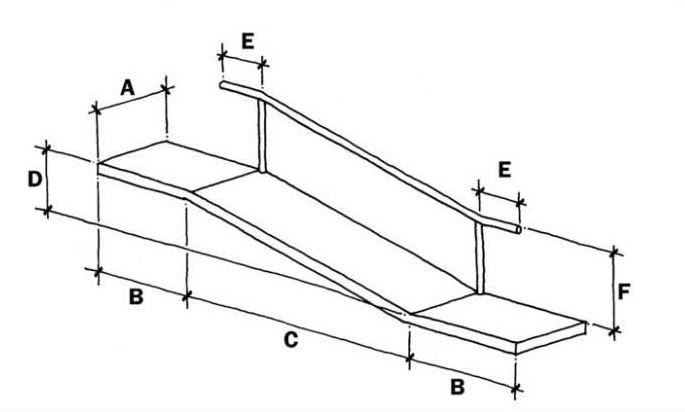
A. 3 feet clear, min.
B. 5 feet minimum. If ramps change direction at a landing the minimum landing size is 5 feet by 5 feet.
C. 30 feet max. Max slope of 1:12
D. 30 inches max.
E. 12 inches max.
F. 34 inches min, 38 inches max. Minimum clear space between handrail and wall is 1.5 inches
Off-Street Requirements
Parking spaces within property lines as required by a city ordinance and often expressed as parking spaces per dwelling unit or per commercial space.

-
Codes & Regulations32
-
Project & Practice Management25
-
Environmental, Social & Economic Issues13
-
Materials & Technology0
-
General Structures Principles0
-
Lateral Forces Principles0
-
Seismic Forces0
-
Wind Forces0
-
Plumbing0
-
Electrical0
-
Lighting0
-
System Specialties0
-
Construction Drawings & Project Manual0
-
History0
-
Programming & Analysis0
-
Site Planning & Design Principles0
-
HVAC0
-
Building Design & Construction Systems Principles0



